New Camera

dpryke

Active member
Big showing at SuperMeet tonight by Canon.

http://www.supermeet.com/

7:55PM West coast time.

"Joe Bogacz of Canon will present the first worldwide public unveiling of Canon's new MPEG-2 Full HD (4:2:2) file-based recording codec and workflow to the industry and will also introduce the first US public preview of Canon's upcoming file-based professional video camera."
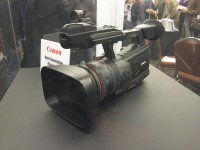
 
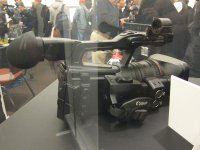
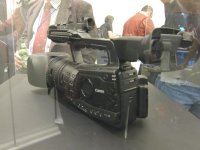
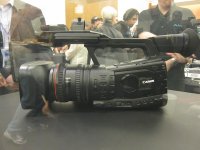
here are some pics of the camera from the supermeet

here are some pics of the camera from the supermeet

here are some pics of the camera from the supermeet. it's quite large. I was told by the canon rep 1/3" sensor (he didn't say CCD or CMOS) and two slots for compact flash cards. I also asked him if the MPEG-2 4:2:2 50M codec would ever make it into the HDSLR's and he didn't know.
 

Attachments

  • 20100205-174558.jpg
    20100205-174558.jpg
    81.7 KB · Views: 0
  • 20100205-174620.jpg
    20100205-174620.jpg
    94 KB · Views: 0
  • 20100205-174644.jpg
    20100205-174644.jpg
    92.4 KB · Views: 0
  • 20100205-174657.jpg
    20100205-174657.jpg
    91 KB · Views: 0
Last edited:
Does this thing have a name? Is it CMOS? Why isn't this bigger news? A quick search revealed nothing.
 
The mock-up was already revealed a few weeks ago at trade show but no new details has been released. There's a thread about it in the News section.
 
Wow, that thing really does look quite large. If you look at the XLR inputs, they give a good idea of how big the thing is. At least the battery goes inside of it.
Also, looks like they may be going for a real focus and zoom ring, look at the little notches on them, as well as a window for a distance indicator next to the focus ring. I'm honestly betting this will cost significantly more than the A1S based on that alone.
 
Also, looks like they may be going for a real focus and zoom ring, look at the little notches on them, as well as a window for a distance indicator next to the focus ring. I'm honestly betting this will cost significantly more than the A1S based on that alone.

I doubt it. The A1s also have those notches and the rings spin infinitely. I don't see a hard stop on the focus ring. It does look like they've improved on the way the on-board microphone is mounted though, no more BS about the mic falling off.
 
I didn't even think about the mic, I know that we've had that problem with the A1 in the past at my school. But when I was talking about the notches, I meant the really little ones that are found on TV lenses that are used by the servo zoom and focus controls. The A1 lacks those. To me, it looks like it'll be a similar setup to a TV lens in terms of how it works - controlling the rings by gears that are driven by motors inside the handgrip (or somewhere off to the side in this case), and having a switch to move them away for manual operation. They would definitely be going in the right direction by doing that, after all, none of their cameras have true manual zooming capability.
 
It seems to have the jack pack (HD-SDI, Genlock, etc) so it may be a tapless G1. If it has 1/2" CMOS instead of 1/3" it'd be in the EX1 category. If 1/3" I hope it stays CCD. My only gripe about the EX1 is it doesn't do as well with movement as my A1 did.
 
It seems to have the jack pack (HD-SDI, Genlock, etc) so it may be a tapless G1. If it has 1/2" CMOS instead of 1/3" it'd be in the EX1 category. If 1/3" I hope it stays CCD. My only gripe about the EX1 is it doesn't do as well with movement as my A1 did.

That's not a guarantee Jackpack, since the A1s Canon has implemented that style of inputs in the back.

9565d1225874541-canon-upgrades-xh-a1s-xh-g1s-xha1s.jpg
 
The camera does not look very well planted on the table because of raised bottom surface, looks like a roly-poly toy. This is like halfway between the XH and XL. Does Canon want to combine two families into one? But the XL is not just a "semi-shoulder mount", it also has interchangeable lenses, which this prototype does not. The front of the camera sits on the hood, is it the way it is supposed to be? Are the hood and the threads built to withstand the weight of pimped-out camera?

The LCD is located further to the front and up, which again indicates that the camera is supposed to be used as shoulder-mount. OTOH, this should work for handheld too.

The raised handle is not just a straight bar, but with some kinks. Is it meant to simplify using large matte boxes and filters? As users report, new Sony cams have the handle protrude over the front edge of the lens, and it has the mic removable to allow using square filters. The Canon does not seem to have the mic removable. At least the mic does not hang on a rubber sleeve, so hopefully it won't be prone to accidental damage.

As to sensors, new or old, I don't think it matters much. BBC's Alan Roberts measured that the G1/A1 can deliver 1600x1015 in interlaced mode and 1600x940 in progressive mode. http://downloads.bbc.co.uk/rd/pubs/whp/whp-pdf-files/WHP034_ADD25-Canon-XHG1.pdf Whoever is saying that Canon's progressive mode is not real progressive should compare 940 lines of vertical resolution with resolution of some other, "true progressive" cameras first. To me, these numbers are still competitive in 2010. Even if Canon reuses the same sensor, improvement in recorded horisontal resolution and in reduced artifacting because of higher bitrate will be noticeable. I think that all the factors combined -- high-res CCD, high-bitrate long-GOP with 4:2:2 color, Canon's high-quality MPEG-2 codec and hopefully, inexpensive media -- will give make a good fight to handheld DVCPRO HD cameras. Panasonic needs to up the ante by introducing AVC-I/100 on handhelds if it wants to stay competitive.

Canon still can screw the pooch by using SxS or, even worse, yet another proprietary media. I hope that Canon, promising "amazing performance for amazing price", will stick to budget solutions like SDXC/SDHC or CF. After all, JVC managed to break out of Sony's SxS jail, and now offers recording with XDCAM EX container onto standard SDHC cards (the original version of the HM700 recorded XDCAM EX only onto SxS cards).
 
Last edited:
Whoever is saying that Canon's progressive mode is not real progressive should compare 940 lines of vertical resolution with resolution of some other, "true progressive" cameras first. To me, these numbers are still competitive in 2010.

This statement's validity depends upon which market you are referring to. To be perfectly honest, even though I love my XH-A1 and it has served me well, I feel horrifically outdated using a tape-based workflow in the age of tapeless workflow. I rationalize by saying that Canon makes better glass and that the lens on the XH-A1 is better than the lens on Panasonic's HPX-170 or other similar cameras, and while that may be true it doesn't change the fact that Canon's old line is rapidly becoming a thing of the past.

A tapeless workflow solution is definitely a step in the right direction, but again, it really depends on what market you're talking about. As you all probably know. SCARLET is releasing this summer, and with all the talk and hype about it Canon could stand to be blown away even in the prosumer market, if RED delivers on everything SCARLET promises to be. Just take a look at the numbers and prices and tell me that you can see Canon competing in the prosumer market when SCARLET releases. And the only reason I'm citing the prosumer market is because in the professional market, Canon isn't even mentioned at all.
 
Cranky said:
Whoever is saying that Canon's progressive mode is not real progressive should compare 940 lines of vertical resolution with resolution of some other, "true progressive" cameras first. To me, these numbers are still competitive in 2010.
This statement's validity depends upon which market you are referring to. To be perfectly honest, even though I love my XH-A1 and it has served me well, I feel horrifically outdated using a tape-based workflow in the age of tapeless workflow. I rationalize by saying that Canon makes better glass and that the lens on the XH-A1 is better than the lens on Panasonic's HPX-170 or other similar cameras, and while that may be true it doesn't change the fact that Canon's old line is rapidly becoming a thing of the past.
If you re-read my message, it was not about tape-based workflow, but about the camera section of the camcorder. The five-year old hardware seems to be capable of producing competitive resolution good enough for 2010. Just swap out tape section to tapeless and raise the bitrate, and off you go.
 
If you re-read my message, it was not about tape-based workflow, but about the camera section of the camcorder. The five-year old hardware seems to be capable of producing competitive resolution good enough for 2010. Just swap out tape section to tapeless and raise the bitrate, and off you go.

I know what you were saying in your previous, but my point is that SCARLET aims to take over the market that the Canon XH-A1s/XL-H1 models currently operate in. To elaborate, RED has designed a SCARLET model with a fixed zoom lens (appropriately named SCARLET fixed) to target the "prosumer" market - people who are either filmmaking enthusiasts but not professionals or niche market professionals like event videographers, music video producers, and other types that don't necessarily need a full set of super fast prime lenses.

With the SCARLET offering a 2/3 sensor, 3K RAW format resolution, complete modularity for bodies, accesories, and peripherals all for $4750 (the current price tag for the starting kit of SCARLET fixed), Canon and Panasonic and Sony have their work cut out for them. That is the only point I was making with my original post. Canon's new camera includes tapeless workflow which is a step in the right direction, but if SCARLET is everything that it claims to be, or even if its mostly what it claims to be, it will dominate the market that Canon operates in effectively forcing it out of the market entirely.

As someone else stated, the look of the camera and its build suggest it will be quite a bit more expensive than its current counter-parts. So here is the question: why would any consumer, even prosumers or professionals, even consider buying the Canon model over the SCARLET when the SCARLET is not only a superior camera but also cheaper?
 
...As someone else stated, the look of the camera and its build suggest it will be quite a bit more expensive than its current counter-parts. So here is the question: why would any consumer, even prosumers or professionals, even consider buying the Canon model over the SCARLET when the SCARLET is not only a superior camera but also cheaper?
If it uses CCDs (which I really hope it does), I wouldn't be surprised if a somewhat decent amount of people went with this over SCARLET. Given the two choices, I probably would as long as long as the Canon isn't insanely more expensive like the EX3 was when that got released. However, if in fact it is insanely expensive, then I'd probably have to consider the HMC150 or whatever version of it Panasonic is on at the time.
 
If it uses CCDs (which I really hope it does), I wouldn't be surprised if a somewhat decent amount of people went with this over SCARLET. Given the two choices, I probably would as long as long as the Canon isn't insanely more expensive like the EX3 was when that got released. However, if in fact it is insanely expensive, then I'd probably have to consider the HMC150 or whatever version of it Panasonic is on at the time.

That prompts another question. Why do you prefer CCD to CMOS? I'm aware of the rolling shutter effects, but to be perfectly honest they've never quite been a problem for me.
 
For what I shoot (skating), I just don't think I could really get away with it. A lot of the establishing footage that I'll shoot has very fast pans or tilts in it, as well as the close-up shots that pretty much just have the board. Eventually, I won't be surprised if engineers manage to make the effects even further minimized than they are now, but I feel like using a current CMOS camera would be a limitation on what I can do.

Also, keep in mind, I'm still a student now. As much as I'd love to, I won't be shooting skate videos for the rest of my life. Chances are that after a while, I'll wind up in one of the many fields where there's absolutely nothing wrong with CMOS cameras. But for now, in terms of what I do for my own personal projects, I'll take CCDs any day.
 
Although a host of new features would be good, If Canon just updated the XH-A1 with AVCHD - tapeless workflow, it would be a still be pretty good cam if it was priced right.

Grant
 
Although a host of new features would be good, If Canon just updated the XH-A1 with AVCHD - tapeless workflow, it would be a still be pretty good cam if it was priced right.

Grant

This is true. But "priced right" is relative. The Panasonic HPX-170 is priced around $4300 new right now, and that includes all the peripherals you need to work with it out of the box. If SCARLET fixed retails at $4750 like it is supposed to, and you can get full 1080p, super 35mm sensor equivalence and interchangeable lenses on something like the Canon 7D (which retails for $1600 body only) then really, you're looking at a price range of $2000-2500 new at best. I just don't see what the XH-A1 offers that the 7D doesn't, except for XLR inputs. And for narrative filmmaking, sound is recorded separately 95% of the time anyway so that's kind of a moot point. Of course, for niche market filmmaking like event videography, the XLR inputs are kind of a must.
 
I just don't see what the XH-A1 offers that the 7D doesn't, except for XLR inputs.
Seriously? I mean, are you saying "I don't see what additional features the XHA1 offers that I'd pay more for, for my particular purposes" or are you saying "the XHA1 doesn't offer anything more than the 7D"? Because those are very huge different things.

The XHA1 offers timecode, professional audio, higher resolution, moire-free recording, immunity from rolling shutter artifacts, longform recording, no overheating, a 20x zoom lens, autofocus (even during recording), extensive image controls, proper video ergonomics, and all sorts of other advantages over a stills camera. For almost any professional usage, the XHA1 is a hugely superior product. The only advantage the 7D has over the XHA1, really, is shallow DOF and lower pricetag.

Of course, for many users, that's all they're really looking for.
 
Back
Top