GH4 V-log

And that's why I come here: Yes, Headmaster!

@renegadewill Yeah, I've pretty much married a 1/4 black pro mist to the front of my 12-35 for this reason and to cut the "crispness" a bit. While diffusion doesn't help capture any more information as a V-Log profile _might_ (who knows if there is simply a limitation to the sensor...), it has helped create a bit more pleasing transition to the clipping. I'm also just bringing in more light even tho it hampers my mobility.

Working with what I have tho I would love to shoot some of these scenes with a D750 or a C100 to compare.

SHHHHHHHHHHHH! Never reveal the actual type of diffusion you use! That's every dp's dirty secret. Their dirty, filthy, sad, disgusting, depressing, little secret.
 
Last edited:
In another thread a forum member posted a 40 minute review of the Shogun.

https://vimeo.com/114978513

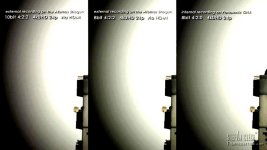
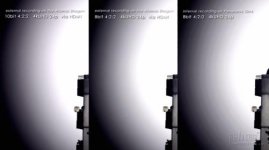
Jump to about the 24 minute mark to see a banding test on the GH4. When the contrast is pushed hard there's a clear difference between internal & external recording even in just 8-bit, while the 10-bit looks perfectly smooth.

Atomos has stated Record Trigger is coming to the GH4 & hopefully V-Log will be included in the same firmware release.
 
In another thread a forum member posted a 40 minute review of the Shogun.

https://vimeo.com/114978513

Jump to about the 24 minute mark to see a banding test on the GH4. When the contrast is pushed hard there's a clear difference between internal & external recording even in just 8-bit, while the 10-bit looks perfectly smooth.

Atomos has stated Record Trigger is coming to the GH4 & hopefully V-Log will be included in the same firmware release.

The difference between 8-bit and 10-bit recorded by the Shogun seems pretty miniscule. It's almost worth the minor hit to have both external and internal recording as a backup.
 
Yep that review is great...and he is a great film maker.
However there was no real footage from the Gh4, it was kind of more aimed to the A7S...(which is totally cool) but the rolloff A/Bs although really well done...in no way inspired me to get the Atomos at all.
Also in the writing below it said A7s 10bit 4.2.2 footage...I am pretty sure the A7s does not do that resolution...not a big deal really, but I am pretty sure thats a mistake.
However I have to say I love the exposure tools in the Atomos...wow!!
 
Last edited:
yeah! these things are looking like a 3 in one: recorder, screen, AND many very handy tools!
 
The difference between 8-bit and 10-bit recorded by the Shogun seems pretty miniscule.

I don't think Vimeo supports 10-bit playback and many computer monitors support only 8-bit color, so I don't think this is a fair test to judge the difference between 8-bit and 10-bit footage. If you had the original 10-bit footage and watched it on a 10-bit monitor ( instead of Vimeo ), then I would expect to see a bigger difference here.

I do agree that the difference between 4:2:0 gradient banding versus 4:2:2 non-banding in the image was quite significant, and that alone makes the external recorder a worthwhile investment.
 
In another thread a forum member posted a 40 minute review of the Shogun.

https://vimeo.com/114978513

Jump to about the 24 minute mark to see a banding test on the GH4. When the contrast is pushed hard there's a clear difference between internal & external recording even in just 8-bit, while the 10-bit looks perfectly smooth.

I wonder how he got so big difference of 8bit internal and external sample banding. I have never seen that bad banding in my 0-255 GH4 internal recordings. By the way the 4:2:2 has no meaning in that gray sky image.

And WHAT IS THAT MAGICAL 10 BIT MONITOR OTHERS TALKED ABOUT?
 
I don't think Vimeo supports 10-bit playback and many computer monitors support only 8-bit color, so I don't think this is a fair test to judge the difference between 8-bit and 10-bit footage. If you had the original 10-bit footage and watched it on a 10-bit monitor ( instead of Vimeo ), then I would expect to see a bigger difference here.

i don't think, you would percieve muche difference using a 10bit monitor on the given source files in this example (btw. professional 10bit monitors usually do not use HDMI but display port etc.). the vimeo file is only 8 bit h264 -- so you will never see any difference and you can not reproduce the results by yourself. (if you try to do it -- just for fun -- it will will look like the attached example :))

but that doesn't negate the impact of 10bit source material for further corrections in post processing. the characteristics of the used codec and a well choosen recording profile always have to be seen as important factors to maximize this capabilites.

I do agree that the difference between 4:2:0 gradient banding versus 4:2:2 non-banding in the image was quite significant, and that alone makes the external recorder a worthwhile investment.

4:2:2 vs. 4:2:0 does not make a difference here. it's only the signal in the luma channel that counts.

it looks very interesting to me, that the difference between 8 vs. 10bit from a clean source using the same compression mechanism does not show more exciting results, even under very extremous conditions like in this demonstration. in an ideal world you should see four times more color/grey steps in the 10bit result than on the 8 bit side (in practice, sensor noise and noise handling could often lead to much more diversity).

but this example does not tell us so much about dynamic resolution issues. it's more a demonstration of typical compression side effects.

in general image/video compression is using this kind of simplification of color transition as one of their main principles. intermediate codecs, like high bandwith prores, show impressive benefits in this respect in comparison to typical acquisition/delivery codecs. but this advantage is quite relative. next generation HEVC based codecs, as used for internal recording in new cameras, could look even better again. ;)
 

Attachments

  • banding.jpg
    banding.jpg
    44.9 KB · Views: 0
Last edited:
I know Panasonic is delaying the firmware for the trigger function for the Shogun. With Atomos JUST NOW releasing the Shogun, I don't know if Panasonic was waiting for the production units to finally ship to start getting the firmware ready or not. You would think Atomos would give that info to Panasonic beforehand. You'd think Panasonic would have access to that before the general buying public.

With that being said, I really do hope, in a lofty wish, that V-LOG is slipped in there too then.

What I love about the GH4 (I come from the Nikon D800) is that it is scaleable. You can start with just the GH4 and micro 4/3 glass. You can then step up, optically through a speedbooster into faux S35 territory (which I have being that I already owned a ton of Nikon glass). But then, you can beef up the actual format you can use with the application of the Shogun.

Now, I think V-LOG is an important element with us GH4 owners having access to the Pro Res HQ 10Bit 4:2:2 format. This is a production format, ergo, if we are shooting at this quality of format, compared to the H.264, there is a 99% chance we are going to do some heavy work to the footage in post (i.e. color grading, compositing, etc. etc.)

I would be totally okay if V-LOG was only available through the HDMI output because shooting in LOG already guarantees the need for heavy grading.
That's a misstep with Sony. It's great that they have SLOG for their cameras, but using LOG for a 8Bit 4:2:0 format won't get the results one will want out of their camera.

Panasonic, it is obvious you have teamed up with Atomos to bring even more quality to your GH4. You gave it a clean 10Bit out. There's proof there. Get that LOG in there so we can really push that image in Pro Res 10Bit 4:2:2!
 
But if you look at his footage ( see captured image below ) there is a significant difference between the 4:2:2 and 4:2:0 images...

are you really shure, you can grasp the difference of 4:2:2 vs. 4:2:0 (and nothing else) in this example? ;)
 
Last edited:
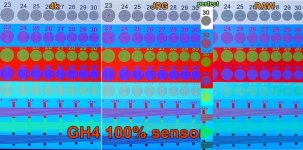
Here is the difference between GH4:

1. 8bit 4:2:0 video ----- 2. 8bit 4:2:2 JPG photo ---- 3. 10bit 4:4:4 RAW photo ---- and perfect photo, downsampled from very big photo

4k.jpg
 
are you really shure, you can grasp the difference of 4:2:2 vs. 4:2:0 (and nothing else) in this example? ;)

We can only use the images he shot during his test and based upon this the 4:2:2 images are not showing the same banding that his 4:2:0 footage is. It's possible that the author made a mistake in shooting or labeling his footage, but considering how detailed he was with the rest of the review, I'm going to assume that what we are seeing accurately represents the performance of the Shogun recorder.
 
Back
Top