
Navigation
Install the app
How to install the app on iOS
Follow along with the video below to see how to install our site as a web app on your home screen.
Note: This feature may not be available in some browsers.
More options
You are using an out of date browser. It may not display this or other websites correctly.
You should upgrade or use an alternative browser.
You should upgrade or use an alternative browser.
GH5 How interested are you in a GH6 anymore?
- Thread starter filmguy123
- Start date
 rogar-Laugh(LBG):

ahalpert
Major Contributor
Is this a valid thought? You can shoot in various flavors of ProRes that can match your 150-200mbps, 400mbps file sizes that you may be using now with the same or better quality.
Yes, this is an exceptionally valid thought. The entire purpose of compression is to yield equivalent quality (peak signal-to-noise ratio) in a lower bitrate. The entire purpose of ProRes is to provide a minimally compressed file that edits and plays back without taxing the computer.
At equal bitrates, especially on the low end, prores will give you a much crappier image than H265. Look at a ProRes proxy file and compare to an H265 file with the same bitrate.
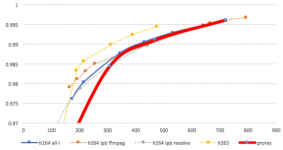
It's hard to find head-to-head matchups of prores and h265, but here's one that someone on eoshd did using a program that compares "SSIM" scores (something to do with deviation from a full-quality source image):
The following is what I've seen much more often, a comparison of PSNR between H265 and H264:
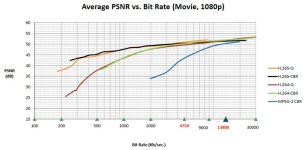
So, while you could deliver ProRes files with small bitrates, they will look much worse than H265 files with equal bitrates, and the only advantage (assuming that both are 422) is that the ProRes would be easier to play back. But if your system has H265 hardware acceleration, then you probably won't have any trouble anyway. The higher quality of prores is linked to the higher bitrate.
What's expected of the IV? ...
Two rumors. 32 MPX, 4K (obviously). Then, no one knows nothing. I say they won't be able to charge the anticipated $2,500 for 8-bit line skipper because R6 has 10-bit (in 265 internal and 264 external) and a full sensor readout. The other possibility is that it won't be $2,500 but rather the same old $2,000 as III. In which case, they might be able to get away with 8-bit but then they might need a better stills performance than 32 MPX. Then line skipping is very likely. So, 42 MPX and stills oriented or 32 MPX and a "real" hybrid.
Obviously, Sony has A7SIII to protect, so some form is video crippling on A7IV is expected.

NorBro
Major Contributor
Yes, this is an exceptionally valid thought. The entire purpose of compression is to yield equivalent quality (peak signal-to-noise ratio) in a lower bitrate. The entire purpose of ProRes is to provide a minimally compressed file that edits and plays back without taxing the computer.
At equal bitrates, especially on the low end, prores will give you a much crappier image than H265. Look at a ProRes proxy file and compare to an H265 file with the same bitrate.
It's hard to find head-to-head matchups of prores and h265, but here's one that someone on eoshd did using a program that compares "SSIM" scores (something to do with deviation from a full-quality source image):
The following is what I've seen much more often, a comparison of PSNR between H265 and H264:
So, while you could deliver ProRes files with small bitrates, they will look much worse than H265 files with equal bitrates, and the only advantage (assuming that both are 422) is that the ProRes would be easier to play back. But if your system has H265 hardware acceleration, then you probably won't have any trouble anyway. The higher quality of prores is linked to the higher bitrate.
So you're using charts for a visual conclusion...?
How about using a camera and comparing instead? Have you ever tried a Blackmagic?
And haven't you said that a lot of times you shoot HD on your a7SIII?
ahalpert
Major Contributor
So you're using charts for a visual conclusion...?
How about using a camera and comparing instead? Have you ever tried a Blackmagic?
And haven't you said that a lot of times you shoot HD on your a7SIII?
Do you think ProRes proxy looks good? 4k24p prores proxy is 155Mbps. I invite you to compare it to H265 at that bitrate.
The charts are an objective standardization of what you would see with your eyes. Just a way of quantifying the preservation of detail and image.
Probably 40% of my shooting is still HD on A7SIII but that fraction is steadily decreasing and it's irrelevant to this point because you'll save the same ratio of data in any resolution
In order not to cannibalize A7SIII sales - which is probably their #1 bread winner, if one goes by the total profit - I anticipate a high res sensor for stills (they could take a 47 MPX sensor from S1R) and a line skipping video with H265. This way A7c and A7III slide down to the entry full frame and A7IV will be a formidable contender a step higher. This will also create separation between tiers and fill in that mid-$2,000 gap.
Uhm, watch me being wrong.
Uhm, watch me being wrong.

Zim
Veteran
Well I did it. Just ordered a Canon R6. My journey to the dark side of the force is complete. Well I guess I should say the light side...
The M6 mk2 was my gateway drug and I just couldn't shake the urge.
In the end the DPAF won me over along with FF 4k 60p which the S5 is missing and a much better lens selection. Rf mount can adapt EF lenses very well and that kind of won me over I the end. We have said it a few times now in here but its the lenses that absolutely kill the Panasonic S series of cameras. Good RF glass is just as much but Canon has options all the way down to older generation EF lenses. sure far from great but its an option. I'm glad I can keep using my Tamron 70-200 f2.8 G2. If it works as well las I hope I can now get the 24-70 which is about $1,600 less than similar L mount or RF lenses.
Canon also has a very nice super option a 24-240. Slow and optically gets a bit funky on the wide end but I think that will be a great replacement for the workhorse Panasonic 14-140 I used since the GH1. Has no focus breathing and combined with DPAF and the OS plus IBIS it should be a much more solid video lens compared to what I could ever get out of the GH4 and 14-140 lens. Its mostly the corners that greatly suffer on the 24-240 but when shooting video that's not an issue at all.
The R6 is not perfect. Not sure we will ever get that but what it does compromise I can deal with.
To be honest I also got tired of lens converting. FF lenses on m43 were always going to be softer even with a Speedbooster. FF lenses on APS-C were always going to perform not as well. m43 zooms were always going to be slow and/or limited. Olympus has been making some great options but honestly those things cost more than the Tamron f2.8 zooms and sometimes not much smaller. I'm becoming a fan of using lenses designed for the sensor size. I will greatly miss the extra reach potential of APS-C and m43 but I will cross that bridge when I get there. I will eventually get get a 70-300 EF lens or maybe a 100-400 and be done with it. Nice thing about FF is the slower speeds do not hurt as much as they did on m43. f5.6 on FF is like f2.8 on m43 so at the very least a slow variable EF zoom lens will be as good as f2.8 native m43 zoom lenses. I know I will likely get a 300mm f2.8 FF lens but I have to be ok with that and know that f5.6 actually isn't all that bad at all on a camera like the R6. Plus at least for video I still have the option to crop for some extra reach at the expensive of losing oversampled video. Might be worth it vs a lower quality 300mm lens. We will see. Like I said I will cross that bridge when I get there. 140mm on m43 was always my furthest reach anyway. Even with the 70-200 I used a Speedbooster so it essentially the same reach as it was on the Canon M6. A good 70-300 should be all I need then.
Anyway I'm not gone. I'm still la fan of Panasonic and m43 and look forward to seeing what they can do. Maybe I will be back but considering the price of the GH6 is going to be the same $2,500 as the R6 I made the decision to finally move up to FF. Its really kind of funny since I absolutely could not stand the look of Canon DSLR video for many years. The R6 and R5 are the first time I finally feel Canon got it right. Sucks they cannot figure out how to get that right without overheating but whatever. I have a Ninja V to get around that if I must.
Maybe it won't be $2500.
Zim
Veteran
I don't even think it makes sense to compare subsequent models on features. It's more like computers. Nobody is shocked that the latest $1K macbook or iphone is 10x faster than a model from 8 years ago but the same price (and I feel like the entry-level laptop price and the flagship smartphone price roughly coincide because its what consumers are willing to pay for it)
Good point. Apple has been making big improvements and keeping cost down. They are killing off the camera market. I used to take my Nikons everywhere. No more. I gave them to my kids. I only have my Gh3 now. I hope they improve the GH6 or lower the price on the GH5II and maybe do some more firmware updates on the AF (if they can). I retired and only need a camera for my film work. I'm done giving the big camera companies my money after this.

Peter C.
Veteran
Ahalpert is right about lower bitrate Prores compares poorly to the same bitrate of a compressed codec like h265.So you're using charts for a visual conclusion...?
How about using a camera and comparing instead? Have you ever tried a Blackmagic?
And haven't you said that a lot of times you shoot HD on your a7SIII?
You speak like your an expert on every subject when you have very little real world experience with these technologies.
NorBro
Major Contributor
Ahalpert is right about lower bitrate Prores compares poorly to the same bitrate of a compressed codec like h265.
You speak like your an expert on every subject when you have very little real world experience with these technologies.
Abe has an opinion that sounds like it was formed from possibly never using a ProRes camera and that's all good, but you...guess what? You are wrong, again.
You'll actually never see my speaking about lights or audio (rarely) or sets or various practices or viruses because I stay in my lane.
If there is a subject that is my expertise, this is it. Cameras. The amount of questions I have answered on this forum about various cameras over the years is unheard of. You would actually think a machine is answering them because sometimes it's not possible for one person to know so much.
And I did because of real world experience using them. Stuff you can't learn from only reading the manuals - which I did anyway, for fun.
But your noggin wouldn't know that though, right? Let me guess...started with a Betcam about 40 years ago and you haven't learned much since, am I right?
___
I have used more technology and cameras than you could possibly ever dream of.
Paid double and triple the price for Blackmagics at a time in 2012 and 2013 when I'm sure you were still shooting standard-definition thinking you know tech but it extended as far as being able to white balance.
Was editing H.265 from a NX1 all the way until they discontinued the camera.
___
I've shot every single ProRes flavor on all of the BMs and various recorders and know what they look like.
I've poured an unthinkable amount of money into various systems and testing all of them and knowing how the formats and codecs compare to theoretical conclusions.
H.265 is amazing. I love it. But ProRes from good sensors is extremely capable.
The white paper conclusion that H.265 is more efficient isn't a surprise, of course it is; but it's actually my experience and conclusion that I find it ironic that someone might question the quality of a format when the results online from another format that they are posting don't look that great to begin with.
ahalpert
Major Contributor
I wouldn't use proxy, but used to use LT all the time.
Sure but LT is still 328Mbps in 4K24p. Xavc-I is 240Mbps. And H265 on the A7SIII is 100Mbps which makes sense because long-GOP saves about 50% over all-I and H265 saves about 50% over H264, which would actually bring it down to 60Mbps relative to XAVC-I.
You can argue about whether ProRes 422/ProRes LT looks better than XAVC-i but I don't think you can argue about whether ProRes or H265 looks better at 100Mbps. (And obviously that bitrate scales up as you're talking about 60p and 120p.)
I've shot and edited material natively recorded in ProRes and obviously it's a nice format. It doesn't compete at the bitrates I'm talking about.

Thomas Smet
Veteran
ProRes is about as good as a codec could ever want to be. Yeah its not efficient so the files are larger but the plus side to that there is no funny business either. Its about as unaltered of a video codec one could ever get with only the most basic rules of DCT compression at play. No codec can really look better. Just look close to it at a smaller file size. Its really a benchmark standard all other codecs try to meet.
I'm not saying this as some kind of apple fan either. Wal-mart could have made it and it would still be one of the best video codecs ever created. Hate apple for many reasons but the one thing they nailed 100% perfectly was ProRes.
I'm of course talking about a broadcast standard 4:2:2 10 bit codec and not including raw formats. It does sound like ProResRaw may be more unaltered of a raw format than Braw is however. Its really too bad its not included in any camera to record internally. External raw would have been the sliced bread of the video world five years ago. Now today compared to the really good internal log formats and codecs we have its very hard to justify it. Heck Sony fans are still arguing that 10bit is unnecessary.
So if anyone thinks a broadcast format is visually better than ProRes its purely a placebo effect.
Even on the raw side ProRes4444 is a RGB, 12bit 4:4:4 format similar to raw. Sure its still baked in but even Hollywood does a lot of productions with ProRes4444 vs raw because when it comes t grading they found very little to now difference. Raw really has become the excuse to shoot like crap for a lot of users and that's sad. For me its purely a means to get 4:4:4 and not live in a hobbled rec709 YUV world anymore.
Thomas Smet
Veteran
I'm actually realizing you're probably talking about saving space, and not questioning the quality of various ProRes options.
"Data conscious" read like quality conscious to me at 4am.
For me I'm not even all that concerned about recording the file size of ProRes or eve archiving it. Storage is cheap but bandwidth still is not. 4k ProRes422 HQ doesn't work very well from a single HDD. One typically either needs a 2 drive raid-0 or a SSD to edit from. Thats where the cost of working with ProRes can get high. Thats kind of where proxy comes in I guess but not everyone wants to go through that extra step either. I was editing 4k proxy on a 2011 MBP however and a portable 5400 RPM drive. Hard to beat that ability with the only downside is a little time to convert to proxy.
When it comes t short form projects like a TV spot or music video ProRes really is king and a 1 TB SSD to edit off of is super cheap these days. Long form projects like weddings are much more complex to handle however with the bandwidth requirements. Especially if editing 2,3 or 4 cameras at a ceremony. Even a single Ssd might struggle to play back 4 streams of 4k ProRes at the same time. One doesn't really need picture perfect quality during the Multicam edit however and again proxy is absolutely perfect for stuff like that. I have edited entire projects using proxy and flip the switch back to ProRes when time to export. Even grading is totally possible using proxy since its still 10bit.
NorBro
Major Contributor
As far as storage/capacities, I feel the same way - which is why I didn't even realize it was a consideration these days.
For post, I've been using SSDs for a very long time but everyone's situation is different so understood.
P.S. PR422 HQ used to be used on the ARRIs for so much TV/film stuff...I definitely agree with your point about RAW kind of missing the boat [in most cameras] because of how great formats are these days.
All cameras should have had it a long time ago, but now...the other choices are "good enough"...great enough.
ahalpert
Major Contributor
I'm actually realizing you're probably talking about saving space, and not questioning the quality of various ProRes options.
"Data conscious" read like quality conscious to me at 4am.
Yes, almost the opposite. But the quality must be sufficient
ahalpert
Major Contributor
For me I'm not even all that concerned about recording the file size of ProRes or eve archiving it. Storage is cheap but bandwidth still is not.
I think it's more about the cost of cloud storage but also simply the cloud transfer time, especially for fast-turnaround projects and especially if you're off-shoring your editing to timbuktu or wherever. One of my clients uses a really fast cloud service that charges them by gigabyte downloaded.
And some of my wedding clients are pinching pennies just for archiving footage, but since they may get 10+ hours collectively from 3 or 4 cameras, it would amount to maybe 5TB or so of recording ProRes 422 4K redundantly stored. So, the head honcho could save themselves $100+/wedding with H265 recording.
Liam said some TV channel in the UK (sky tv?) was complaining about his C500mk2 bitrates. Probably, again, because they are archiving **** tons of footage and couldn't care less about any marginal gain in IQ
NorBro
Major Contributor
C500 II's highest XF-AVC 60p bitrate (810) is almost identical to DCI ProRes HQ 24p (754).
When I bought a 1DX Mark II in 2016, I noticed that the 60p's data rate was only just a bit higher than the 24p (800 vs. 500). Should have been closer to approximately 2.5x like what a constant target DCI PR HQ/60p is (1886).
It was never apples to apples in most cameras, but maybe for the better as that would easily get out of hand for many with HFRs for daily acquisition even with non-RAW formats. 24p/25p is more manageable.
Last edited:
Thomas Smet
Veteran
I think it's more about the cost of cloud storage but also simply the cloud transfer time, especially for fast-turnaround projects and especially if you're off-shoring your editing to timbuktu or wherever. One of my clients uses a really fast cloud service that charges them by gigabyte downloaded.
And some of my wedding clients are pinching pennies just for archiving footage, but since they may get 10+ hours collectively from 3 or 4 cameras, it would amount to maybe 5TB or so of recording ProRes 422 4K redundantly stored. So, the head honcho could save themselves $100+/wedding with H265 recording.
Liam said some TV channel in the UK (sky tv?) was complaining about his C500mk2 bitrates. Probably, again, because they are archiving **** tons of footage and couldn't care less about any marginal gain in IQ
I'm not entirely sure I would consider uploading camera video files to cloud storage as a normal practice. I realize its becoming more common but that has an even more extreme concern than the edit drive speed. Is uploading and then downloading that much data actually faster than overnight shipping? I guess if sending it to another country but you have to realize that's not a very common practice yet. I also don't want video files to get smaller just so we can send it via cloud storage.