Varicam pricing

ill try to test it on a shoot. not on a DR chart though. one in 800 then one with 5000 with ND filter.
im guessing it wont be huge enough of a difference.
Thanks! Without a DR chart, what is important is a very high contrast scene obviously. If the scene is low contrast it obviously wouldn't make much difference!

I'd predict that the 5000 mode should still manage DR of about 10 stops, so the actual effect very scene dependent.
 
I think when DLD first brought the subject up, then it had more to do with a client wanting to ensure their product was truly "4k compliant". Like it or not, cameras like the Alexa or Amira wouldn't allow the production to genuinely put "4k" on the tin - a camera with a 3840x2160 chip would. Compare if you like with an organic restaurant offered non-organic (but very high quality) steak. Even if it's taste, texture etc were all first rate, the very fact of the non-organic origins would have to rule it out if the restaurant wanted to stay within the law. If it wants to (legally) promote itself as an organic restaurant, it has to sell organic produce - end of story. Same if you want to claim "shot in 4k" for your production.....
Barry Green posted Panasonic's PR release (in the PR release thread) about several Amazon shows being shot on Varicam due to Amazon wanting to use an "authentic" 4K camera (here I assume that the default choice prior to that were the ARRI products).

But a while back I posted - in this very thread, quite possibly - that I recall the old CD's sold in the 1980's, where one of the major selling points were the source of the recording. DDD (Digital Recording + Digital Mixing + Digital Mastering) was deemed as the top choice, ADD the second best and AAD the last and the least, as many noisy albums from the 1960's and 70's were rushed to the market during the CD craze without being digitally cleaned up and thus were full of the mixing hiss. I speculated that this battle of nomenclature was to be followed in the 2K-2-4K transition.

And I was right.

PS. There was no need to advertize the SD to HD transition, as SD was in 4:3 and HD in 16:9 and the difference was clearly obvious at the time. I have, however, seen some old Soviet B&W clips "converted" to 16:9 with what must have been a variable aspect ratio software, which makes the image appear floating on a soap bubble. I assume West of Oder, this is done via a manual pan & scan.
 
sorry harddrive didnt mean anything negative with nerdy, geeky - I use these terms affectionatley really - my main point was that specs arent everything

As for "nerdy spec sheets", then at one level I agree. But with cameras of this type phrases such as "F55 image" and "Varicam image" become increasingly meaningless - image quality becomes far more determined by grading skill. If A looks better than B is it because camera A is better than camera B, or because A has had a better grader work on it.......?

my only query with this is if so, why isnt the F55 being used instead of say the Alexa, if it is just down to the grading? I see something in the image of the Alexa (and Varicam from what I've seen so far) that is far more appealing than any of the Sony's bar the f35, f65. That is not all down to grading
 
PS. There was no need to advertize the SD to HD transition, as SD was in 4:3 and HD in 16:9 and the difference was clearly obvious at the time. I have, however, seen some old Soviet B&W clips "converted" to 16:9 with what must have been a variable aspect ratio software, which makes the image appear floating on a soap bubble. I assume West of Oder, this is done via a manual pan & scan.
Depends where you live.....! In the UK, 16:9 came in with digital transmission and initially (late 90's) that was SD (though 576i, not 480i). HD transmissions came quite a few years later. (And of course commercial DVDs are 16:9 SD.) But it's worth thinking about the changeover. For quite a while before HD transmissions started in the UK at all, ACQUISITION - at least for the bigger budget productions - started to go HD, even if their first showings were only going to be SD. I think we're at a comparable point now with HD and 4K - ACQUISITION having to go 4K well before there are many facilities for delivering it, certainly as far as broadcast TV goes.

(As an aside, about 10-15 years ago, the situation was that the main channels would be broadcast digitally as 16:9, the analogue simulcasts were 4:3 for legacy reasons. The procedure adopted was "shoot and protect 14:9". (Google if you're interested!) The initial shooting was done in 16:9, but with the proviso that all essential action, captions etc had to be in the central 14:9 area. Come transmission on the analogue (4:3) channel and what went out was a 14:9 letterbox within the 4:3 frame. The logic was that not too much was lost off the sides of the frame, but the 4:3 viewers didn't feel it as obtrusive as a deep 16:9 letterbox. But that's adigression....)
ade4all said:
my only query with this is if so, why isnt the F55 being used instead of say the Alexa, if it is just down to the grading? I see something in the image of the Alexa (and Varicam from what I've seen so far) that is far more appealing .....
My comment was really intended for the F5 and Varicam and personal observations. As far as the Alexa goes, then I can think of two series I've watched (and enjoyed both of them) but in terms of what the image looks like it's hard to believe they are from the same camera. Personally, I strongly prefer one to the other - but it would be wrong to call them "right" and "wrong". It's a matter of the relevant directors choices and what they think suits the subject matter. But it begs the question of how anyone can sensibly talk about the "look" of a camera - any camera of this type - per se? If I didn't know, I wouldn't think these were from the same camera. And that's before we even think about lenses. I'd actually think lens choice may make more inherent difference to image quality than whether a Varicam or F5 was used.

And it shouldn't be a surprise. Time was when "the look" was largely determined by the cameras circuitry and internal processing etc. Heck, it's not that long ago when even whether it was 1080i or 720p camera was hard wired and inherent to make and model. Times have vastly changed now, and most (no, not quite all) of those factors have gone into software and post processing, especially so in RAW workflows.

But of course all this is anathema to the sales and marketing people. They rely on being able to present their offering as "special" - different to the pack. And their different will be presented as "best", obviously. Maybe most revelaing were some (user) tests done with an F5 and a FS700 when RAW could be obtained from both. For image quality there wasn't much to choose - though the F5 obviously offered a lot more features. Do you think you'll find that presented in official Sony marketing? :)
 
Alexa SXT has just been announced - the same "classic" 3.2K Alexa sensor with an in-camera upscaling.

ARRI claims internal 4K Pro-Res at both UHD and DCI.

So, that's another competitor ... if the producers buy the ARRI 4K assertion.
 
Last edited:
Noel, it's still coming across as if you think by "two native ISO's" you're interpreting it as two ISO values, with all else equal between them except for a 1dB noise penalty in the ISO5000 mode. It's almost never the case that anyone gets something for nothing - and that's nearly always true in camera design. And so it is here. It may well be true it has two switchable ISO values, it may well be true that the higher has a noise threshold only 1dB higher, but you need to ask - as with offers of "guaranteed 20% pa return, no risk" - where's the catch?

I've been holding off responding. I have seen it first hand and without being able to do that and without the relevant info, I appreciate we're going around in circles a little. I've asked Pana to give us something there.

Which backs up what I've been saying. Look at the response graphs and the length of the line effectively represents dynamic range at the sensor. The ISO800 case represents "native ISO" with max dynamic range - the longest line it's possible to have. In the ISO5000 graph, the usable DR is represented by the red portion of the line - it's a remapping of the dotted black line in that graph, the solid black section of the line becomes effectively lost..

Sorry, but you've misread that a little. The lines represent noise only, theres no DR info represented there at all.

Until Panasonic provide the info (the person who can do the xyla charts for us is in India at the moment apparently) I'll leave with this statement for consideration:

The Varicam35 has the same Dynamic Range at all ISO values.
 
I asked a friend for clarification on a few facts I was unsure about, and I think it's worth posting the reply in full. Sorry, it's technical, I don't see how it couldn't be, but it certainly clarified a number of points for me.
Apologies for the delay, but finally a few words in response to your queries. I’m afraid what follows is complicated enough, but the practical reality is even more complicated. For example, I have ignored noise, but hopefully it may be of use in helping to understand basic principles. At the most basic level the dynamic range of a sensor is governed by the difference between the amount of light just required to give any output at all and the amount at which saturation sets in. The point at which increasing the light gives no higher output.

So if it needed 8 light photons to hit a photosite during the exposure period to give a just discernible output, and if saturation occurred after incidence of 131,072 photons (8 x 2 to the power 14) the sensor could be said to have a maximum dynamic range of 14 stops. This will correspond to a range of f stops corresponding to light levels, which is another way of saying a single ISO value. This is what is referred to as the native ISO value of the sensor.

If you want to rate it at a higher ISO value, then that infers the same camera output for lower input light levels. If you are talking about a 3 stop difference, it means that for a given scene lighting level, stopping down by 3 stops and switching to the higher ISO will give the same result.

But we need to think about what is physically happening. Assume the input image is a series of squares, with successive squares being each twice as bright as the preceding square. Following on from the above, further assume that that for the darkest square the incident light is 8 photons/photosite, so 16 for the next, the next 32 and so on. The act of stopping down by 3 stops will divide by 8 the amount of light in each case – so in terms of photons/photosite the figures then become 1,2,4,8,16 etc. So if 8 are needed to give any output at all, it follows that all of the first three squares are effectively black and indistinguishable from each other. And this is inherent in principle to such a sensor. For a given scene, detail will be lost in the darker areas.

You ask about whether any such a ISO increase must necessarily mean a decrease in dynamic range, and the answer is not completely clear cut. The sensor will retain its 14 stop dynamic range as it is a physical property, and will still handle highlights to that extent. But it may a false way of looking at the situation as such may also be considered to be simply a case of stopping down and increasing the scene illumination – so no ISO increase in the first place! It may be hard to generalise, but for a given scene any act of increasing ISO whilst stopping down the equivalent number of stops is likely to have the effect of being detrimental to shadow detail, but may be of benefit to highlight detail. That follows from the paragraph above.

But that all relates to the sensor itself, and there is an assumption that it’s the sensor itself that is the defining factor. But that may not be true, and there are a set of circumstances where the weakest link is elsewhere, namely in the analogue circuitry and the A-D convertors. If the performance of the latter is inherently worse than the sensor figure, the performance will be defined by them, not the sensor itself.

So if the native sensor dynamic range was to be 15 stops, but the analogue circuitry could only manage 12 stops, the CAMERA dynamic range could never be better than 12 stops. In such a case, the analogue range could then be chosen to be the 12 stops nearer saturation (and low ISO), or the 12 stops close to just perceptible detail (high ISO). In which case, if it was selectable, the concept of “dual-ISO” would be true – and in each case DR performance etc would be identical. You really could switch between two ISO figures, and vary the f stop by the corresponding amount and not notice any difference to output.

But I’d argue that the basic ISO of such a system was the higher figure. Why not just accept that as the normal, and why bother with the lower setting? And in any case, it’s a sign that the analogue circuitry is poor in relation to the sensor and the camera itself never able to achieve the potential of the sensor.

It’s worth mentioning the principle behind the Alexa, as that does indeed use dual analogue circuitry, and individually such circuitry is not capable in isolation of doing justice to the sensor. The Alexa sensor is sub-4K resolution, which means individual photosites are large compared to 4k s35 sensors. Which gives it an inherent native DR advantage compared to the 4K versions. But the 14 bit A-D convertors can’t take full advantage of that (they become the limiting factor, not the sensor). To get over this they employ dual simultaneous read, one low gain A-D dealing with highlights and the high gain path dealing with the dark areas. Combine the results and you have what they call meaningful luminance information in all 16 bits. See http://www.arri.com/camera/alexa/technology/arri_imaging_technology/alexas_sensor/ .


i didnt exactly get the chance to shoot a proper test of the varicam. I didnt have the time.
I just snuck it out to do a shot of the same thing at diff ISO. 800 & 5000 with ND.9

pretty much i made sure the outside was overexposed. (100+ on waveform)
I didnt expose for inside.

ISO 800
https://www.dropbox.com/s/uhfdjkxiro607gp/421PD3WN.Still001.jpg?dl=0

ISO 5000 with 3 stops ND
https://www.dropbox.com/s/l2pkt6161zzzdvo/421PD3WN.Still002.jpg?dl=0
Thank you for that dcloud! At first, I wasn't sure what if anything the images proved, but taken with paragraphs 4 & 5 from above I think some conclusions can be drawn. The most relevant sentence may be "It may be hard to generalise, but for a given scene any act of increasing ISO whilst stopping down the equivalent number of stops is likely to have the effect of being detrimental to shadow detail, but may be of benefit to highlight detail. That follows from the paragraph above.


At first I thought the difference was simply one of exposure, but looking more carefully it seems that the mid tones are comparable (as they should be), but the dark parts of the image are much darker in the ISO5000 result, whilst the highlights show much better detail.

This is as that bit of theory predicts. The relevance is that switching from ISO800 to ISO5000 and reducing the light level by 3 stops does affect the image, mainly in respect of reducing lowlight detail, but also with a noticeable increase in lowlight noise.

For a given scene lighting level, stopping down by 3 stops and switching to the higher ISO would be hoped to give exactly the same result. That's what some are assuming. From the images you posted, it does not appear to be the case.
 
i didnt exactly get the chance to shoot a proper test of the varicam. I didnt have the time.
I just snuck it out to do a shot of the same thing at diff ISO. 800 & 5000 with ND.9

pretty much i made sure the outside was overexposed. (100+ on waveform)
I didnt expose for inside.

ISO 800
https://www.dropbox.com/s/uhfdjkxiro607gp/421PD3WN.Still001.jpg?dl=0

ISO 5000 with 3 stops ND
https://www.dropbox.com/s/l2pkt6161zzzdvo/421PD3WN.Still002.jpg?dl=0

I think there's a minor issue with your numbers as viewing the waveform shows that image two is about a stop and a half lower. Which is going to effect everything here, especially where the shadows are placed. I have a theory as to why - however can you confirm how achieved an ND.9? Did you have external NDs?
 
I think there's a minor issue with your numbers as viewing the waveform shows that image two is about a stop and a half lower.
That's not what I see (though it was my first impression). If you compare the midtones between the two images those are pretty close in level - look at the vertical patch of light on the back wall on the left (just right of the girls arm on the ISO800 image). Compare it with the ISO5000 image and there's not a lot of difference.

I suspect what difference is seen is accounted for by a 3 stop difference from ISO800 would translate to ISO6400 - so at ISO5000 we would expect a third of a stop drop. That's in line with what is seen in the midtones.

It's in the darker areas of the image that the difference between the two becomes far, far more pronounced. I've downloaded dclouds images and put them side by side into photoshop. Try it for yourself - and compare the face in the two images, also the T-shirt. The high ISO version has far more noise and is severely losing gradation in the darker parts of the picture, as well as them being darker overall. Noel posted earlier " It {the Varicam} achieves it by having two analog circuits and when you select 5000 iso, it switches from one to the other - 5000 has 1db more noise than 800."

On the basis of dclouds images, the ISO5000 result has a lot more than 1dB more noise compared to ISO800, let alone the loss of gradation in the shadows.
 
That's not what I see (though it was my first impression). If you compare the midtones between the two images those are pretty close in level - look at the vertical patch of light on the back wall on the left (just right of the girls arm on the ISO800 image). Compare it with the ISO5000 image and there's not a lot of difference.

Very confused.

The second image is about a stop and half less. Im not guessing this - it's what the waveform tells me. The second image is far more underexposed. This is pretty succinct in representation as to what happens in any camera when under exposed.

I suspect it's happened in the following manner. At this stage Im making a bit of an assumption as well. The VariCam has built in ND's 2, 4 or 6 stops. Thus the reason I asked DC if there was an external ND used. If it was internal it was most likely actually 4 stops. And based on that we have a 1 stop difference. The other half stop comes from the fact that ISO 5000 is actually 2.67 stops difference from ISO800, not three full stops. Thus entirely around 1.33 stops less than image 1.

It's in the darker areas of the image that the difference between the two becomes far, far more pronounced. I've downloaded dclouds images and put them side by side into photoshop. Try it for yourself - and compare the face in the two images, also the T-shirt. The high ISO version has far more noise and is severely losing gradation in the darker parts of the picture, as well as them being darker overall. Noel posted earlier " It {the Varicam} achieves it by having two analog circuits and when you select 5000 iso, it switches from one to the other - 5000 has 1db more noise than 800."
On the basis of dclouds images, the ISO5000 result has a lot more than 1dB more noise compared to ISO800, let alone the loss of gradation in the shadows.

But it is 1db. I have no dog in this race. But that simply isn't the case. The second image under exposes all areas of the image - light thats direct, light thats reflected - its what happens. I have compared the two images side by side, on a waveform and the second image, however it's occurred is about a stop and a half less exposed. Putting the on a histogram tells me exactly the same thing - about 1.5 stops less. She was under exposed in the first shot - by a lot, then that was stretched even further in the second.

Here's two images - shot at 5000. Graded and ungraded - same image.

1_1.6.1.jpg


2_1.6.2.jpg
 
Very confused.

The second image is about a stop and half less. Im not guessing this - it's what the waveform tells me. The second image is far more underexposed.

I agree it's underexposed - but I disagree that it's as much as that. I strongly think it's more of the order of 1/3 stop and fully explainable by 3 stops from ISO800 being ISO 6400 - not ISO5000. But let's see what dcloud has to say about the circumstances.....

I've tried tweaking in photoshop ("levels" control) and it doesn't need much to get the midtones to correspond, which makes direct comparison more easy.

And what stands out is the huge difference between the two images in the noise in the darker areas - in particular the subjects face and the darker background. There is simply no way that is only a single dB.

Here's two images - shot at 5000. Graded and ungraded - same image.

But in this context, and in isolation, they don't tell us very much.

What's at issue is how the ISO5000 mode compares with the ISO800 mode *with all else equal*. And the simplest way to test it is what I previously suggested - "Shoot a high DR scene at Iso 800, (ideally a DR chart), then switch to the other mode and stop down nearly 3 stops. From your interpretation, the results should be virtually identical, at least in DR terms - but is that what you find.....? Go on, try it, ......

And I hope that is what dcloud did do. And allowing for the 1/3 stop difference, it is obvious that the results are far from identical - in this case manifesting as a much higher noise level.

(With differing profiles, setups, the differences may show in different ways - that's why the tests need to be on the same scene and the only two things that change are ISO mode and a reduction in light by about 2 2/3 stops. I think it may be worth your trying exactly that yourself Noel, if you still have any access to the Varicam.)
 
I think there's a minor issue with your numbers as viewing the waveform shows that image two is about a stop and a half lower. Which is going to effect everything here, especially where the shadows are placed. I have a theory as to why - however can you confirm how achieved an ND.9? Did you have external NDs?
i used the built in ND. Its .6, .9, 1.2

This was pretty much my process, checked waveform, shoot 800, switch nd, shoot 5000.

i do think i made some mistake in exposing. I probably viewed the Rec 709 waveform not the VLog.where i thiught i saw the outside blown out in the waveform.

anyway this is a terrible test by me. I dint get the chance to do it properly.

and yes harddrive is right, .9 would account for 6400 not 5000 thats why 5000 is darker.

to my eyes, 5000 is noisier in the shadows but the highlights are enormous and its better to over expose by a stop. So yes it prbably loses 1or2 stops in the shadow area.
I hope i get to play wth it again to confirm this. :)
 
Last edited:
i used the built in ND. Its .6, .9, 1.2

This was pretty much my process, checked waveform, shoot 800, switch nd, shoot 5000.i do think i made some mistake in exposing. I probably viewed the Rec 709 waveform not
Hmmm - according to the brochure - ftp://ftp.panasonic.com/provideo/varicam_35/varicam-35_brochure.pdf - it says the built in NDs are "• Built-in ND filters (0.6ND, 1.2ND, 1.8ND, CLEAR).. Which is not to say the model you had wasn't fitted with non-standard filters by request, but......

But in a way it's slightly irrelevant. The big difference between the two images you showed is that the ISO5000 version has way, way more noise in the dark areas, and that would be true even if the camera had been capped up! Likewise the absolute exposure - it doesn't need to be correct as for a usable scene, just as long as there are dark areas to compare between the images.

It's also interesting to note that in your ISO5000 image, the overall noise level is higher than in the image Noel posted. But that doesn't really prove a lot either way. Noise in the coded image will vary with mode, setup etc - which is why any comparison has to be done with the same camera, same scene, and same setup to be meaningful - solely changing ISO and light input.
 
I agree it's underexposed - but I disagree that it's as much as that. I strongly think it's more of the order of 1/3 stop and fully explainable by 3 stops from ISO800 being ISO 6400 - not ISO5000. But let's see what dcloud has to say about the circumstances.....
(With differing profiles, setups, the differences may show in different ways - that's why the tests need to be on the same scene and the only two things that change are ISO mode and a reduction in light by about 2 2/3 stops. I think it may be worth your trying exactly that yourself Noel, if you still have any access to the Varicam.)

So, it was 1 1/3 stops...

I don't but I have done it numerous times as part of the roadshow pana held here in Australia. Im pretty sure LEMAC here may have the files so I will see if I can get them from them.
 
Hmmm - according to the brochure - ftp://ftp.panasonic.com/provideo/varicam_35/varicam-35_brochure.pdf - it says the built in NDs are "• Built-in ND filters (0.6ND, 1.2ND, 1.8ND, CLEAR).. Which is not to say the model you had wasn't fitted with non-standard filters by request, but......

But in a way it's slightly irrelevant. The big difference between the two images you showed is that the ISO5000 version has way, way more noise in the dark areas, and that would be true even if the camera had been capped up! Likewise the absolute exposure - it doesn't need to be correct as for a usable scene, just as long as there are dark areas to compare between the images.

It's also interesting to note that in your ISO5000 image, the overall noise level is higher than in the image Noel posted. But that doesn't really prove a lot either way. Noise in the coded image will vary with mode, setup etc - which is why any comparison has to be done with the same camera, same scene, and same setup to be meaningful - solely changing ISO and light input.
oh 1.2? well that could be the culpirt. i dont quite remmber the ND. so i guess based on these shots, it still couldve looked way better.
anyway, heres a semi-graded screenshot from the shoot.
bys grade_409HZ7PT 2.jpg
 
ISO comparisons.jpg

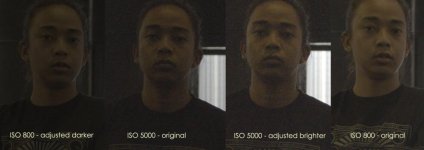
I'm still hoping this test can be conclusively repeated with no question of exposure variations, but in the meantime played around with dclouds images to see if anything meaningful could be gathered. The composite above shows small sections of the originals, and the intention was to boost the ISO5000 image levels to match the ISO800 ones for brightness, (right hand pair), and conversely lower the gain of the original ISO800 image to match the original ISO5000 image for brightness (left hand pair).

What stood out to me immediately were the noise levels. The act of boosting the original ISO5000 image has increased the noise level (middle two images) - but it doesn't seem anything like as big an increase as between the original ISO800 to ISO5000 images.

I simply don't believe on that basis that on switching from ISO800 to ISO5000, the only penalty is a noise increase of 1dB - all else staying equal. What I see there is much more than that. The ISO5000 performance seems pretty good in itself - but not much different from any other camera in this class with an s35 sensor.

But I'd like to see the test repeated with assurance that the exposure was being reduced by about 2 2/3 stops as the gain was increased, and the test should ideally be with a fairly low key subject.
 
View attachment 99404I simply don't believe on that basis that on switching from ISO800 to ISO5000, the only penalty is a noise increase of 1dB - all else staying equal. What I see there is much more than that. The ISO5000 performance seems pretty good in itself - but not much different from any other camera in this class with an s35 sensor.

OK, well Im not here to convince you. I'd suggest that you use the camera and see for yourself, before basing it on flawed images.
 
Back
Top