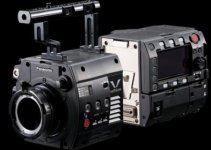
Tye
Active member
To quote the GoGos...."My lips are sealed..."
Jim Martin
EVSonline.com
Wouldn't it be more like BananaRama's.......'Cruel Summer' ??!
Cheers - Tye

Follow along with the video below to see how to install our site as a web app on your home screen.
Note: This feature may not be available in some browsers.
To quote the GoGos...."My lips are sealed..."
Jim Martin
EVSonline.com
But you have to ask WHY the image quality fell short of what had been hoped for. Fundamentally, it wasn't because of 4/3 chip size as such - but it WAS because to make the project viable Panasonic used a lot of off the shelf, already existing technology, which was centred around 4/3, largely from the GH1. If.... *IF*.... they had purpose designed a video centric 4/3 chip specifically for the AF100 it would have been a different matter - but that would have vastly increased the price. The AF100 really has to be thought of as a DSLR in a more video-friendly housing. As such, the concept was clever, but what let it down was the long delay time between conception, announcement and actual sale. By the time it reached the shops, it was already starting to look stale.How so? The only camera that I can think of that was aimed at cinema without a S35 sensor and didn't sell very well was the AF100. In my opinion, it wasn't because of the sensor size that it didn't do well, it was because of the (relative lack of) image quality, ..........
But to get even close to "exact same image quality" you're talking about an optimised for video new sensor. And even then it will inevitably have a sensitivity disadvantage due to smaller photosite sizes. I just don't see this being 4/3, but we'll see. My money is still on something like the F5 - the current Varicam as a one piece unit - and the big question will then be how much it costs.It would also make for a clear distinction between low end Varicam (m4/3) and high-end Varicam (S35), where they share the exact same image quality, but the difference is in sensor size and perhaps frame rates.


My money is still on something like the F5 - the current Varicam as a one piece unit - and the big question will then be how much it costs.
Why would anyone go for that, when they can get half a dozen Sony FS7s, with money to spare?
Maybe the question is whether anybody IS going for it, at that price?How can the current Varicam 35 go for $55,000? Why would anyone go for that, when they can get half a dozen Sony FS7s, with money to spare?
 Which may explain what is to be announced. A way of cutting the cost without being seen to actually cut the cost, if you see what I mean..... Bring out a new model.....

I agree completely.But you have to ask WHY the image quality fell short of what had been hoped for. Fundamentally, it wasn't because of 4/3 chip size as such - but it WAS because to make the project viable Panasonic used a lot of off the shelf, already existing technology, which was centred around 4/3, largely from the GH1. If.... *IF*.... they had purpose designed a video centric 4/3 chip specifically for the AF100 it would have been a different matter - but that would have vastly increased the price. The AF100 really has to be thought of as a DSLR in a more video-friendly housing. As such, the concept was clever, but what let it down was the long delay time between conception, announcement and actual sale. By the time it reached the shops, it was already starting to look stale.
I don't think they have to design anything new. Use a smaller section of the current S35 sensor in the Varicam 35. Just like RED is doing with their Dragon sensors in the 8K Weapon vs the Raven. They both share the same sensor, but Raven uses a smaller cut from the same sensor wafers (if I understand correctly, as I am not a sensor expert in any way).Yes, it would be possible to custom design a new sensor of 4/3 size, optimised for video, say with a 4096x2160 photosite count - but I don't see that happening.

The hierarchy of sensor sizes is pretty clearly goes from small to large - you begin with the smartphone size and end up with the medium format. And that places MFT below s35/APS-C, which is itself below full frame, which is below medium format. Under the current price/value breakdown, MFT is basically entry level photography/video and, indeed, Sony could have made a BSI 16:9 8.8 MPX MFT sensor ... except they've moved onto the s35 and FF themselves and what they make for Olympus is definitely stills first product. And Panasonic hasn't brought out an original sensor in a while, so all it has left is to lead on the value scale and they seem to have whiffed out on that front too with the Varicams (GH4 was obviously a huge hit for them).... But it still seems that 4/3 sensors are primarily designed for stills use, video secondary. Use such a sensor, and call the result "Varicam" and I think there is a huge danger of damaging the whole Varicam brand. Yes, it would be possible to custom design a new sensor of 4/3 size, optimised for video, say with a 4096x2160 photosite count - but I don't see that happening. If the forthcoming announcement is branded "Varicam", expect it to be s35. (Or yes, maybe even bigger?)
That's called "wholesale" and the 50% margin is what photo-video gear gets under a cartel controlled market.... As as far as price goes, I've talked to some people I know that own rental houses and Panny is and has been selling to the rental houses for about half of MSRP...
How can the current Varicam 35 go for $55,000? Why would anyone go for that, when they can get half a dozen Sony FS7s, with money to spare?
Does the Varicam have any advantage besides 120 fps UHD? I've also heard mention of its dual ISO, which it says gives ISO 5000 cleanly. Not bad, but ISO 5000 is just 1.5 stops brighter than the FS7's native ISO of 2000.
I just don't get it. The best I can guess is that it's institutional inertia. A decade ago, it would have been a fair price. I guess I also don't get how Red sells any cameras anymore at those prices or even why any C300's sell anymore in light of the Sony FS5.
I feel a bit abrupt, but I don't mean to make anyone mad. It's just I really feel like that kid in the story of the emperor's new clothes.
That's called "wholesale" and the 50% margin is what photo-video gear gets under a cartel controlled market.
+1 Does this handle REALLY have to be that tall??? We shall see, maybe there's a key reason for this.
I don't think that really answers it though. Certainly not if we assume *ALL* photo-video gear is subject to a 50% margin? Because then you'd expect the rental houses to also get the half MSRP (the wholesale price) on all other such equipment as well?That's called "wholesale" and the 50% margin is what photo-video gear gets under a cartel controlled market.Run&Gun said:... As as far as price goes, I've talked to some people I know that own rental houses and Panny is and has been selling to the rental houses for about half of MSRP...
That wouldn't work. For QFHD we are talking about 3840x2160 photosites in an s35 area with the Varicam sensor. Use a centre crop to correspond to the area of 16:9 4/3 and it must mean roughly half the photosite count, so somewhere around 2680x1508.I don't think they have to design anything new. Use a smaller section of the current S35 sensor in the Varicam 35.
I am talking about the variable costs (per unit production and distribution), without the fixed/overhead.... That's a bit ambiguous though, since every sale of a camera has to also go towards paying off the R&D costs associated with it, not just production...
The retailers make a higher profit percentage on the higher priced units than on the lower but they move more lower priced units (price effecting the demand negatively). I have read that the Lens Rentals folks anticipate the rental product to have no more than a 20-week lifespan. If so, a rental establishment needs to get its desired profits within those twenty weeks. There are other variables, obviously, but that's the general rule of thumb.I don't think that really answers it though. Certainly not if we assume *ALL* photo-video gear is subject to a 50% margin? Because then you'd expect the rental houses to also get the half MSRP (the wholesale price) on all other such equipment as well?
I would say that's in the ballpark.So they pay $25,000 for a camera with list price $50,000 - and only $12,500 for one at list $25,000.
I think that's true to the extent that, as I mentioned above, a given retailer won't sell as many Ferrari cars as he will Toyota Camry. I knew a number of people in the car trade and the highest earning opportunities were in the middle of the line - Camry, Accord, F-150, Chevy trucks - because of the turnover/number of units sold. The margins were obviously much higher on a Mercedes or a Porsche but those jobs were often feast-or-famine. I knew people who sold high end audio and that was a very tough way of earning a living.What that boils down to is if we think a list price of $50,000 is twice as much as it realistically should be, the rental houses will think a wholesale price of $25,000 is twice as much as it realistically should be!!!...