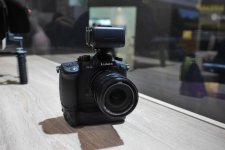
GH4 Panasonic GH5 coming in 2017

The sensors are still from/by Sony but Panasonic claims that it will be tweaked to its own specs.

Others chimed in that Olympus EM1 MKII and GH5 will have basically the same sensor and a lot of other common (LSI) parts. Both will oversample into 4K a la DVX 200 rather than deliver only a center crop. If the above is reasonably accurate - and there have been suggestions that the only major difference between two cameras will be the in-body 10-bit recording by Panasonic - then the image quality can be judged in a few weeks' time when EM1 MKII is released. FOOl's (Friends of Olympus ... I dare not post an acronym for Friends Of Panasonic) already have the camera but are not allowed to post any footage yet.
 
I see, thanks! So first look at the new sensor next month... and it sounds like this is the next generation sensor from Sony, so is that one generation newer than GH4 sensor wise?

And currently no spec leaks to go by regarding this sensor?
 
it sounds like this is the next generation sensor from Sony, so is that one generation newer than GH4 sensor wise?

Panasonic has already produced other cameras ( GX85, G85, etc... ) that shoot 4K and perform better than the GH4 when it comes to low-light, color, contrast, etc...

So my guess is that the GH5 will use a sensor that is several generations newer than the original GH4 sensor.
 
After googling about this for a while, I can't yet seem to find more than anecdotal posts and comparisons. Is there a legit, hard numbers comparison on the GX85 vs GH4 image - in terms of the difference in both lowlight and dynamic range at different ISO?

It's hard to quantify how significant or insignificant the changes are between sensors.

Also as far as I can tell the Sony IMX269 is the latest M43 sensor in use, which has been out for over a year... so newer than the GH4, but only one iteration.
 
I can't yet seem to find more than anecdotal posts and comparisons.

I've been regularly shooting with my GH4 for the past 2 years and have seen a lot of GH4 footage shot by other people. When the GX85 hit the stores I kept an eye out for good 4K footage, and noticed that some of these GX85 shoots were producing a better image than I've seen from anyone's GH4 camera, including my own. I've also read lots of anecdotal comments from people who bought a GX85 that already owned a well used GH4 camera, who pretty much stated exactly this, that the GX85 was producing a better image than the significantly older GH4 camera. ( V-log is not possible with the GX85, so they are talking non LOG profiles )

I haven't seen any technical tests comparing both cameras, but if you dig around you can find some high quality footage shot with the GX85. Here's one I like, but keep in mind it is NSFW. ( the downloadable version is better quality, even if it's not an original file )

I plan on picking up a G85 camera when it finally hits the stores in November, so I will definitely post some comparisons with my 2 year old GH4 beastie.
 
To get an idea of the difference between the GH4 and the G85, you can just look up G7 vs. GH4 comparisons. Supposedly the GX85 and G85 use the G7 sensor, just without its anti-aliasing filter. I've seen a couple different ISO test vids showing the G7 to be a good stop cleaner than the GH4.

Hopefully the GH5 is one stop past that!
 
Was it confirmed at what modes the camera can capture 10-bit 4:2:2? Is that at 4k with 60fps, or just 4k 24fps?

Will it require any upgrade to high speed SD cards commonly used with the GH4?

Regarding the 5-axis in-body optical stabilization... so this will work with all lenses, even FF adapted lenses and full manual lenses such voigtlander m43 lenses? How big of an improvement in other camera implementations has this made practically to handheld and semi-handheld (IE shoulder mount) footage? What about on gimbal?
 
10-bit 4:2:2 capture is only for the following resolutions frame rates: 4K/30p, 25p, 24p, 23.98p
The format for 4k/60p recording is something less than this (probably 8-bit 4:2:0 although this hasn't been specified).

No bitrates for any of the recording modes have been given yet, so it's hard to know if any special SD cards will be required. The SD Card Association did announce a new set of video speed class ratings earlier this year, including V60/V90 (corresponding to 60 MB/s and 90 MB/s minimum write speeds): https://www.sdcard.org/consumers/choices/speed_class/index.html
However, it's not clear that these have been widely adopted by any of the SD card manufacturers yet.

Before the new video speed class ratings, the fastest SD card standard for minimum write speed was UHS Speed Class 3 at 30 MB/s (or 240 Mb/s). Which may in part explain why the GH4's maximum recording bitrate was 200 Mb/s. And the top recording bitrate for the new OM-D E-M1 Mark II is 237 Mb/s, which would also just get it in under the UHS 3 write speed standard.

5-axis in-body image stabilization hasn't even been officially confirmed yet by Panasonic, although it has been widely rumored.

Pretty much all we know definitively so far comes from the Panasonic press release:
http://www.panasonic.com/global/consumer/lumix/gh5/
 
There's a recent YouTube interview with a Panasonic rep at PhotoPlus about several new products (G85, FZ2500, GH5). On GH5, he clams up.

Which is why I didn't post the links.
 
Will it require any upgrade to high speed SD cards commonly used with the GH4?

If Panasonic raises the recording data-rate then I would say yes, which is fine with me, I don't mind buying new higher performance cards if this gives me outstanding 4K 10-bit 4:2:2 footage.

Regarding the 5-axis in-body optical stabilization... so this will work with all lenses, even FF adapted lenses and full manual lenses such voigtlander m43 lenses?

Panasonic and Olympus have created a 5-axis stabilization LSI chip so I expect to see 5-axis stabilization in pretty much any camera costing $800 US and up from either of these companies.

You won't get DUAL-IS from non Panasonic lenses, and even then it will only work for lenses that support DUAL-is like the 12-60mm kit lens or the older 12-35mm f/2.8 Lumix lens. ( my favorite Lumix lens )

For fully manual lenses like old Nikons or the Voightlander M43 lenses I would expect to see 3 - 4 F-stops of stabilization from the camera body, which should make a big improvement for both stills and video.
 
An email to 43Rumours claimed that the New Zealand price for Olympus EM1 MKII will be $2,500 (NZ dollars). The direct conversion is U$1,750. The same store that is alleged to send out the quote has 5D MKIV for $4,600 (NZ dollars, VAT included). I'd say this points toward a U$1,700-$1,800 range for EM1 MKII. If GH5 is priced higher - internal 10-bit and all that - then that might indicate a $2,000 neighborhood for GH5.

Of course, with a 2-4 month release lag, EM1 MKII actual sales performance will have further bearing on GH5 pricing. If A6500 keeps topping the mirrorless charts at $1,400, both Olympus and Panasonic may be reluctant to go that much higher.
 
The Japanese price for Olympus EM1 MKII is (allegedly) ¥245,000 or 62% higher than the original EM1 c. 2013. If the ratio holds for the US release, this would take it above $2,000, with GH5 likely another few hundred dollars higher.
 
Haha, that's a ridiculous price, good luck Oly. Let's hope Panny is more sensible with their pricing and GH5 stays sub 2k.
 
If Panasonic raises the recording data-rate then I would say yes, which is fine with me, I don't mind buying new higher performance cards if this gives me outstanding 4K 10-bit 4:2:2 footage.

Perhaps not. The GH4 already supports cards to handle the 200mbps HD mode. 200mbps is double what we can use with 4k now and even with 4:2:2 and 10bit 200mbps might be enough to cover that. Just because Panasonic is calling it 10bit and 4:2:2 do not assume this means the same thing as ProRes or will have that level of a data rate requirement. I'm almost positive the internal format will not be an intra-frame format so 200mbps may be considered a good compromise from Panasonic to support the widest range of cards and provide solid stability. Even 200mbps 4k will have a huge impact on the visual quality and this is a data rate the GH5 should without a doubt be capable of doing.

Panasonic could could higher of course but my point is they may not need to. Many of us would of course take more but Panasonic tends to target data rates they consider a more realistic balance between quality and record time. They also heavily factor in stability and what impact dropped recordings would have on the overall user perception of the camera. While perhaps not perfect, Panasonic doesn't make sloppy cameras that crash or overheat. The Panasonic cameras are some of the most stable in the world and that perception is likely very important to them. That is why I say don't expect data rates that push the limits of what cards can do. That would affect the joy of using m43 cameras and I don't think Panasonic will compromise on that.
 
So the new Olympus EM-1 Mk2 is shipping at a price of $2,000 US.

While this is not a review of the video features of this new camera, take a look at the 5 and 6 second handheld shots. The Olympus dual IS is extremely impressive...
 
Back
Top