F3: Noise in Slog?

If those F65's ever get down into the fire-sale F35 price range someone will need to physically restrain me from hitting the "Buy It Now" button.

They'll get there, just give it another 2-4 years. I've been sorely, sorely tempted by a couple that have popped up at $40k. That's ridiculous money for that level of peformance.

I'd go for Alexa over F65 @ F35 prices wouldn't you?

+1

I think Sony picked up on this with the F5(5) though. I think any high-end Sony cams we'll see from here on in will have similarly pleasing ergonomics. And whilst I think the Alexa's menu system still has the F55 beat for simplicity, having the menus on the operator-side certainly wins out IMO (I love my ACs, and I couldn't do what I do without them but I'm never going to be fully comfortable with someone else setting up or adjusting my camera for me).
 
...And whilst I think the Alexa's menu system still has the F55 beat for simplicity, having the menus on the operator-side certainly wins out IMO (I love my ACs, and I couldn't do what I do without them but I'm never going to be fully comfortable with someone else setting up or adjusting my camera for me).

Even more off topic from this thread... today I was testing the new 64GB 180MB/s Sony XQD cards (2.6 times cheaper than Sony Pro Plus cards) in the F55 and I could change ISO, shutter speed, and even the preset white balance WHILE the camera was recording?

Am I missing something here, but was that also possible on the F3?


P.S. Grug, I'm the same way. Ain't no one touching my settings but me!
 
My 2pence/cents

I'm coming from the fs700 side but there are similar issues (in terms of shadow noise - slog or otherwise) that bugs me.

I think one of the issues is that the path from sensor to data is never very clear and i think the noise characteristics could be naturally part of the way everything works. If you remember light in the real world is linear, from darkness to brightest there is a huge range of values of which all the detail is skewed to the highlights.

If you had 14 bits example in a *straight* linear world without any trickery that would allow you to hold 14 stops of light. But if you look at the distribution of those stops you have

0-1
1-2
2-4
8-16
16-32
32-64
64-128
128-256
256-512
512-1024
1024-2048
2048-4096
4096-8192
8192-16384

Notice that the darkest 4 stops would be represented by only 16 discreet values, even in 14 bit. This is an extreme illustration if you approach the problem via integer math.

Now the cameras would apply a curve to this to skew the results so the detail is more balanced, hence Log curves etc,.

However this still doesn't get around the fact that if the source AD convertors are at 14 bit then are there could be some issues here? Now ideally the cameras would be representing all this real world linear data in floating point to allow and compensate for this. But because we do see a lot of noise at low level it does make me wonder whether this is simply the nature of how the ADC handles all this. This was always the biggest difference between the F3 and FS100 - the surrounding hardware in the F3 was so much better. And it's the same between the FS700 and the F5.

All cameras that i've seen have similar characteristics to a lesser or greater degree. But even the Linear RAW output from the 700, F5 etc,. has shadow noise. I think the Slog just seems to exacerbate this and perhaps 10 bit slog still isn't enough shadow separation to hold that portion of the scene.

I could be off on a tangent here but i *think* it might be applicable?

cheers
Paul
 
This is also a little beyond me but log straightens that data jump..

Maybe allocating 100 steps per stop.

That is the point of it.

But there is BG noise maybe sitting at the first 200 levels.

So you get (im guessing the numbers)

Stop 1, 0-100+noise
Stop 2 101-200+noise
Stop 3 201-300 clean
Stop 4 301-400 clean
etc

and
Stop 8 needs 256, but only gets 100, so can go wonky
Stop 9 needs 512, but only gets 100 so will go wonky

Simple putting the blacks at 201 you wont get noise. But how many stops do you have above 200.. and also we see that the higher stops should have far more than 100 levels allocated to them, and at some point really 100 is not enough and looks rubbish if an important tone (skin) is in that zone

So we need to find the sweet spot where we are keeping out of the noise floor and also not putting criticals in the flat zone, quite a challenge and clearly far less superior than 14 or 16bit which gives many more levels to play with

Personally I think Slog is right at the pracitcal limit and found Slog2 (even flatter), recorded at 10bit, on the F5 to be extremely challenging - which is fair enough on Sony because it is not designed for recording in 10bit but showing the full DR when using a 16bit (wrapped) raw recording.

S
 
Last edited:
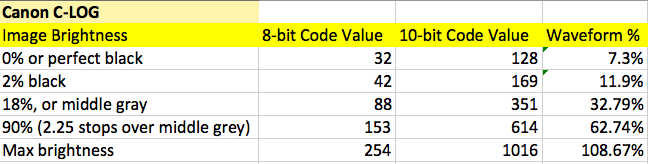
This is not in stops, but this chart I put together shows exactly how much data bits are allocated throughout the range of slog on the F3 which some of you might find interesting.

Incase it is it difficult to interpret, the 8-bit and 10-bit columns show the number of bit values that are allocated to the various signal brightness ranges. So for example looking at 8-bit storage you can see the amount of data allocated between 18% grey and 90% white by subtracting 159 - 99 = 60 data bits or approximately 23% of the overall data bit container. Look at the data bits allocated over 90% white. A dramatic increase. 97 data bits, or 37% of the overall data bit container.

sony_s-log_zps1b1891f9.png


This is the same chart but for Canon log
canon_c-log.png


If you are really looking for rich blacks the only options as I see it are to;

- over-expose your ENTIRE scene (not just your subject) by 1-2 stops and then pull it down in post. This will effectively INCREASE the signal-to-noise ratio further than even the cameras own specification.

- light your shadows and pull only the dark tones in post (this is NOT crushing)

- don't shoot with slog, use a custom picture profile instead that boosts the low and mid-tones (like Cine3) and again in post only reduce the low/mid tones for a cleaner image.
 

Excellent post and excellent film.

After you watch the film, watch the behind the scenes with 25 minute commentary by the DP:

https://vimeo.com/40346970

Fast tracking the BTS video & Highlights:
Lenses used: Superspeeds 1.5 Compact Primes
Monitor used: DP6
Lights used: 2.5k HMI's, 1.6k HMI's, Kino Flo Diva, and a few battery powered LED lights.
Camera Settings: slog. ISO not mentioned.
External Recorder: kipro mini
Generators used throughout the shoot so almost all sound was ADR later for cleaner sound.
Daylight shoots: 4 bank kino's used, 2.5k HMI,
Other hardware: Kessler crane and revolution head, Kessler pocket jib, ipad clapper board, cineroid EVF, Oconnor FF,
Grading: Davinci Resolve

@ 13:48 shooting at night Sebastian says: "too much light looks like television, not enough light too grainy. Difficult part is finding middle way"
 
Lights used: 2.5k HMI's, 1.6k HMI's, Kino Flo Diva, and a few battery powered LED lights.

My Nex5n would look good with that lot.

It is a semi serious point because to me a decent cam is to cut or stretch the lights budget - IMO - particularly keeping it at a level were you dont need a genny and bum yourself with ADR.

He is still getting wooden skin - esp at the opening - probably putting the skin too high - a concern for me as there is less tonality as the curve flattens off.

Sorry Im just not a fan of the kid.

S
 
Last edited:
Lights, camera, action. You need lights for that level of quality, doesn't really matter what camera.

I love the look of this guys piece.
 
I think we need to see the ungraded files to really know how the sensor was reacting to the lighting set up.
Those skin tones are probably more effected by the color grade than anything. They look properly exposed, they're just a bit to pink/magenta for my taste as seen on my display .
 
Im telling you I can smell lack of depth in skin a mile off.

It is very simple that at the top of the log curve (but where?) not enough steps are allocated to get a good tonality to important parts of the image.

To me there is no reason why an F3, with HMI/Modifiers package should not look basically like a proper movie - IMO this does not.

S
 
It is a semi serious point because to me a decent cam is to cut or stretch the lights budget - IMO - particularly keeping it at a level were you dont need a genny and bum yourself with ADR.

S

Can't agree with you on that. A decent cam is not to compensate for a lack of good lighting.
On the contrary a camera like the F35 is still a great cam, but definitely needs lighting for instance. Film needs lighting too. A heck of a lot more than that shoot.Further, it's not just about exposure and working in low light. It's also about the quality of the light.
Lighting is an art unto itself and I definitely think that a chief electrician and a DP have their work cut out for them these days, because for the most part video cams make video. Highlights are the issue.
 
Last edited:
Can't agree with you on that. A decent cam is not to compensate for a lack of good lighting.
On the contrary a camera like the F35 is still a great cam, but definitely needs lighting for instance. Film needs lighting too. A heck of a lot more than that shoot.Further, it's not just about exposure and working in low light. It's also about the quality of the light.
Lighting is an art unto itself and I definitely think that a chief electrician and a DP have their work cut out for them these days, because for the most part video cams make video. Highlights are the issue.

1990s man. I shot for years on a very good camera 25ISO - good but needed lighting. Lights do three things, boost the level, control DR, create art. My desire is only to need to do the third. With enough of the first two most cameras look good, including the NEX5n. To me a huge step point in cameras is the avoidance of gennys and the costs implied lugging them around.

I really dont see why people buy 'good' (read High ISO/Wide DR) cameras and continue to light using 1990s methods and crew costings. It just doesn't commercially stack up (like the F35 mainly doesn't or my 25ISO hasselblad MFDB). Especially when one is commiting to a larger data load and implied post costs.

S
 
Last edited:
I really dont see why people buy 'good' (read High ISO/Wide DR) cameras and continue to light using 1990s methods and crew costings. It just doesn't commercially stack up (like the F35 mainly doesn't or my 25ISO hasselblad MFDB). Especially when one is commiting to a larger data load and implied post costs.

S

3 words for you.

Quality of light.

It's the difference between mediocrity and having something special to say as a DP.
Try telling Christopher Doyle that he is so 1990's and that he just shoot a with a really "good" camera.
It's all about the light, man. All about the light.
 
Last edited:
Back
Top