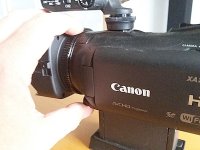
My Canon XF400 review: Not good for my needs...

Jaime Valles

Veteran
Well, today I tested a Canon XF400 that I rented over the weekend, because on paper it looked like the perfect camera for my needs.

Except it's not. For me, at least.

Some background: I shoot a lot of multi-camera theatrical events (concerts, musicals, cabarets, readings, etc.) sometimes in low light, always operating the camera as a one-man-band, dealing with visuals and audio simultaneously. When Canon announced a 4K all-in-one, 1" sensor camcorder with built-in servo zoom lens, XLR inputs, ND filters, 5-axis stabilization, dual SD card recording and Canon's Dual Pixel Auto Focus with face tracking for only $3000 it seemed like everything I wanted in a tool I'd use constantly for paying gigs. So I went to LensRental.com and ordered one to use during a jazz concert at a nightclub in New York City alongside my two C100 cameras. I also have a 1DX Mark II, which I love for the face tracking autofocus (among many other things) but the DSLR form factor always leaves me wishing it had better video ergonomics. Hence, my interest in the XF400.

I wanted to see how the footage compared between my trusty C100 and the XF400 in a nightclub atmosphere, and how well the DPAF face tracking worked when recording an event on a stage.

It did not go well.

I'm not talking about the image quality here, mind you. I haven't even looked at the footage on my computer yet. But I can already tell you it won't look good, because focusing the thing was tricky at best. The face tracking was all over the place, sometimes locking onto the performers, sometimes not at all. When it didn't lock on, it would just go into a crazy focus hunting mode for several seconds at a time, making the footage unusable at those points.

If I just tried to do object tracking using the touchscreen, that was also a compromised experience. On my 1DX II all I have to do is touch the screen wherever I want to focus and the camera will lock onto that spot instantly; no crazy hunting for focus. If I want to change what I'm focusing on, I just touch the screen on whatever new thing I want in focus and that's that. Simple. Perfect. But on the XF400, I have to first touch the "focus tracking" button on screen, then touch whatever I want to focus on. If I then want to change the focus to something else, I first have to cancel the tracking of the object I'm currently following, then press the "focus tracking" button again, and then the new object to track. Why would Canon complicate things so much, when they had it working perfectly on the 1DX II?! It's ridiculous.

The entire point of me getting this camera was to improve upon the DPAF of my C100, which requires the desired subject to be dead-center in order to use the One-Touch AF. But the C100 is vastly easier to focus than the XF400. I center the subject, press the One-Touch AF button, and bingo. The C100 doesn't have face tracking, but at least I'm not sweating bullets wondering if the focus is going to simply go haywire a few minutes after I've set it to track a person that's just sitting there playing a piano. It's not like I was trying to follow a football player moving around erratically. This was a person sitting still. And it was hard to keep in focus.

I know, I know, I can always use manual focusing. But that's not what I wanted this camera for. I wanted to remove the focusing worry from the equation, and be able to concentrate on framing the shot and getting the right exposure (which is tricky when recording live events with lights changing constantly). If I can touch the screen and know that the little box around the subject's face is going to stay there, then it's one less thing to worry about. That's how the 1DX II works, but that's simply not the case with the XF400. And it's not like I was working in low light. It was a nightclub, yes, and the audience was dark, but the performers were under bright stage lights. I was shooting on the C100s at f/4 and ISO 850 and had good exposure, so it was plenty bright. Yet the XF400 couldn't handle AF in those conditions. I can't even imagine trying to use it in a dimly-lit wedding reception, for instance.

But here's the real kicker: Even if I could get the auto focus to work exactly as I hoped... Even if Canon issues a firmware upgrade that makes the touchscreen work like the 1DX II... I still cannot purchase this camera. Why? BECAUSE TO CHANGE THE BATTERY I HAVE TO REMOVE THE CAMERA FROM THE TRIPOD AND EVEN REMOVE THE TRIPOD PLATE! The button to eject the battery is below the battery compartment. I had a standard length Manfrotto tripod plate (not the extra long kind) and it's impossible to change the battery with the plate attached. What is supposed to be a 10 second process becomes a 2 minute ordeal that requires a screwdriver! The other day I was shooting a 9-hour conference, and swapping batteries quickly mid-shoot is critical.

Other complaints:
  • The batteries are tiny. They last 2 hours at best. My C100 lasts 4 hours on one battery.
  • The camera doesn't display ISO, only GAIN. Why?!
  • The lens is not parfocal. I can't zoom in, focus, then zoom out and expect the image to still be in focus.

About the only good things I can say about it are that the zoom rocker is awesome (super smooth, slow zoom action) and the lens hood has a built-in retractable lens cap.

Maybe this camera works for you. I've seen some really nice footage online taken with the XF400. But for my purposes, it's a bust. The battery removal issue alone is a deal-breaker.

I really wanted to like this camera. I was 95% sure I was going to buy two of them before the end of the year. But right now I'm just happy I rented one for the weekend to try it out. Tomorrow I have another gig for which I was planning on taking the XF400. Instead, I've already sealed the camera in the return packaging. What a disappointment.
 
Sorry to hear the camera did not fit your needs. This is the sad trend of late where the camera makers are leaning towards the 'sumer end of the prosumer spectrum. Too many non-pro cameras have been released in the 1" chip segment imho. I can not understand why other than they are waiting for the tech to allow them to make truly pro versions of their cameras. 1" is the perfect event camera sensor size. It leans towards deep DOF but not too much. My hope is that NAB has a P2 version of its 1" chip cameras. Maybe Canon and Sony will do the same. It is like they have given up on the professionals in this space and are shooting for the advanced amateurs.

I say it all time on internet forums. I want the gear to cost more and be a little pricy. That's when the pro features show up. Camera makers have always priced on end image quality for the market of the day. They (especially Canon) never give things away for free. So give us some $5,000 1" chip cameras! Maybe a better DVX200 while your are at it. I am sure they will read this post and get right on it... :)
 
Nice review and convinced me too that it would not work for me. I had similar views on replacing my trusty NX5U for a 1" UHD 60P camera and too was hoping the XF400 may be the one. I had spotted the battery issue ( same as all my little Sony's ). Only one that is close at the moment is the Panasonic UX180 / HC-X1.
 
Thanks for your post and review Jaime. That is disappointing. I am in the midst of shooting two documentaries where we were thinking the XF400 was going to be a good B camera solution for being unobtrusive in situations where we normally wouldn't be shooting, but need to shoot, and for shooting small and low key out of racing boats where my C200, fully rigged, is just too large. The battery changing would be a nightmare for us too in many situations shooting from tripods and gimbals. And the DPAF sounds very disappointing. That's too bad, it seems Canon came 90% of the way and just blew it on the last 10% as far as operation. I may still rent one to try on some of our outdoor shoots, I am curious if the focus would have as hard a time in bright exteriors?
 
The DPAF might work brilliantly in broad daylight. I only used it indoors. But I highly recommend renting it first to see if it works for you.

And I fully admit that I haven't spent much time working with the camera to "get the hang of it" and learn to work around the issues. But I spent a lot of time before the event studying the instruction manual section about how the autofocus works, and a few hours testing all the different AF settings at home. It just doesn't do what I want it to do.
 
You're never going to get any better than the 1DX Mark II or 5D Mark IV for AF...and that includes the cinema cameras.

The only ones that will be (or should be) better will be their replacements IMO.
 
That is a disappointing. DPAF is such an awesome feature, not sure why they bothered implementing it in such an inefficient manner. It sounds like it might be something they can fix with a firmware update. But even if they fix how to use DPAF on this camera it sounds like the XF400 doesn't focus very well. You would think that because it uses a smaller 1" sensor it would have an easier time focusing....guess not. Kind of sucks because the DPAF was, to me, a key selling feature for this camera.

I own an XA30 which is a similar form factor to the XF400. I completely understand the base plate/battery problem but in my experience with the XA30 you can position the Manfrotto base plate just far enough ahead that you can get the battery out. Maybe they changed it with the XF400, in which case that is a really poor design decision.

The XF400 also uses the same battery as the XA30 - do you know which battery shipped with the rental ? Reason I ask is because the battery that shipped with the XA30 was small. I ordered some knock off BP-828 knock off battery that were considerably larger and lasted a lot longer than the battery that shipped with the camera. I was concerned about XF400 using the same battery as the XA30 because I figured it would have higher power consumption than the XA30.

Thanks for the review
 
TI completely understand the base plate/battery problem but in my experience with the XA30 you can position the Manfrotto base plate just far enough ahead that you can get the battery out. Maybe they changed it with the XF400, in which case that is a really poor design decision.

Hello,

i have 2x XA25 and 1x HF G30 (VIXIA)

I have made an Metall Bracket to "Lift up" the Cameras to can change the Battery without remove from the Tripod.
The Camera Plate is the Standard Manfrotto

See my picture

XA25.jpg
 
Thanks for the review. How did the camera perform in a lower light venue? I'm considering renting one for a gig shoot as the back of room locked off safety angle. The other two cameras will be roving C200's. Do you think sensor-wise it's up to task? Running AC power and manual focus so the battery and DPAF issues won't be a problem.
 
Well to answer my own question, that's a resounding no. In my opinion the XF405 sensor isn't up to scratch for a low light shoot like a concert.

It's a surprisingly fun little camera for good light doco work. It's never going to rival the IQ or ergonomics of a `C`class camera but on a budget it doesn't do too badly.

However get the gain up past the mid teens - around 21db in my case out of necessity - and it all goes muddy and noisy fast. So yes, it scraped through but no, I won't be hiring one again for a night interior shoot.
 
Well to answer my own question, that's a resounding no. In my opinion the XF405 sensor isn't up to scratch for a low light shoot like a concert.

It's a surprisingly fun little camera for good light doco work. It's never going to rival the IQ or ergonomics of a `C`class camera but on a budget it doesn't do too badly.

However get the gain up past the mid teens - around 21db in my case out of necessity - and it all goes muddy and noisy fast. So yes, it scraped through but no, I won't be hiring one again for a night interior shoot.

There just to be such an elegant solutions to expose the scene correctly, here is an excerpt from my Yashica manual:


"...a lamp symbol will appear in the Exposure Window and recommend the use of movie-light. "
 
To update, we tried shooting one of our races last week utilizing three XF-405s. I played around with the camera a few days before and I have to say that overall, my experience with it is very good, although the camera is definitely not without it's quirks.

1. In bright daylight outdoors, all of the focusing issues went away, DPAF worked well and out of the all of the footage we shot on three of them, only a few shots had focusing issues, about the same ratio as our C200 A camera.
2. If you put the camera into WDR, the camera automatically adds 9db of gain. Took me a while to figure out why this was happening, the manual, as most prosumer cameras have, is not very clear about a lot of things. If you go to standard color profile, 0db gain is possible, WDR, 9db, anything below is grayed out. Lame but not a big deal as the images when shot outdoor are obviously plenty lit and saturated.
3. The whole battery release on the bottom was a none issue as we were shooting handheld mostly and only had one unit on a Sachtler tripod with the older small tripod plate. But yes, if you are using a tripod with a longer tripod plate, I could see how this would be a PITA to deal with.
4. We have plenty of batteries, 828s and knock offs, we were only getting about 90 minutes from each but that wasn't a big deal for our shoot.
5. It's very nice to have a small and light weight camera that shoots 4K 60p at 150 Mbps. There were several times when we were hanging over the rail on the front of a bouncing, bucking 18' Boston Whaler in 15' high swells. If we would have had our C200 or the rented C300 MKII we had in that position, it would have been much more difficult to shoot there. For some situations, small, fixed lens servo is just better than S35 digital cinema camera with a non-servo lens.
6. I liked how face recognition is just on while the DPAF area tracking is also on. As you know, on the C series cameras, it's kind of either or.
7. We just used the large area and the touchscreen for the DPAF and generally had pretty good amounts of keepers. I think the hunting and weirdness others have experienced is simple lack of illumination. DPAF is not good in super low light or underexposure.
8. Sound and image look good, I tried some preliminary grading and the footage is pretty hard to tell from C200 .Mp4, it's basically the same, perhaps with a little more softness compared to a sharp lens like the 70-200 2.8 IS II but very usable for our needs.
9. The lack of a Waveform was the biggest complaint I received from our operators. The little exposure guide gets you in the ballpark as long as you understand how to read it and take it with a grain of salt.
10. We used Hoodman H400s on the screens with a boost on the luminance and brightness and it worked fine. The EVF is a little tiny but semi-usable.

Overall, for specific situations, like ours where we need multiple cameras in multiple locations, running and gunning, trying to be unobtrusive with the smaller size and profile and you want the cameras to match up with the C series cameras, the XF-400/405 is a good choice. Not perfect, but for us, the right tool for these race shoots as support for our C200 and C300 MKII. If Canon put a slightly larger battery that lasted longer and was top or side load rather than from the bottom, waveform, better lower light performance with DPAF, and perhaps added C Log, I would buy one. As it is, we will be using them for the remainder of our racing season. The audio setup is very familiar, the handle, weight and size are really great when you want to appear more like an amateur or tourist, which can be very helpful in many documentary situations.
 
To update, we tried shooting one of our races last week utilizing three XF-405s. I played around with the camera a few days before and I have to say that overall, my experience with it is very good, although the camera is definitely not without it's quirks.

1. In bright daylight outdoors, all of the focusing issues went away, DPAF worked well and out of the all of the footage we shot on three of them, only a few shots had focusing issues, about the same ratio as our C200 A camera.
2. If you put the camera into WDR, the camera automatically adds 9db of gain. Took me a while to figure out why this was happening, the manual, as most prosumer cameras have, is not very clear about a lot of things. If you go to standard color profile, 0db gain is possible, WDR, 9db, anything below is grayed out. Lame but not a big deal as the images when shot outdoor are obviously plenty lit and saturated.
3. The whole battery release on the bottom was a none issue as we were shooting handheld mostly and only had one unit on a Sachtler tripod with the older small tripod plate. But yes, if you are using a tripod with a longer tripod plate, I could see how this would be a PITA to deal with.
4. We have plenty of batteries, 828s and knock offs, we were only getting about 90 minutes from each but that wasn't a big deal for our shoot.
5. It's very nice to have a small and light weight camera that shoots 4K 60p at 150 Mbps. There were several times when we were hanging over the rail on the front of a bouncing, bucking 18' Boston Whaler in 15' high swells. If we would have had our C200 or the rented C300 MKII we had in that position, it would have been much more difficult to shoot there. For some situations, small, fixed lens servo is just better than S35 digital cinema camera with a non-servo lens.
6. I liked how face recognition is just on while the DPAF area tracking is also on. As you know, on the C series cameras, it's kind of either or.
7. We just used the large area and the touchscreen for the DPAF and generally had pretty good amounts of keepers. I think the hunting and weirdness others have experienced is simple lack of illumination. DPAF is not good in super low light or underexposure.
8. Sound and image look good, I tried some preliminary grading and the footage is pretty hard to tell from C200 .Mp4, it's basically the same, perhaps with a little more softness compared to a sharp lens like the 70-200 2.8 IS II but very usable for our needs.
9. The lack of a Waveform was the biggest complaint I received from our operators. The little exposure guide gets you in the ballpark as long as you understand how to read it and take it with a grain of salt.
10. We used Hoodman H400s on the screens with a boost on the luminance and brightness and it worked fine. The EVF is a little tiny but semi-usable.

Overall, for specific situations, like ours where we need multiple cameras in multiple locations, running and gunning, trying to be unobtrusive with the smaller size and profile and you want the cameras to match up with the C series cameras, the XF-400/405 is a good choice. Not perfect, but for us, the right tool for these race shoots as support for our C200 and C300 MKII. If Canon put a slightly larger battery that lasted longer and was top or side load rather than from the bottom, waveform, better lower light performance with DPAF, and perhaps added C Log, I would buy one. As it is, we will be using them for the remainder of our racing season. The audio setup is very familiar, the handle, weight and size are really great when you want to appear more like an amateur or tourist, which can be very helpful in many documentary situations.

Let this be a lesson to you all: RENT BEFORE YOU BUY. It's the only way to know if a particular camera is the right tool for the job. In Puredrifting's case (outdoor daylight action video) the XF400/405 worked great. In my case (indoor nightclub moody atmosphere concert) the XF400 was a complete bust.

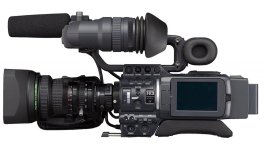
Glad to hear it worked out well for you, PD. I think I'm still on the lookout for my ideal event video camera. Honestly, I'd love it if Canon made something like this:

81WG6Lcm4VS._SL1500_.jpg

  1. Comfortable, lightweight shoulder mount design with no need for additional rigs or cages
  2. 1/2" 4K Dual Pixel Autofocus sensor
  3. DPAF face and object tracking like the 1DX II
  4. MP4 internal recording at 150 Mbps to dual SD card slots
  5. 4k 60p, 1080 at 120p
  6. 4K RAW output via HDMI or SDI for external RAW recording
  7. Parfocal servo zoom with manual focus and aperture rings (constant f/2.8 aperture throughout zoom range)
  8. High-res viewfinder built in for shoulder mounted shooting
  9. Flip-out LCD for tripod work (full touchscreen autofocus tracking)
  10. Clean images up to 6400 ISO
  11. XLR inputs on top handle (with audio controls that are easy to access)
  12. Canon LOG available


I would pay good money for a camera like that.
 
What this project has shown me thus far is that it's not wise to buy a camera and get locked into it and try to make it work under every set of circumstances. We've been using the C300 MKII and my C200 for on shore b-roll and lots of stand up interviews, both are perfect for that. Ideally, we wanted to rent the Perfect Horizon System for the boats and have my C200 with the 100-400 F4.5-5.6 IS II. But for budget and other reasons, that just didn't work out. So the XF-405s handheld, when our chase boat can get in fairly close 15-25' away, has given us enough keepers to tell the story. It's not ideal and at first I balked at my co-producers idea to shoot on the water with $3k cameras in .MP4 versus C200 Cinema RAW Light that we are shooting on everything else, but in the end, the small, light and inexpensive XF-405s have turned out to be the perfect tool for the job at hand. I am even shooting some b-roll on shore with my iPhone 8 Plus and the Crane M and it's giving us some wonderful footage and the small size and footprint allow us to look more like tourists and less like a professional film crew. That allows us to capture shots that just wouldn't be possible with a big pro looking camera. For documentaries, GETTING the shot is much more important than getting the shot that looks good. That's been my lesson so far on this film.

The other documentary we are shooting is a completely different story, shooting almost all interiors, much more controlled circumstances. The C200, shooting RAW, with the 17-55 2.8 has been perfect for that project. Although I bought the C200, largely to shoot these two films, I would consider renting other cameras for other projects because no camera is the perfect tool for all projects. Could be a Go Pro, could be an Alexa, just depends on what you are doing.
 
Well, there's a flip side to that. I appreciate the sharing of thoughts, but it's also a bit curious to read reviews based on mere hours, not weeks or months. Yes, this camera has its quirks (not the least of which seems to be the inability to control the focus point with the joystick!!! -- which the OP didn't even mention). I've been using the XF400 on assignment for 6 weeks now, and I'm not even close to writing up a useful review for my fellow shooters.

OP: "I haven't even looked at the footage on my computer yet. But I can already tell you it won't look good." Really??? Because the face/object tracking AF on a 1" sensor wasn't performing alongside a cine cam? It just seems to me that this person's assessment is premature, to say the least. All the OP had to say was, I tried it for a few hours in low light and the DPAF performance was disappointing compared to my super-35 chip C100's.

The statement about the battery plate is curious. I have ZERO issue removing the battery with the LONG manfrotto plate. If the OP put his plate on positioned over the battery release, well, maybe he should just move it forward. Works for me.

Anyway, I'm hoping to post an extensive review here some point. I'd just caution anyone looking to buy this cam (or anything) look close and hard at who's doing the review. I'm sure Jaime is a smart guy with lots of good observations, so no offense!!

BTW, the image quality out of this little guy is absolutely phenomenal. It cuts beautifully with my C200. The DPAF does get wonky in low light, but it actually does GREAT with sports. The footage grades nicely.
 
I appreciate the sharing of thoughts, but it's also a bit curious to read reviews based on mere hours, not weeks or months. Yes, this camera has its quirks (not the least of which seems to be the inability to control the focus point with the joystick!!! -- which the OP didn't even mention). I've been using the XF400 on assignment for 6 weeks now, and I'm not even close to writing up a useful review for my fellow shooters.

Great in good light seems to be the consensus. I'm okay with writing it off after a few hours use as it just wasn't up to the task of covering a low light event. Unsurprisingly, in retrospect.
 
Let this be a lesson to you all: RENT BEFORE YOU BUY. It's the only way to know if a particular camera is the right tool for the job. In Puredrifting's case (outdoor daylight action video) the XF400/405 worked great. In my case (indoor nightclub moody atmosphere concert) the XF400 was a complete bust.

Glad to hear it worked out well for you, PD. I think I'm still on the lookout for my ideal event video camera. Honestly, I'd love it if Canon made something like this:

View attachment 130975

  1. Comfortable, lightweight shoulder mount design with no need for additional rigs or cages
  2. 1/2" 4K Dual Pixel Autofocus sensor
  3. DPAF face and object tracking like the 1DX II
  4. MP4 internal recording at 150 Mbps to dual SD card slots
  5. 4k 60p, 1080 at 120p
  6. 4K RAW output via HDMI or SDI for external RAW recording
  7. Parfocal servo zoom with manual focus and aperture rings (constant f/2.8 aperture throughout zoom range)
  8. High-res viewfinder built in for shoulder mounted shooting
  9. Flip-out LCD for tripod work (full touchscreen autofocus tracking)
  10. Clean images up to 6400 ISO
  11. XLR inputs on top handle (with audio controls that are easy to access)
  12. Canon LOG available


I would pay good money for a camera like that.

I used to own one of those cameras. It is a JVC GY-HD250U http://pro.jvc.com/prof/attributes/tech_desc.jsp?model_id=MDL101625&feature_id=02 . It served me well for about 5 years. When I was at NAB NY last week, I told a JVC sales rep I would love for JVC to take the 1" sensor and processor in their new GY-HC500 series cameras http://pro.jvc.com/prof/attributes/features.jsp?model_id=MDL102557 and put in a body like the HD250U. Would not need a Frankenrig like I used to have for my C100.
 
Back
Top