Camera industry in the 21st-digital-century... vs smartphone market's advent

Yes, no doubt they will be! I was just saying that our camera prices don't drop that fast in Aus. That camera started at that price and hasn't changed. It hasn't dropped $1000 in 6 months.

Look here, same websight

B&H
http://www.bhphotovideo.com/c/product/1028548-REG/panasonic_lumix_dmc_gh4_mirrorless_micro.html

Globalmediapro
http://www.globalmediapro.com/dp/A2K8T1/Panasonic-AG-GH4U-Digital-Camera-with-Interface-Unit/

Or am i misinterpreting what DLD is saying with the price change?

oh my .... look at that. I'm pretty sure that's the "old" retailers' mentality , I don't think that the distributors keep the prices that high. I believe that's the retailer's mentality. can you guys get the stuff from NYC? on top of that price B&H gives a 4% cash reward as well. In any case I'm sorry that you guys have to deal with prices like that!
 
Cartels are legal in Japan and, in the 1970's, the Japanese TV manufacturers were sued for the "product/price dumping" by the US TV manufacturers. The case lasted into the mid-1980's and was eventually won by the Japanese, who were represented in the US by Jeffrey Kessler (now working on Tom Brady's behalf in the Deflagate scandal). All the major makers of that era were accused of selling their wares for too low a price in order to drive the US manufacturers out of business. Once the verdict was rendered, the US manufacturers (Zenith, RCA, Sylvania, Quasar, Magmavox, Curtis Mathis, GE) pretty much folded..

interesting, thanks for the info. very interesting.
my point was more about "controlled" video quality for pro-sumer models as opposed to broadcast (where the real money is). For years we had ridiculously low quality pro-sumer cameras at interstellar prices (think EX3, the panasonic... all crushed by the sudden D90 and now the cell phones). Still it took them years to adapt. My question is (plain and simple) : was it intentional? keeping the pro-sumer segment that low in quality? I think it was. The technology was clearly there and yet if it wasn't for the D90 we'd all still shoot with XL1-like kind of horrendous video quality.
And let's be clear about the BS of the lenses, the sensor size, the rolling shutter of the CMOS (it's the slow read-out of the sensor, and I bet that they keep it slow in purpose as well) . again let's all take a good look at the lens of the 4K galaxy phone or even the HD iphone, what's the size of the sensors in there?
 
Last edited:
A silly side story - I was taking a late swim tonight and ran into a neighbor around the pool area. She has a new Galaxy6 and began to show me photos of the various botanical gardens that she took with it. Well, I don't know if it's the photo camera inside the smartphone or an AMOLED screen shining brightly at night but those images were just gorgeous. I told her that stuff was so pretty she should buy a pro camera. She shrugged. It made no sense to her whatsoever. The smart phone was the be-all/end-all for her.
 
A silly side story - I was taking a late swim tonight and ran into a neighbor around the pool area. She has a new Galaxy6 and began to show me photos of the various botanical gardens that she took with it. Well, I don't know if it's the photo camera inside the smartphone or an AMOLED screen shining brightly at night but those images were just gorgeous. I told her that stuff was so pretty she should buy a pro camera. She shrugged. It made no sense to her whatsoever. The smart phone was the be-all/end-all for her.

I think the screen on the phone may have played a large roll. I see good looking images on my iPhone regularly... Until I DL them onto my laptop and look at them on the 15" retina screen.

And I wish most of the stuff I shot looked as good when it airs as it does when I'm shooting it and viewing it on my smallHD OLED.
 
I think the screen on the phone may have played a large roll. I see good looking images on my iPhone regularly... Until I DL them onto my laptop and look at them on the 15" retina screen...
It's apparently a 2.5K res screen (2560x1440) and the colors were just stunning. So, after I came back home, I went online to look for some OLED or AMOLED computer monitors and basically found zilch.

On the smartphone topic again - some Apple geared rumor sites are reporting that the new iPhone will have a new Sony sensor that has a RGBW (12 M) pixel layout. That White pixel will purportedly result in a much better low light performance, which has historically been a problem for the smartphones.

Generally speaking, I suspect that, much like what's been happening in a video camera market over the last decade and a half, soon the sensor sizes and the pixel counts of those sensors will begin to creep up in smartphones as well. Once someone figures out how to do a small zoom out of a small package, he will have struck gold.
 
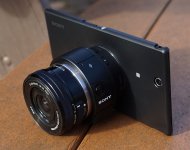
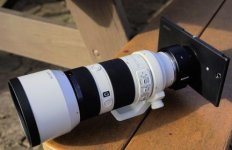
Since I had many E/FE mount lenses for my VG900 and A7r I purchased the Sony QX1 APS-C smartphone camera that works great with my 6.44" Sony Xperia Z Ultra smartphone with case that has a mount built-in for it. My Z Ultra has no flash and the QX1 does so it works great with the small 16-50mm zoom for indoor flash shots.
15947075285_4f58229370_c.jpg

It looks funny with a large lens and my VG900 or A7r works better with them.
Screen Shot 2015-05-29 at 8.28.58 AM.jpg
 
A silly side story - I was taking a late swim tonight and ran into a neighbor around the pool area. She has a new Galaxy6 and began to show me photos of the various botanical gardens that she took with it. Well, I don't know if it's the photo camera inside the smartphone or an AMOLED screen shining brightly at night but those images were just gorgeous. I told her that stuff was so pretty she should buy a pro camera. She shrugged. It made no sense to her whatsoever. The smart phone was the be-all/end-all for her.

yes , on my youtube channel there are soccer games that I did many years ago, with a canon XL1: to cut the story short on a cell phone the XL1 looks as good as my current 4K camera. And the use of youtube is dramatically going into the cell phone direction (in terms of views). So that's our reality and our future reality. If the destination of our work leaves the TV sets and goes to the cell phones then the camera doesn't really count anymore. What counts (and will count) is the type of camera that we should use, and shoulder cameras will be back in our bags for events and weddings for the stability and less fatigue. I have one already. Part of the success of cell phones is because they can't zoom, and that alone makes a difference (huge) compared to the everyday footage of the handycams zooming in and out like crazy. The selfie stick and other gyro gadgets will compete against the beauty of a shoulder camera. So we can compete again. LOL
I am alone here in this but I don't see a future for DSLR in the video biz , again (and for the last time -I Promise!-) it will be either a cell phone or a shoulder camera.
 
I am alone here in this but I don't see a future for DSLR in the video biz , again (and for the last time -I Promise!-) it will be either a cell phone or a shoulder camera.

Er, no. If it's cell phone or shoulder cam, then you have to explain why a shoulder cam is better than a DSLR in absolutely every way... which yes, there are things the shoulder cam is better for, but things that the DSLR is better than the shoulder cam for too, including size and convenience. And since the cell cannot do everything the DSLR can do, both can coexist. Basically, if a shoulder cam is assured survival, then so is the DSLR, as it can do things which neither a shoulder cam (due to size), nor a cell phone (technical capabilities) can.
 
Since I had many E/FE mount lenses for my VG900 and A7r I purchased the Sony QX1 APS-C smartphone camera that works great with my 6.44" Sony Xperia Z Ultra smartphone with case that has a mount built-in for it. My Z Ultra has no flash and the QX1 does so it works great with the small 16-50mm zoom for indoor flash shots.
The problem is that Average Joe (not you, Joe) or Elena (that was the gal's name) wants it simple and won't get anything beyond that. And s/he will carry only one piece with her.

My hunch is that you'll see more of Oppo style rotating cameras that are placed on the top of the phone and thus can protrude further and yet be a part of the main body. The next step is a mini-zoom derivation of the above, sort of like this.

http://www.lightinthebox.com/subini-dvr-q2_p1708987.html

The other option may be a revolver style attachment ... or something no one has thought of yet.

... Part of the success of cell phones is because they can't zoom, and that alone makes a difference (huge) compared to the everyday footage of the handycams zooming in and out like crazy...
They can't zoom in yet (optically, that is). But give them time and they will.
 
Videocameras should shake out into four bodies, one consumer and three pros:

  1. Cell phone. Consumers will not buy any more cameras, unless they're into photography.
  2. DSLR. Hobbyists, pros undercover or travelling light, students, people on tight budgets. If NDs and XLRs somehow, this is all I want.
  3. Handicam. Pros who shoot weddings and other events and want to keep their subjects looking natural. My second choice, if done well --- which it hasn't yet.
  4. Shoulder. Pros with a large lens, lots of audio gear strapped on (shotgun, handheld, wireless), or who don't care about sticking out in a crowd.

All the weird ones, like the Blackmagic 4K, Sony FS700, F3, etc., should go the way of the Dodo Bird. The problem with those is that they wanted to be either DSLRs or Handicams but are too big and heavy for that class. The DSLR and Handicam categories have very tight tolerances, and if you can't make it, you should just turn it into the next level. For example, the Blackmagic 4K is trying to be a DSLR. But that class shouldn't be more than a pound or two and no bigger than a GH4 or something. Can't swing it? Turn it into a handicam. Likewise, the FS700 is trying to be a handicam but that class falls apart above five pounds (including battery, lens, screen, etc.). Should have just made it a shoulder cam. This is why I doubt the Ursa Mini will be used as a handicam too, though it's ever so close. With battery and lens it will tip the scale, and people will either use it on the shoulder or develop Carpal Tunnel Syndrome.
 
Last edited:
My crystal ball has been recharged and so I'll chime in --

I mostly agree but ... there might/could be a modular setup, that turns a cell phone into a DSLR (we see it with Joe's photos) and a DSLR into a handheld a la GH4/A7s + Q7/Shogun but in a more of a piggyback/ergonomic design.

And the large shoulder cam will be for a rare occasion, as the quality of the handhelds will be sufficient for pretty much any use. For example, the high end from 2012-14, C500 weighs in at 1,820 grams (4 lbs) while C300 was 1,430 grams already, which is roughly a handheld weight of something like JVC GY-HM200 (1,550 grams, lens and battery included).

In terms of sensors, there's a bit of a riptide going. On the one hand, there is a move toward larger sensors (s35, FF, MF) on the pro end. On the other, there are technologies that make small sensors a lot better, such the previously mentioned "White Pixel" Sony design for the new iPhone and the pixel-shifting idea that Sony is making for Olympus EM 5 MK II in the MFT and for Hasselblatt in MF. Add the BSI, currently on NX1, and then combine all three of these advancements, toss in a bunch of new processors and you get something like an APS-C size sensor with 8K video, 15+ stops of dynamic range, 120-150 MPX still capability equivalence, et cetera. Then add a small'ish standard zoom a la Canon 17-55 mm F/2.8, a Pentax 60-250 F/4 and you're all set.

you keep mentioning the HM200: it's a good camera, one of the best WB control that I can remember. sharp (scary sharp) in 4K. Good in low light (again in 4K @1.2). no questions. It's a keeper.

B U T

it needs a rig. Period. and with THAT all the fun goes away instantly. Trust me.. I know (I have it).

DLD (dunno your name) look : it depends on the work we do. For example the best modern camera for sport was (hands down) the SONY AX100 in HD on a tripod , in both daylight and night on artificial . Compact files, easy to digest, easy to file without any post-processing. Fast WB control (but the HM200 does it a little better) , fast enough read-out for panning (in HD, only). A pleasure to shoot with (on a tripod).

But the best run&gun and events is (in my opinion) the JVC HM70. Nearly identical in HD to the HM200 , a little "rough" on the audio part but manageable and simply a joy to shoot. I do some broadcast with it as well: it's a shoulder camera, you get access and you don't see many cell phones in front of your lens blocking your shot (that's a fact, not an opinion). And who says that's not important then never shot an event and talks just because...

The DSLR and mirrorless are for movie sets (with actors, script, focus pullers, directors, assistants, budget and production people): at that point you rent the Arri's instead.

the cell phones are great, and embarrassing for many of us. And that's a fact (again).

to others pointing out the beauty of a dslr compared to a shoulder mount I can only say that a shoulder mount can do both shoulder and handheld, no problem.... so? The only difference is about the absurd frankenrigs and the bokeh but that "mania" is fading out (finally!) because is distracting, unreal (real life doesn't have bokeh) and boring to watch. It was a nice "toy" to play with but now it's over: no more bokeh (and that's for all to see, no bokeh anywhere, from real movies to rock bands and DJ promos shot for free).

no no: I have to insist: it will be cell phones or shoulder cameras (and arri for movies).
 
Videocameras should shake out into four bodies, one consumer and three pros:

  1. Cell phone. Consumers will not buy any more cameras, unless they're into photography.
  2. DSLR. Hobbyists, pros undercover or travelling light, students, people on tight budgets. If NDs and XLRs somehow, this is all I want.
  3. Handicam. Pros who shoot weddings and other events and want to keep their subjects looking natural. My second choice, if done well --- which it hasn't yet.
  4. Shoulder. Pros with a large lens, lots of audio gear strapped on (shotgun, handheld, wireless), or who don't care about sticking out in a crowd.

All the weird ones, like the Blackmagic 4K, Sony FS700, F3, etc., should go the way of the Dodo Bird. The problem with those is that they wanted to be either DSLRs or Handicams but are too big and heavy for that class. The DSLR and Handicam categories have very tight tolerances, and if you can't make it, you should just turn it into the next level. For example, the Blackmagic 4K is trying to be a DSLR. But that class shouldn't be more than a pound or two and no bigger than a GH4 or something. Can't swing it? Turn it into a handicam. Likewise, the FS700 is trying to be a handicam but that class falls apart above five pounds (including battery, lens, screen, etc.). Should have just made it a shoulder cam. This is why I doubt the Ursa Mini will be used as a handicam too, though it's ever so close. With battery and lens it will tip the scale, and people will either use it on the shoulder or develop Carpal Tunnel Syndrome.

well said. I will add that a shoulder camera is actually easier to shoot , to carry, to keep in the bag and to put it on the floor to rest a little: plus less fatigue for long shoots, stable footage naturally: to the point that I don't understand who got the idea of handycams in the first place? they are a pain to keep steady, in mid-air like that ... absurd... who came out with that idiotic idea? really? who?

dslr are shooting video for a mistake that Nikon made with the D90 (they didn't even know that it was about to change the entire pro-sumer video segment forever, leaving huge embarrassment to the absurd prices they used to place the poor quality stuff they were all selling to us). But now cell phones take even better videos... so RIP . I personally have to thank Nikon for doing that and forcing sony, pana,JVC to come out with decent pro-sumer cameras for half the cost of the previous jokes they used to sell to us.

LOL
 
you keep mentioning the HM200 ...
Just so we're on the same page - I am talking about a camera roughly the size and weight of HM200 with all the necessary accoutrements about two years into the future. It may or may not be made by JVC. It may or may not include a lens. Spec-wise, it'll probably be a somewhat improved version of DVX-200 but for approximately half the price.

PS. DLD are my initials. My first name is Dan.


shoulder cameras , how it suppesed to be! for Pete's sake!!!!

Dan (It's Mark here) please take a look at this :
http://video.foxnews.com/v/42643212...album/?playlist_id=929831930001#sp=show-clips

the camera operator deserves a medal for delivering a miracle, holding that brick (I believe that's a F55 or 65 on frankenrig).
but WHY WHY WHY WHY? Why do we have to suffer like that with those bricks to be held in mid-air. it's crazy, not natural, sadomaso... what else? Idiotic.

Now take a look at the same broadcast, ironically the same talents:

http://video.foxnews.com/v/42641049...ingle/?playlist_id=929831930001#sp=show-clips

here the cameraman deserves a medal too for delivering such a great footage up-close. But look at him !!!! he's holding the hood with 1 finger (two fingertips actually) and he could get a cup of coffee while shooting no problem. Calm, relaxed, camera on the shoulder, perfectly balanced, nice and easy.

AS IT SHOULD BE!

enough of the frankenrigs, come on.... people... let's all wake up now. enough is enough.
 
Nikon D90?! Nikon may have announced it a few days before the 5DMKII(according to Wiki), BUT the 5DMKII is what opened the flood gates of (H)DSLR's in the world of production. I remember seeing Nikon's booth at NAB last year, but when do you ever hear about Nikon cameras being used to shoot video? At least anywhere close to the scale of Canon DSLR's.

That being said, I don't want to have to shoot with anything "frankenrigged" if I can help it. Still my hands down FAVORITE camera in my roughly two decades of doing this is my 2700(P2 VariCam). Damn near perfect as far as a camera goes. I love the image from my C300, but HATE shooting with it. My F55, while not an ENG camera, isn't bad(I wish Canon would have designed the 300/500 that way). If you don't have to make adjustments at lightning speed and can put a Canon 17-120 on it, it's closer to an ENG camera than ANY rig and smaller cam will EVER get. DSLR's… They are still cameras, for God sake. I own three 5's(2x mkII's and 1x mkIII), and I didn't buy any of them for video. But I have had to use them for that purpose. Usually as a lock-down alternate angle or throw-away reporter reversal, but I've never had to walk around with one and shoot. Always on stix. "Handycams" are useful in maybe .1% of the shooting that I do and are thought of as a great idea by the people that do not have to use them(bean counters). I'd rather shoot with my old Betacam than a new HD or 4K "Handycam". The image may not be as good, but at least I can get THE SHOT.
 
My impression as a viewer of the handheld camera footage from those OAR interviews is that someone ought to invent some sort of a rapid-use monopod - with a suction cup for instant placing or something - so shaky footage disappears forever.

Sure, if you're chasing a dog around, then use a gimbal. But, if you're standing still and your subject is stationary as well, set the darn cam down.

PS. Speaking of prices - when MoVi was released two years ago, it was retailing for $15,000. Now, I see fully assembled DSLR handling 3-Axis gimbals for $500 on eBay. Sure, it's not the same thing but the price point is not the same either.
 
Nikon D90?!

yes, D90. It was a surprise because by then nobody knew that the pro-sumer video cameras were (ALL) intentionally limited to the point to pale compared to the first D90 samples going around and again by "mistake". Nikon didn't know... they didn't do it in purpose, after all they were NOT in the cartel of pictures in motion jokes sold to the low-end segment of the industry (weddings, mainly). Actually the very first "hint" that the marketing was covering up the limitations to keep a distance from the broadcast cameras was "unveiled" by the Canon G9 (producing a stunning 15minute 1024x768 @15fps or 640x5480 @30fps). Even the G9 was light years ahead of ANY pro-sumer joke by then. I saw the G9 footage (again by mistake) and I didn't connect the dots. But I saw it and it was stunning by our standards (by then). Still I didn't get it. Saw it, compared to my $5K camcorder by then and dismissed, again I wasn't smart enough to understand what was going on in our segment. Please let's remember that by the time the G9 was shooting 4:3 in 1024x768 we where shooting SD for VHS with those $5K jokes. Imagine that :)
 
And back to smartphones -- a PR release from Toshiba.

This looks like another pixel shifter, which is the same technology used for an on-sensor image stabilization, but with a slightly new twist.

Toshiba has developed a super high quality image processing technology that achieves image quality comparable to that of larger image sensors. This new technology is able to apply a compact image sensor like the ones in smartphones and in-vehicle cameras. Our technology sequentially processes a continuous series of captured images to realize a high image quality previously attainable with only larger image sensors.


With the miniaturization of semiconductors, the number of pixels in image sensors has been increasing year by year. It is now possible to take an image with higher resolution than ever before. However, the size of image sensors has not changed and this leads to increase of noise in the image because the amount of light received per pixel decreases as the pixel count increases. The long time exposure reduces image noise, but the image quality suffers due to camera shake. Conventionally, electronic image stabilization technology has been used to prevent image quality deterioration. In electronic image stabilization, several copies of the image are overlaid to compensate for the noise and a large amount of parallel memory is required to hold the multiple image copies. As a consequence, the noise reduction effect is limited by the number of image copies that can be kept in memory.


Toshiba has developed the super high quality image processing technology, allowing the user to acquire a much higher quality image by significantly reducing noise and preventing camera shake without requiring a large amount of memory. This technology generates a very sharp image with less noise by overlaying many continuously recorded images. By correcting camera shake with our proprietary high-precision motion detection technology, the image is sequentially generated using the memory capacity required for just a single image. This new technology effectively and precisely detects everything from tiny vibrations to large camera shake. Random noise is canceled out by overlaying multiple images, and object edges are kept clear and crisp through the same process. The increase in the number of captured images makes it possible to obtain very high image quality using very little memory for storage, which to date has required a highly sensitive large image sensor. In particular, night scenes suffered from increased image noise. Our technology will enable users to produce extremely clear images at low light conditions....

http://www.toshiba.co.jp/rdc/rd/detail_e/e1503_02.html
 
Videocameras should shake out into four bodies, one consumer and three pros:

  1. Cell phone. Consumers will not buy any more cameras, unless they're into photography.
  2. DSLR. Hobbyists, pros undercover or travelling light, students, people on tight budgets. If NDs and XLRs somehow, this is all I want.
  3. Handicam. Pros who shoot weddings and other events and want to keep their subjects looking natural. My second choice, if done well --- which it hasn't yet.
  4. Shoulder. Pros with a large lens, lots of audio gear strapped on (shotgun, handheld, wireless), or who don't care about sticking out in a crowd.

What did I say about a head-mount?

https://www.facebook.com/photo.php?fbid=10152883142416027&set=o.157756937606832&type=1
photo.php
 
Back
Top