
Navigation
Install the app
How to install the app on iOS
Follow along with the video below to see how to install our site as a web app on your home screen.
Note: This feature may not be available in some browsers.
More options
You are using an out of date browser. It may not display this or other websites correctly.
You should upgrade or use an alternative browser.
You should upgrade or use an alternative browser.
Camera industry in the 21st-digital-century... vs smartphone market's advent
- Thread starter Emanuel
- Start date

combatentropy
Veteran
I will forever want a camera that lets me do things with my hands.
I want to turn the aperture ring to the f-stop I choose.
I want to turn the focus ring from the mark I choose to the other mark I choose, at a speed I choose.
I want to turn the zoom ring to the --- wait, zoom? I mean, I choose the focal length from my set of prime lenses.
I want to record RAW, or at least 10-bit log, so that I choose the curve and I choose the colors.
Doing these things with my hands brings me joy. All the automatic things do not take a way my pain, they rob me of my pleasures.
That smartphone revolution has some good side effects as well. When people will see you entering room even with a DSLR/mirrorless/camera they'll straight away tell that you're a real deal. In the next two, three years only pros and passionates will use proper photo/video cameras.
The way the market is shaping out right now is that the entry level small sensor cameras are all about zooms right now. This smartly distinguishes them from .. eh, smart phones. Nikon Coolpix 900 (soon to be up on the store shelves) is offering an 83X zoom for $600. Canon SX60 is 60X for $500. There are several models in the 50+ range. Smart phones obviously can't match that and that's the battlefront that the camera makers have smartly chosen.
The next step, as I'd mentioned on other threads, is the ever decreasing price of the MFT and the APS-C models. Olympus has an MFT model for $300, including the 14/42mm F/3.5-5.6 lens. Samsung NX300 is an APC-S sensor with 20-50mm F3.5/5.6 for ~ $355. These offer a superior ISO to smart phones and are fairly compact in size as well.
Then after that, you're getting discounted mirrorless and the DSLR models from the last few seasons such as A3000 ($300) and A5000 ($450) from Sony, K50 from Pentax ($350), Canon T5 for $400 (kit lens included) and Nikon 3200 for ~ $450 with the kit lens as well.
And so on.
PS. To a large extent, the camera manufacturers are victims of their own success. The technological advances of the previous half a decade made the replacement of the cameras already in shooters hands far less compelling. A five year old Nikon or Canon DSLR can still take excellent pictures and the new cameras, for the most part, offer only incremental improvement.

Bern Caughey
Veteran
Canon's Reps at their Hollywood facility freely admit the C300 was a response to the bottom following out of the Point 'n Shoot, & consumer dSLR, markets.
On another note...
http://www.bbc.com/news/technology-31747911
On another note...
http://www.bbc.com/news/technology-31747911

DPStewart
Veteran
Think back to the day BEFORE the iPhone went public. Not so long ago AT ALL.
Now look at the iPhone 6 (or Galaxy) and notice how much things have advanced.
Now extrapolate and imagine where we'll be in 5 years.
Seems to me the camera market for "regular folks" will be just about gone.
I suppose that sucks...but I really like having a decent camera in my pocket at all times. - so part of this future will make me quite happy.
Bern Caughey
Veteran
Now extrapolate and imagine where we'll be in 5 years.
http://www.dvxuser.com/V6/showthread.php?334599-Perfect-colors-captured-with-one-ultra-thin-lens

BillP
Well-known member
Kind of a relative story...
A couple weeks back, I was hired to shoot some stage performances. I was set up way in the back, on sticks, using my Panny AC160A at almost full telephoto (about 600mm).
During the performance of an amazing blind pianist, out of the corner of my eye, I see a couple teenagers walk up a few feet next to me. One of them pulls his cell phone out, and proceeds to pinch his fingers on the screen a few times, zooming in to about the same framing I had with my camera. That phone's image was way steadier than it had any right to be. And I bet it was recording 4K as well. It was sad and exciting at the same time.
Now it wasn't perfect, a little grainy and a little shaky, but I'm sure a few years out these phones will be ridiculously good.
The writing is definitely on the wall.
Kind of a relative story...
A couple weeks back, I was hired to shoot some stage performances. I was set up way in the back, on sticks, using my Panny AC160A at almost full telephoto (about 600mm).
During the performance of an amazing blind pianist, out of the corner of my eye, I see a couple teenagers walk up a few feet next to me. One of them pulls his cell phone out, and proceeds to pinch his fingers on the screen a few times, zooming in to about the same framing I had with my camera. That phone's image was way steadier than it had any right to be. And I bet it was recording 4K as well. It was sad and exciting at the same time.
Now it wasn't perfect, a little grainy and a little shaky, but I'm sure a few years out these phones will be ridiculously good.
The writing is definitely on the wall.
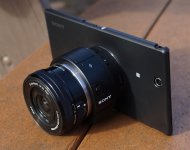
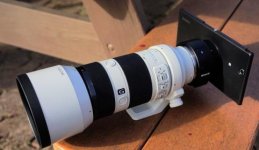
Imagine if that teenager added a telephoto lens attached. I shot a couple of videos with an anamorphic adapter and it's amazing what the mobiles these days can do. It got me thinking if they could create different anamorphic lenses -wide, telephoto, fisheye- for the iphone.

hscully
Veteran
I will forever want a camera that lets me do things with my hands.
I want to turn the aperture ring to the f-stop I choose.
I want to turn the focus ring from the mark I choose to the other mark I choose, at a speed I choose.
I want to turn the zoom ring to the --- wait, zoom? I mean, I choose the focal length from my set of prime lenses.
I want to record RAW, or at least 10-bit log, so that I choose the curve and I choose the colors.
Doing these things with my hands brings me joy. All the automatic things do not take a way my pain, they rob me of my pleasures.
Preach, Combat, preach! Fantastic post. I could not agree more. "... do not take away my pain, they rob me of my pleasures." That line needs to be in a script!
BillP
Well-known member
Imagine if that teenager added a telephoto lens attached. I shot a couple of videos with an anamorphic adapter and it's amazing what the mobiles these days can do. It got me thinking if they could create different anamorphic lenses -wide, telephoto, fisheye- for the iphone.
I think the way around having to increase telephoto optics is to just crop in on the sensor because of the many extra pixels...



ugafan
Looking for a woman
And the smart phone manufacturers aren't giving up and keep driving up the performance of their cameras.
And there are some photos attached too.
http://www.technobuffalo.com/2015/05/01/lg-g4-camera-example/
As it stands, the Galaxy S6 (and S6 Edge) is the market’s camera king, offering sharp pictures, accurate colors, and excellent exposure. It’s not perfect, but it’s pretty darn close—it was always going to be a tough act to follow. That hasn’t fazed LG one bit. At the top of New York earlier this week, the Korean company proudly unveiled what it claims can completely replace not just your point-and-shoot, but a DSLR.
And there are some photos attached too.
http://www.technobuffalo.com/2015/05/01/lg-g4-camera-example/

Egg Born Son
Veteran
The revolution I'm looking for is the one where iphones can make phonecalls. I can hack satellites and launch nukes but buggered if I can hear a word anyone is saying. Games are loud enough, videos pick up sound. Why does the phone function have inferior speakers and mics?
onemanband-videomaker
Carbonite Member
that's the reality (in progress, but growing pretty fast). not just for the makers : it involves the distribution of our work as well that will end up more and more on those devices instead of TVsets or even computer screens. So from our perspective it should tell us that in the next years we're gonna have to adapt. does 4K even make sense? on a smartphone (which is the fastest growing audience of youtube for example) my old XL1 footage looks as good as my new 4K camera. So again : does 4k make sense? For events (the paid ones) access is more important than the resolution of the footage (and if it will end up on youtube and from there to the smartphones then...). Now the real question: a full size shoulder camera gets better access. It's a contradiction in terms , I know: but that's the reality. In other words why you think that a camera like the ea50 gets to be popular in the wedding crowd (along with the mc2500, hm70 ac8 ...) ? because they are big. So let's be honest : if access is more important than 4K then all the new small cameras to be held in mid air make a very little sense. I say that anything paid (beside movies) needs access more than anything else. I'll give you an example: a real life scene that I see every day: there is a celebrity passing by, lots of smartphones shooting, lots of small cameras and a couple of news crews with those big pmw500: the big cameras get the best spot and the smartphone people won't block the lens, but they will block all the other cameras. it's the reality of things. smartphones as the future distribution of our work and big shoulder cameras to produce it. In a way I kinda agree with the article: the "makers" did it all wrong concentrating on those small video things to be held in mid air. At that point a smartphone can produce as good as those small little cameras , all shooting 4K (next to useless in the perspective that I just exposed).
am I wrong?
LOL I kinda wish that I was (wrong), but I'm afraid that I am not (so wrong).
am I wrong?
LOL I kinda wish that I was (wrong), but I'm afraid that I am not (so wrong).
lovecameras
Carbonite Member
Phones are for making calls. Cameras are for making videos.....next