Best Documentary Camera

Money aside, what would you say is the best documentary camera?

Arri Amira, F55, Red, Varicam LT, C300 Mark II, C100 Mark II, FS7, A7s II, A7r II, GH4, 1DX Mark II, etc.?

Now try to imagine fitting three FS7's into one bag with all that other gear.

Into the equivalent space I imagine fitting...

one AMIRA...

or two RED...

or two Varicam LT...

maybe three C300...

or two FS7...

somewhere between a dozen, & two dozen, GH4 or A7s/r...

a half dozen 1DxMk2...

or three hundred iPhone 7.
 
Last edited:
Hey Eric,

I love Tampa! So...keep the case under 50 pounds or you will pay a LOT for overweight baggage. Soon, get yourself a press pass from the Tampa PD, find a buddy who is connected somehow to a station or a client media company and once you have that you can get the media rate. Also, when you make the case too heavy the baggage handlers literally drop them out of spite.

Today I was in dreaded Group 4, so all the overheads were taken by the time I boarded and I had to have the camera under my seat and they took my bag who knows where. Also, assume they may lose your baggage for the better part of a day so have with your on board package batteries, lavs, etc., enough to start basic shooting while the airlines route the rest to you, so the client isn't too upset. Never have connecting flights that have less than two hours in case the first one is late.

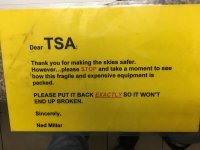
But very importantly, and this happened today with my Sachtler in my Portabrace case today, is they will NOT put things back the way they found them, and if you pack too tight they will not figure out how to put things back so the lid closes, so DO NOT make puzzles. This is especially important since the exploding battery scare started, their x-ray machine sees batteries and they assume it's dangerous Lithium, and now the Samsung scare, so they will open cases and not remember how to put items back and close it. I made several of these laminated signs several years ago, put them on TOP of the gear, and they seem to help, suggest you do likewise:
 

Attachments

  • TSA SIGN.jpg
    TSA SIGN.jpg
    61.1 KB · Views: 0
Well for now I'm not checking bags, and in the event the overheads are full and it needs to be checked, it has already gone through security, so they wouldn't need to open it. Airlines rarely weigh carry-ons (Spirit does, apparently, but I also found Spirit is to be avoided at all costs), so you can load up the carry-on as much as you like. If the plane is full and they have to check it, they still won't weigh it. I brought a 60 lb carry-on on a flight once with no issue. Now my two bags are about 40 lbs and 45 lbs.

I know a few video people who print press badges at fakeIDs.com (not the actual URL) or some site like that, and they say it gets them the media rate and is never questioned.
 
I've been preaching this for years now: If you have the time or extra gear to spare, ship it ahead via UPS or FedEx ground. I live on the east coast and can usually send anything within two days to at least NY and FL and as far west as at least Chicago. I HATE carrying gear on a plane and will drive whenever I can. I consider anything within ~7 hour window as "drivable".
 
Hi,

I have been asked to film a sports team with two co-head coaches.

It will be a run and gun situation and I don't think my dslr will be ideal as a one man crew.

Someone suggested getting a camcorder.

I have a few questions please.

1) Is 4k necessary? I'd like to be able to show it in theatres if the doc actually turns out well.
2) Since I have 2 subjects to follow plus the team, I plan to use wireless lavs on both coaches. I found these, think they are good enough? https://www.bhphotovideo.com/c/product/1029165-REG/sony_ecmaw4_wireless_micro_for_mic.html
3) Any suggestions on how to switch back and forth between the two with the lavs? I don't wany to switch them on and off constantly.
4) I have some sound gear - psc promix mixer, tascam dr 60, boom, cans and shotgun mic. I'd like to get a back up of the audio in case something terrible happens but I am concerned on how to handle all the equipment.

From time to time, I will have maybe one person helping me but with no experience.

Thanks for your help.
 
1 no
2 no idea. These are Bluetooth short range and it depends on the environment. Will they reliably pair correctly where there are multiple units? I suggest you read the less than positive reviews on that link.
3 use a 2 channel recorder (i.e. the DR60 ) and record both continuously and edit accordingly.

Thanks for the reply. Is 2k good enough for theatrical?

Thanks.
 
Not really. If you do photograpy then you will know that an 8mp raw file probably delivers a better file than a '20mp' file from a phone

Same is true for motion.

"K" is a rubbish metric

it takes no account of colour bit depth compression level and many other true identifiers of quality.

FYI the Alexa is low res but wins on every other metric

If you shoot awesome comtent on that little canon people will buy it though - don't exclude a cheap camcorder from your possible camrra choice
 
Thread is label "Best Documentary Camera" and you guys are talking about a toy handicam?

In my opinion audio is at least half the requirement in a documentary camera. That is why the DSLR users use dual system sound, the sound system behind those minijacks suck. My opinion is, one of the requirements of a "decent" documentary camcorder are XLR jacks.

I think we can ignore "best", because then you are talking $50,000-$100,000. On the other hand, "best affordable" might be something like a Sony X70 in the $2K range (I am definitely not up to speed on the latest and greatest).
 
Well, prior to the digital age, 8mm or 16mm film and then SD analog video were inferior to the HD image quality. Sure, it's nice to be able to afford Amira with some high end glass but, if all someone has is $250, then this Vixia HD-cam, an inexpensive powered mic and a few practicals just might do the trick.
 
Something light weight is best for documentary film.

It's about picking the right tool for the job at hand. Yes sometimes a light weight camera is the correct choice. Other tines it's not.

For example... I watched a doc some time back "Standing in the shadows of Motown" where the performance segments were captured on 7 35mm film cameras. Remember all documentaries are not low low budget, or run n gun.

Back in the day I had 4 Eclair NPR's which were my workhorse doc cameras. 2 were 16mm and 2 were super 16mm.

Dave
 
Last edited:
What a fascinating thread. Some great advice here and I’ve enjoyed reading everyone’s contribution. Perhaps some of the confusion has arisen from the word “documentary” which seems sometimes to be used as a synonym for “non-fiction” and there are obviously different requirements for each genre of factual filmmaking, from news gathering to feature docs and everything in between.

Form factor has been mentioned a couple of times in the thread already and, for me, it’s one of the most important considerations, if not the most important. I make verite documentaries. spending at least a year with my subjects following their lives, filming most days, all of it handheld sometimes for hours at a time. I was at the BBC when mini DV cameras were first becoming viable, mostly used for B roll or for daytime magazine programmes, but as soon I got my hands on a Sony VX1000, I had no interest in going back to using the big shoulder mounted DigiBeta cameras in general use at the time. The image quality of the smaller camera was terrible in comparison but the important lesson I learned is that you have a different relationship with your subject when using a palm-held camera than when using a shoulder mounted one.

Beautifully composed pretty pictures are all very well but story is everything. When the brown stuff hits the fan and you’re standing there holding your small camera, the subjects – however familiar you are to them - react to you on some subconscious level as if you’re the drunk uncle on Christmas day with his camcorder rather than a film crew who will broadcast everything to an audience of several million. Those moments of high tension and maximum stress where the subjects behave truthfully without any sense of self-censorship were the moments where the stories came alive and all the compromises I had to make by using the technically inferior camera became worth it. Robert Thirkell, my exec producer, kept trying to throw DigiBeta cameras, a sound recordist and several assistants at me. I kept politely refusing and going off on my own to stand in corners of rooms to film with my cheap little DV camera. The film ended up being the first BBC Specialist Factual doc shot entirely on mini DV and the result was a vindication of the format. When the PD150 came out a year or so later, it quickly became my favourite verite camera of them all.

I grew disheartened when the BBC moved away from pure verite and cancelled strands such as Modern Times and Trouble at the Top in favour of heavily formatted series such as the Apprentice. I went away to do other things but now I’ve returned to my first love and I’ve started shooting my first doc in over a decade. I was very impressed by the Panasonic dvx200 the first time I picked it up. It’s only slightly larger than the old PD150; it’s unobtrusive, easy enough to hold in the palm of my hand all day and is a quantum leap ahead in image quality. The difference in quality between a dvx200 and an Amira is trivial compared to that between a PD150 and a DigiBeta. Of course, I’m not saying it’s the “best documentary camera” (as if any such thing exists or could exist) but what I would say is that it best fits my requirements right now for the sort of film that I want to make.
 
Back
Top