Best Documentary Camera

There's no doubt small handheld cameras have their place in documentary. I've owned a VX1000, PD150 and a DVX100 and have been contemplating adding one of the latest crop of run arounds to my arsenal. The problem at the BBC was they were handing these cameras to PAs and junior producers, giving them a one-day course and sending them off to shoot a story. This isn't radio, you still need good craft skills and an eye for a great shot; otherwise, it's just light hitting a sensor and who cares whether it's a large sensor in an expensive camera or a small sensor in a cheap one.
 
BBC must not show their crap programs here in the USA, because I don't remember substandard stuff since the early Doctor Who days.

I think the use of the iPhones etc was for news reporting. This meant were every news person be they a reporter, producer, director, editor, researcher etc had the basic skills and equipment to record "something" The idea being they were trained news/tv/journalists (with a BBC ID/Press Pass) and therefore would do at least a good a job as anyone else with a smart phone. And of course the BBC would own and know the provenance of the material. They could report until a "proper" camera crew got there.

AFAIK it was based on this. http://www.rosenblumtv.com/training/ I did one of his boot camps years ago. It's based around how to shoot reality TV. An oxymoron I know but...... the course used very basic consumer hand cams. (I forget which make) The point being that technique of story telling was the key.

The BBC was not suggesting the use of smart phones for normal TV production though I do know some documentary programs produced by others for the main UK TV channels have used consumer camera on occasions, for some short clips, where for practical (and usually security/safety) reasons anything looking professional or anything that could not be put in a jacket pocket in an instant. Not quite secret filming but getting that way. Sometimes in some areas you have to look like an amateur to be safe. init?
 
Last edited:
Money aside, what would you say is the best documentary camera?

Arri Amira, F55, Red, Varicam LT, C300 Mark II, C100 Mark II, FS7, A7s II, A7r II, GH4, 1DX Mark II, etc.?

Better ask for the best specs for a documentary camera
- battery live, longer better
- image quality, better better
- recording time, longer better
- weight, less is better
- durability,
- audio quality
- size, less is better unless showing of clients or talents is important.
- price range less is better
- autofocus
- image stabilization
- ease of use
etc.

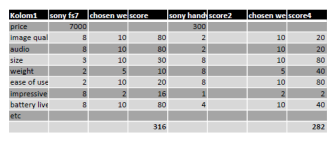
Now find a excel wizzard, and translate all the specs to a table. Give your preferred qualities a number from 0-10, and voila your camera.

I did some work for you, sony handycam and sony fs7. :smile:
The sony fs7 has the most points, but the price is higher. Weighing the factors is the most important part of this. Image quality, battery live, audio quality etc. can be rated scientifically. The weighing factor is your choice.

score.png
 
Last edited:
I think the use of the iPhones etc was for news reporting. This meant were every news person be they a reporter, producer, director, editor, researcher etc had the basic skills and equipment to record "something" The idea being they were trained news/tv/journalists (with a BBC ID/Press Pass) and therefore would do at least a good a job as anyone else with a smart phone. And of course the BBC would own and know the provenance of the material. They could report until a "proper" camera crew got there.

AFAIK it was based on this. http://www.rosenblumtv.com/training/ I did one of his boot camps years ago. It's based around how to shoot reality TV. An oxymoron I know but...... the course used very basic consumer hand cams. (I forget which make) The point being that technique of story telling was the key.

The BBC was not suggesting the use of smart phones for normal TV production though I do know some documentary programs produced by others for the main UK TV channels have used consumer camera on occasions, for some short clips, where for practical (and usually security/safety) reasons anything looking professional or anything that could not be put in a jacket pocket in an instant. Not quite secret filming but getting that way. Sometimes in some areas you have to look like an amateur to be safe. init?


That's how it starts out... It's kind of like a "gateway" drug. I have a client that is a major network with DEEP pockets and it is insane HOW MUCH content they air on a daily basis that is from reporters cell phones and "handicams". And the bad thing is, they actually will still use reporter cell phone video(stand-ups & "live shots") EVEN when a real crew is there. I'm not talking about because the reporter captured something the real crew didn't get, either. Recently, we had two reporters on-site. We shot stand-ups for the reporter covering the winning team and the reporter covering the losing team had to shoot his own with his cell phone ten feet away from us. It would have taken an extra 5-10 minutes for us to shoot his. We were already set-up, but we couldn't. He HAD to use his cell phone. And this is standard protocol.

And I remember when Micheal Rosenblum was selling his snake oil all over the US and UK years ago. He would frequent another board I was on, that at the time, was probably THE board for working TV shooters. He would try to defend what he was doing, and at times it started to get ugly, because everyone could see right through what he was trying to do. Being on the freelance/network side, I never thought it would affect me. It was mostly the local stations that were going that direction. But now, a lot of locals figured out what he was selling was crap and now on the network side it's the "squeeze blood from a turnip" mentality.
 
Last edited:
I'm curious what everyone thinks of using a Beachtek or Juiced Link XLR adapter with a camera lacking built-in XLR jacks. I may be heading to South America or Southeast Asia this year for a 6- to 12-month stint overseas and am trying to keep my kit as small as possible without sacrificing too much.

I have shot with a Sony EX1r for a long time and love the picture and the ability to use quality microphones (Rode and Sennheiser), both on-camera, wireless lavs, and on a boom. Lately I've been carrying a Sony AX100 and shooting with the smaller Rode stereo and mono video mics, but obviously the sound is nowhere near the same for anything other than ambient audio.

Since I will be a one-man crew most of the time except possibly if I'm Peru where I have contacts, do you think the AX100, and XLR adapter, and good mics be enough to cover most of my sound needs? The small kit for travel and inconspicuous camera when needed are all very tempting. (I'm also considering purchasing a Panasonic GH5 and selling a lot of my Canon photo stuff to pay for the purchase.)

Any thoughts or suggestions would really be appreciated.

Phil
 
I'm curious what everyone thinks of using a Beachtek or Juiced Link XLR adapter with a camera lacking built-in XLR jacks.

I have no current infomation, but back in the day, Beachtek produced adapters that were just plug adapters, an ones that had pre-amp's in them. The second kind helped, but still your audio went through the lousy audio circuits in the camcorder. Now the adapters provided with the prolevel camcorders, bypassed the in camera audio circuits. The old Sony PDX10 and TRV950 were the same camera, but the XLR adapter on the pro-level PDX10 bypassed the terrible in camera electronics, the TRV950 with a Beachtek adaper did not have as good audio. I know about this because I still use PDX10's.

Now, just what the current situation is, I have no idea (as a hobbyist I cannot afford the new cameras), but since no one else has replied I figured I would provide what info I have.

What I suggest is that, if possible, you take your camera down to the dealer and try out the adapters on it. Nifty thing about digital, you can get immediate feedback on your tests.
 
Not that I'm an expert, but I would probably buy something like a Tascam DR-70D for the audio and feed the output of the recorder back to the camera for a confidence record. I'm guessing your AX100 is using crap AAC or AC3 compressed audio which doesn't really survive much manipulation, so the wave recording from something like the Tascam would be useful. Even something like the DR-40 recorder might be useful since it takes XLR with phantom and will run on batteries for about 7 hours. Not sure of the quality of the line out, we normally use these for our radio students to gather interviews and them seem to work really well except for one thing... Do not get your cell phone too close to them or suffer the digital noise that the phone will generate!
 
Even something like the DR-40 recorder might be useful since it takes XLR with phantom and will run on batteries for about 7 hours. !

I have discovered you can extend that to as long as you like (or have SDHC storage for the audio) by using a USB power bank. Tascam do their own and there is a mains adaptor but I found my DR40 works well with a 10,400mAh Kodak USB powerbank
 
Back
Top