
Navigation
Install the app
How to install the app on iOS
Follow along with the video below to see how to install our site as a web app on your home screen.
Note: This feature may not be available in some browsers.
More options
You are using an out of date browser. It may not display this or other websites correctly.
You should upgrade or use an alternative browser.
You should upgrade or use an alternative browser.
AG-DVX200 4K Large-Sensor Handheld Camcorder
- Thread starter Screenforme
- Start date

Greg Smith
Veteran
Weight?
Think Ikegami HL55 w/Anton Bauer brick, umbilical to Sony BVU150 "portable" 3/4 SP..and the original non-carbon Sachtler Hotpod. I remember trying to follow a group in a parade with that setup. Relative indeed..
Been there, done that, got the aching back and permanent list to show for it! I'm literally, physically not strong enough to do that anymore, and am kind of amazed that I ever was when I look at some of my work from 30 years ago.
The DVX200 is almost exactly the same weight as my PX270, which I find easy to hand hold (although I still like shoulder-mount cameras better). I don't think it will be too difficult to manage.
- Greg
Bassman2003
Veteran
If it is like the PX270 then I would say it is very hand holdable. The PX270 feels like an HMC-150 with just a little more weight to me. Very nice to shoot with.

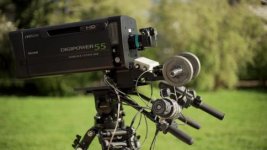
I don't even know why you guys are complaining about weight... if you want real MFT zoomage in 4K just do this ala GH4...
View attachment 104422
Or this even more expensive one http://www.bhphotovideo.com/c/produ...besm_pf_2_3_precision_focus.html/prm/alsVwDtl
There's a lot of jello from that 55x zoom in the YouTube.I don't even know why you guys are complaining about weight... if you want real MFT zoomage in 4K just do this ala GH4...
View attachment 104422
https://www.youtube.com/watch?v=E-baLc-POBM
But it is only on a GH4 :grin:
Last edited:

joe 1008
Veteran
There's a lot of jello from that 55x zoom in the YouTube. But it is only on a GH4 :grin:
Take an URSA mini with global shutter - the crop should still be HD! Or are there any inverted speed boosters, eh, slow roosters?
 rogar-Kriz(DBG):
Barry_Green
Moderator
I did a follow-up test with the PX270. The general sensitivity at a given ISO level is comparable, when zoomed to an appropriate distance. Meaning -- at a given distance from a subject, you're going to be zooming in to such and such magnification, and when you do that on both cameras, the general brightness level of the image is about the same, because the iris on the lens will be different and the more-open iris on the PX270 compensates for its smaller sensor as vs. the DVX200. However, the noise level is vastly improved on the DVX200 as vs the PX270 when it comes to high ISOs (meaning, 5000 ISO on the DVX200 vs. 18dB of gain on the PX270). It's a night-and-day difference. I'm not saying the DVX200 is flawless; at really high ISOs the colors flatten out and you can see noise, but the PX270's display was a biblical plague of locusts vs. the DVX200's. So it's a lot better.Has anyone yet commented on the iso performance? if the gx8 is to be any indicator, iso may (somewhat) offset the relatively slow apertures
I then compared against a GH4. With the 14-140, the DVX200 delivers a significantly brighter image at 5000 ISO, than the GH4 did at 6400 ISO... (at the same zoom range I'd been testing, the 14-140 was at f/5.7, the DVX200 was at f/4.2). At the light level I was testing at, I could not get the GH4 bright enough to compare against what the PX270 and DVX200 were delivering. But when equipped with an f/2.8 lens, the GH4 wins; when set to comparable brightness the GH4 can be at a lower ISO (don't remember what exactly) and delivers a cleaner image.
My conclusions: when compared against a conventional 1/3" camera, the DVX200 wins for cleanliness of the image at comparable brightness levels. When compared against a GH4 using a comparable zoom lens, the DVX200 wins. When compared against a GH4 using a fast short-range zoom (12-35 or 35-100) or prime lens with f/2.8 or wider aperture, the GH4 is going to win in low light. And when comparing in extremely dark conditions, the DVX200 can go into IR mode and literally see in pitch black, so for super-dark scenarios it can get images that the other cameras just couldn't, so that may be a consideration for some folks. Those IR images are green, and you'd need an IR light to do it, but -- it can do it.
Last edited:
Barry_Green
Moderator
Not answering your question to kplo, of course, but addressing "high sensitivity": High Sensitivity mode delivers cleaner, less-noisy images than low sensitivity mode does. It uses more aggressive noise reduction, so it brightens up and cleans up the image. The downside is, of course, the same downside whenever you use aggressive noise reduction, it can end up smoothing out details and making a softer image depending on the scenario.Was the cam in high sensitivity mode?
Barry_Green
Moderator
Both points were made to them, I can assure you.I'd much prefer to pay $1000 more than the DVX200 current price to be getting hold of a genuine f2.8 lens... Or have a camera that gives you the option of using your own fast glass.
This DVX200 is not that camera. It is what it is. I do hope that they listen and create a DVX250 or something in the future, but even if they do it could be years away, so -- don't count on it. You have to evaluate the DVX200 as what it is. And as you said, I do think it delivers excellent bang for the buck, especially since the bucks they're asking are quite a bit fewer than what we were initially told. Viewed as a comprehensive package for what it is, I think it has a lot of merit. That doesn't mean it'll be perfect for your particular needs, or any one person's particular needs, that's an individual decision that has to be made. But I can say there's a lot to like about this camera.
Barry_Green
Moderator
It's about the same size as, and a little heavier than, a PX270 or HPX250 or AC160, if that helps people get an idea.I played with the DVX200 at EVS this week. All I can say is, if people use it for Run and Gun, it's quickly going to turn into Run and Groan. This is one big, honkin' heavy camera. If you have visions of hand holding it longer than five minutes, I hope you have insurance on your arm. Just a heads up...
Barry_Green
Moderator
Maybe, maybe not. It depends on whether the final production cameras have programmable/erasable storage in them, or if they move to lower-cost read-only modules. If they build them all with reprogrammable chips (which I think they should, and I think they will) then yes, this would probably be a possibility. I think that's a 95% probability, but -- only they know for sure.So, with caveats, some of this should be firmware upgradeable and/or changeable during the production run? (the caveats being that there's a wide preference for this change from the customer base and that altering one variable doesn't effect others)
Barry_Green
Moderator
The auto mode is programmable as to what features go into auto (like the HVX and HPX170, and other prior Panasonics). It has more control than the earlier models (i.e., you can select auto-shutter and/or auto ISO control in addition to iris, focus, knee, etc). And it also has automatic audio level control in addition to the automatic limiter; most of the prior Panasonics had no auto level control option. If you've been happy with the prior Panasonics' control of auto mode, I suspect you will be happier with the DVX200's options.I've shot with most all Sony cams at some point and auto mode is "too auto" for me, making decisions about settings that alter video image and getting decent auto exposure is impossible sometimes. Flip to manual and still issues. You won't understand what I'm talking about unless you've used a Sony cam on real client-driven professional shoots and then picked up a $5000 Panasonic hvx, dvx, hpx etc. Different ball game. Gimme a Panasonic anyday and I won't ***** about the things it doesn't do because I know I'll use a different camera for that. So: I'll buy the dvx200 for most video applications and get a bmc mini-ursa for cinematic work
Barry_Green
Moderator
If it is like the PX270 then I would say it is very hand holdable. The PX270 feels like an HMC-150 with just a little more weight to me. Very nice to shoot with.
It is a little heavier than the PX270. I picked up both, didn't have a scale there, but yes the DVX is a little heavier.
I would gladly pay the same price for a MFT mount version. No Lens. I'll supply my own, thankyouverymuch!
Just bought a GH4 and I'm in the process of rigging it up to shoot video. What a pain in the @$$!!! Different batteries! Cables everywhere! Never going down that 'road' again!
C'mon Panny.... Pleeease!?!
Just bought a GH4 and I'm in the process of rigging it up to shoot video. What a pain in the @$$!!! Different batteries! Cables everywhere! Never going down that 'road' again!
C'mon Panny.... Pleeease!?!
joe 1008
Veteran
Both points were made to them, I can assure you.
This DVX200 is not that camera. It is what it is. I do hope that they listen and create a DVX250 or something in the future, but even if they do it could be years away, so -- don't count on it. You have to evaluate the DVX200 as what it is. And as you said, I do think it delivers excellent bang for the buck, especially since the bucks they're asking are quite a bit fewer than what we were initially told. Viewed as a comprehensive package for what it is, I think it has a lot of merit. That doesn't mean it'll be perfect for your particular needs, or any one person's particular needs, that's an individual decision that has to be made. But I can say there's a lot to like about this camera.
Uh yes, that would be fine. If they managed to build it with a 6,6x zoom with constant f/2,8 that, in HD, would be a 10x zoom adding the 1,5x digital zoom into the mix: Same zoom range as the original DVX100, right? But yes, pie in the sky, I know...

Mike Harvey
Veteran
Uh yes, that would be fine. If they managed to build it with a 6,6x zoom with constant f/2,8 that, in HD, would be a 10x zoom adding the 1,5x digital zoom into the mix: Same zoom range as the original DVX100, right? But yes, pie in the sky, I know...
The more sold on the DVX200 I am, the more I realize they really needed to come out with a big sister "HVX300" version-- P2 (at least micro-P2), AVC-Intra, removable lens a la the EX3.