AF100 or EX3?

And as we all know every camera will produce moire in certain frequencies, even film cameras. Its just that with trumpet charts you can look at a whole range of frequencies at one time.

I remember your HMC40 tests Barry. Very high resolution with just a little moire and no ugly CA. Just what we hope for, the minimum possible.

The 7D had multiple areas of moire and lots of CA. Most of us didn't even notice it until we had a look at the chart. It was a huge gotcha that would have spoiled many shots and reputations if it wasn't known.

I fully understand that we have to wait and that early indications look very promising. I agree that it already has the 7D, 5D and GH1 beat hands down. I hope for the best. I'm just not willing to assume.

@Otis, this is a debayer filter cam, isn't it? Single sensor? So its a matter of how it handles the down rez. No binning, no line skipping, horray!

@dcloud. That is a 1:1 crop, there is no pixel peeping. I just copied a section so the image wouldn't be big.
 
@Otis, this is a debayer filter cam, isn't it? Single sensor? So its a matter of how it handles the down rez. No binning, no line skipping, horray!

You can get good images with many methods if you have an OLPF designed for the output resolution and you process properly. Since it works, a discussion on the method is purely academic. In this camera it works, it's the quality you would expect from a full hd camcorder.
 
Otis, I love to hear your usual informative techical discussions of camera systems, so it sounds so funny for you to say it doesn't matter how it works for this camera. Since nothing is ever perfect and every camera has some moire, I think the proper inquiry is "To what degree?"

And, "To what degree does the filtering affect resolution?"

I'm already convinced its far better than the DSLRs. I also realize that bokeh can hide a lot of artifacts as happens in the DSLRs.

Its not going to happen for awhile and I'm waiting eagerly.
 
Last edited:
Otis, I love to hear your usual informative techical discussions of camera systems, so it sounds so funny for you to say it doesn't matter how it works for this camera. Since nothing is ever perfect and every camera has some moire, I think the proper inquiry is "To what degree?"

And, "To what degree does the filtering affect resolution?"

I'm already convinced its far better than the DSLRs. I also realize that bokeh can hide a lot of artifacts as happens in the DSLRs.

Its not going to happen for awhile and I'm waiting eagerly.

I'm not biased for/against the AF100. It just looks much better than a dSLR in the imaging department. It's interesting to see how they actually do it. Getting a low resolution image out of a high resolution bayer is not an easy task, it can lead to artifacts that cannot be fixed by an OLPF. But the concerns about this camera have to do with dSLRs. The dSLRs were below what I consider acceptable in that department. The AF100 does not appears to be inferior compared to any other properly designed full HD camcorder so it solved that problem. Is it perfect? It doesn't have to be. Every single camcorder has aliasing in some situations. Even still cameras have alias in their native resolution.

OLPF drops the MTF, but you can compensate for that with a sharpening filter in the image pipeline inside the camera.

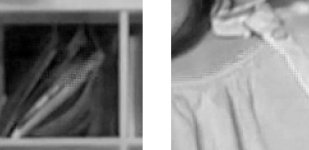
Edit: One thing I noticed is that half the clips have a weave pattern on red (the clips with the girl) and half the clips have a weave pattern on blue (Bloom's clips). The saturated chroma edges look strange. It could be an issue with debayer but why does it change? Different beta firmware or simply web compression?
 
It's actually on both red and blue in the first and on red on the second (but no blue saturated edges to check on this one).

weave.JPG

This could be a modification of a debayer algorithm, a debayering artifact, an AVCHD decoding problem or something Panasonic are still working on.

An OLPF can only work on a single (virtual) pixel size. In bayer cameras we set it to luma and allow some chroma alias to appear, but that's still limited because we do cut at luma frequency (2x the chroma frequency). If we set it to chroma, luma will be way too soft. In cameras starting with high resolution sensors, the artifacts could be higher depending on the resolution reduction method, downsampling, binning, skipping etc. Sometimes the method is asymmetrical, different horizontally and vertically, sum in X, skip in y, things like that. It's a great challenge compared to antialiasing a bayer sensor using OLPF.

Something else I have noticed on the girl shots, is aliasing on a book, on the luma edges. They appear to step more than they should, and the continuous shadows actually separates to independent blocks:

step.JPG

It could be sharpening operating on a modified debayering algorithm because I also see some halos in the horizontal direction. This usually happens if the debayer filtering and/or the reduction method operates using unusual schemes in order to achieve something and the post OLPF sharpening is not taking this into acount.

I predicted that an OLPF will not be able to solve all problems automatically in some old post. I hope I was not right on that one.

Enough nitpicking? I would do this if I was related to Panasonic in any way right? :)
 
That's an interesting discussion. There's no reason to think an Optical Low Pass Filter should fix everything. Every design decision has pluses and minuses. This big sensor with a high pixel count has to be down rez'd somehow. From what I've seen so far Panny made far better choices than any of the DSLRs because they were aiming for a true video camera.

For the final analysis we'll have to wait for a final camera. They've already beat all the DSLRs, now we need to see how it stacks up to real video cameras in the price range.

I expect that Panny was aiming this as competition for the EX1. If the AF100 ends up in the XH-A1 and HMC150 range of resolution vs artifact or better I can see it being a big hit. If it ends up in the EX1/3 and HMC40 level of resolution vs artifact (true 1920 resolution) and has the DOF control it will be stellar.

Especially since at this time the Scarlet is still a gleam in many people's eyes (Scarlet will really have 2048 resolution) and the AF100 should be ready in a few months. That and the supposed advantage of the Scarlet is the price point, but a Scarlet S35 body will cost twice as much as the AF100 body.

To me that's why the true resolution of the AF100 is so important.
 
Last edited:
Basspig I see where you are coming from with 3 chip vs single chip, but its not entirely accurate. RED and Alexa for example are single chip. The difference comes with the chip size. Lets look at the EX3 it has three sensors @2,073,600 pixels each totalling, for simplicity sake - 6,300,000 total pixels split as RGB.

The AF100 is a 12.1 megapixel sensor, cropped to 16:9. So what does that leave you with? Not sure what the math is there, but it would be a bit over the EX series. So your effective RGB number of pixels would be fractionally higher in the AF100. The difference is they are all on one single sensor.

I have never been impressed with the dull color rendering of the RED ONE camera, nor any other single chip camera, for that matter. And then there's the color aliasing issues with single chip imagers, so even if you are starting with DSLR level of resolution, the picture still looks lacking in life.
One of the strong points about the EX cams is the Fuji Velvia-like colors, in addition to to-the-pixel detail resolving power. You can have 12 megapixels, but if they aren't resolving to their Nyquist limit due to MTF issues, then it's just a lot of wasted data.

There are two types of single chip cameras. The small pixel cheap sensor consumer model that does not look very good because they are not good enough and the high end raw recording cameras that do not look good because they expect you to create the look in post. The manufacturers should spend more time in making sure the chroma output, the skin tones, the highlight handling etc are good even if one does not put the image through post color correction. This is what many 3ccd cameras do better.

The bayer sensor type only affects resolution to a degree, not what the chroma looks like. That's the sensor filter quality and the design of the image processing algorithms.
 
The difference is that in RAW you can push the post more without degrading the image to achieve that look.

In every other format doing to much of a push creates banding, blocks, noise or other artifacts fairly quickly, especially in 4.2.0 color.

That's the reason that the A1 and EX1 picture profiles are so important as you can minimize grading.

Which brings up the question of the AF100's picture profiles. I assume they are not yet enabled because I haven't heard them mentioned.

The power of RAW is that it allows you to change your mind in post. You have linear color and the entire camera internal processing is emulated in post, where you can tune it to perfection. The only thing you have to get right on the set in exposure level. There is room for changing that in post, but some quality has to give. Raw is no different from using a camcorder like the HVX, you can just change matrix, gamma, white balance etc in post and it will be free from artifacts because you have 25,000x higher tonality in color (in theory for 12bit although the sensor and the ISO setting could become a limitation).

For Af100 I expect something along the lines of an HVX.
 
Then turn up the saturation slider

That will not transform the output. A saturation control has very little to do with color performance, the key is gamma curves and mapping of color space. There is the question of engineering precision (IR filtering quality, white balance implementation) and the question of aesthetics. Camcorders like the HVX are quite good at getting good images out of the camera.

Compare HVX to Red One on these:

http://provideocoalition.com/index.php/awilt/story/green_magenta/P1/
http://provideocoalition.com/index.php/awilt/story/green_magenta/P3/
http://provideocoalition.com/index.php/awilt/story/green_magenta/P6/

You can change many things in post if you know what you are doing, and they can also be fixed with software updates later on, but the simple reality is that the common camcorder is more predictable.
 
The Red is primarily a color corrected camera in post. The image looks the way it does is because it is optimized for post color correction. It's not a grab and shoot camera to begin with.
 
The Red is primarily a color corrected camera in post. The image looks the way it does is because it is optimized for post color correction. It's not a grab and shoot camera to begin with.

I wouldn't say that such great problems in color balance are optimisations of anything. The predictable color performance wouldn't bother anyone in post, on the contrary the post would be easier. The camera just had (perhaps that is fixed now) bad IR filtering, it has been discussed in many articles on that site. I agree with the articles because I have come across the same problems in implementing sensors. An image that looks different depending on the white balance setting is not a planned feature. Red had received many revisions at that time, but I believe they will have fixed that by now, in software or using a better IR filter.
 
That will not transform the output. A saturation control has very little to do with color performance, the key is gamma curves and mapping of color space. There is the question of engineering precision (IR filtering quality, white balance implementation) and the question of aesthetics. Camcorders like the HVX are quite good at getting good images out of the camera.

Compare HVX to Red One on these:

http://provideocoalition.com/index.php/awilt/story/green_magenta/P1/
http://provideocoalition.com/index.php/awilt/story/green_magenta/P3/
http://provideocoalition.com/index.php/awilt/story/green_magenta/P6/

You can change many things in post if you know what you are doing, and they can also be fixed with software updates later on, but the simple reality is that the common camcorder is more predictable.


You missed my joke :)

Also, a big fan of the Drama!
 
Back
Top