A7s sample footage

??
This is just silly. you cant expect DR on high ISOs.

on most cameras this is true, Canon C100/300 claims that the middle gray point changes slightly but total DR stays much the same. I have not seen a controlled test of this.
 
Last edited:
about the "now i can see" video:

And i need more DR tonight
An i need it more than ever
and if DR is so tight
we will be ML HDR forever

and we'll only make it right
when we have more dynamic range
because the beach is bright
but the background is so strange

I really need you tonight
HDR is a must tonight
HDR is a must daylight

Once upon a time there was a hidden dark face of the moon
But now the bright face is blown away
Nothing I can say
A total clipping of the heart

Once upon a time there was light in my life
But now there's only sony in the dark
Nothing I can see
A total clipping of the heart

http://www.youtube.com/watch?v=lcOxhH8N3Bo

Use SLOG2
Philip Bloom didn't
Use SLOG2
It has plenty of range
Use SLOG2
It has about 3 stops more highlight range for the same middle grey because ISO 3200 is a fake number.
Use SLOG2.

I couldn't think of a song that fits with that. Maybe someone can write one.
 
"Please Sony make it right...
develop a new camcorder...
put two sensors in a prism design...
and DR will be much better...
one for dark another for light...
and we will be happy forever...
but manufacturers will die...
because nobody will change cameras never..."
 
Last edited:
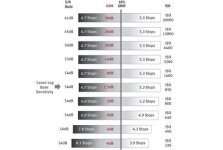
image.jpg


from Canon: How much dynamic range/latitude does the sensor have?
12 stops of latitude, according to tests performed by Canon, Inc. engineers. The optimum dynamic range for both highlights and shadow detail occurs at ISO 850; at lower ISOs, the dynamic range shifts, with a bit more shadow detail and less detail in highlight areas.
 
The effect is the same on th a7s and nearly all Sony cameras with hardware gain modes. They just don't have the negative software gain modes that the C300 has <ISO850. Increase gain to allow the DR-limited ADC to window a different portion of the sensor's DR. That canon chart doesn't account for changing noise levels at each gain setting, but the noise level does change, as it does on the a7s and pretty much every camera that employs the same hardware gain feature...

Note: Many cameras do employ software gain at the very highest gain steps as well.
this
 
i think we are splitting hairs here but i stand by my statement and feel that the last two comments talk about inherent and unavoidable sensor limitations and not camera performance. A camera is a system, not just a passive readout from the sensor.

Obviously Canon uses gain to maintain DR. I shot hundreds of hours on C100s (same sensor as the C300) and the noise at higher ISO, especially in shadow, is a problem. One of the reasons that this new Sony sensor is so interesting is to lessen this. However, the C100/300 does maintain DR as you increase ISO.

Now if you change the statement to say that sensor output becomes DR limited at higher ISO, not that the C300 DR is limited, I will agree. I was disagreeing with the statement that "you cant expect DR on high ISOs" and citing the C300, complete with post sensor readout processing, as an example.

 
Last edited:
Thanks a lot to everyone here, reading this thread has been very useful.
I've been a hacked GH2 users (with Lomo lenses) for the past years and would enjoy a new tool that offers more DR and a larger sensor, so the A7s may well be it.
For some reasons, most of what I've seen online of the A7s looks more organic than the GH4 (to my taste at least).
Not sure if I should rent an A7s and wait for the next generation with internal 4k (?), though?
 
Has anyone tested the audio quality yet - was looking at connecting to SD mix pre-d and recording internally when on my own, can you turn agc off?
 

On the 4k test - viewed on a imac screen, if i put it to 4k res and watch it in the regular YT screen, i get crazy moire/aliasing, but full screen it becomes super clean.
 
^ Nice.

I would have also closed down aperture four or five stops after shooting each shot, so we could actually see some shadows. Both of these cameras have more DR than those shots demand!!
 
For me, C-log looks much more usable in real world situation.

I know s-log2 footage from the FS700 CG OdysseyQ7 in 10bit and it's great.
But s-log2 footage in 8 bit? I don't think it's the right solution for everyone.
I expect heavy banding after delogging it...
8bit means you should be as near on your final look in camera as possible
without loosing to much information in shadows/highlights.

C-Log is a different approach and seems the right amount of DR/ log gamma
for 8bit footage.

We'll have to see how the A7s s-log2 footage will look after final delogging/grading.
 
^ I've been playing with original files from the a7s, from the Arizona Falls piece, and I found no banding issues: the footage is somewhat noisy and that noise masks the banding pretty well. If you push the footage really hard, then banding does appear, but by that point noise is unbearable anyway.

(it's not a nasty kind of noise, BTW: because the XAVC-S codec is reasonably good, it is small dots that dance around, not big blotches)
 
Back
Top