T2i What is going on? / Either me or my camera sucks

And my last question (for now) is, so youre saying that if I'm shooting a scene where all objects in my scene can be captured in a smaller range DR-wise, it makes more sense to have a profile that captures more color information in-camera (or not?), since the camera's codec will probably do a good job in a more limited DR?

IMO

-never waste any of the 'space' in camera use the full histo. because you are maximising the data collected - so yes a flat profile is for a wide DR scene .. only

-you must remember (often forgotten) that a flat profile is an exchange - you can record a wider dynamic range, what you are recording has less tonal detail

(because flat = reduction in sensitivity to tonal detail)

in an 8bit camera you cant really ramp up tonal detail in post without banding cos the information is not there
with a deeper bit camera (alexa/F3 and recorder) you have more tonal data than you need so shooting flat is a clever thing to do

S
 
Last edited:
-Also, I thought shooting flat was good? Allowing more flexibility?

Flat picture styles are very good to keep the details in over exposed and under exposed areas of your frame, but to get the best results you have to learn what causes the problem in the first place. Flat styles can only save so much. These cameras are all sensitive to high contrast so if your lighting is more even with less contrast in the first place you have less to correct in post.

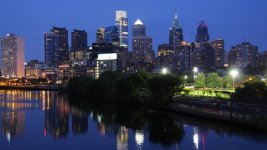
Here a series of shots I did in Philly from late afternoon to evening. I normally shoot everything in cinestyle 0,-4,-2, 0, but this scene I shot neutral 0,-4,-2, 0 because I knew I would have to add more contrast later.
You can see that with change of lighting the scene looks completely different. I know that is obvious being day and night, but look a little deeper at how the camera captures and translates light to the sensor. In any lighting situation you can dramatically change the way the camera sees the subject by changing the lighting.

Your waterfall scene could be better depending on time of day and position of the sun. Maybe you should go back and shoot some variation to understand better what was wrong and how to improve it.
 

Attachments

  • 1.-Philly-Skyline-late-afternoon.jpg
    1.-Philly-Skyline-late-afternoon.jpg
    77.7 KB · Views: 0
  • 2.-Philly-Skyline-sunset.jpg
    2.-Philly-Skyline-sunset.jpg
    76.7 KB · Views: 0
  • 3.-Philly-Skyline-after-sunset.jpg
    3.-Philly-Skyline-after-sunset.jpg
    64.1 KB · Views: 0
  • 4.-Philly-Skyline-dusk.jpg
    4.-Philly-Skyline-dusk.jpg
    63.4 KB · Views: 0
  • 5.-Philly-Skyline-evening.jpg
    5.-Philly-Skyline-evening.jpg
    72.3 KB · Views: 0
Last edited:
And my last question (for now) is, so youre saying that if I'm shooting a scene where all objects in my scene can be captured in a smaller range DR-wise, it makes more sense to have a profile that captures more color information in-camera (or not?), since the camera's codec will probably do a good job in a more limited DR?

I wouldn't put it that way, but I would say that's kind-of-right: if your scene doesn't require a high DR profile, don't shoot with a high-DR profile, because then you're just using a small part of the codec's color space and image quality won't be as good as it could be (i.e. you'll have more noise and banding issues)
 
Hey Samuel, speaking of shooting flat, I was shooting with flaat 2 for the first time the other day and noticed a lot (I mean, a LOT) more noise in the darker reds/maroons than I usually see. Any comments on whether flaat had anything to do with it, or should I keep looking for other factors?

Yes, Flaat will usually show more noise in the shadows than other picture styles (notably CineStyle: it seems like increasing the black point does have some advantages, probably related to how the H.264 encoder works). In exchange for that, it should give you cleaner midtones and prettier skin tones. I understand it's not for everybody...
 
Shooting with the sun at my back is only good 5% of the time :huh: Boy that confuses me now

First of all, saying that's good only 5% of the time is nothing more than hyperbole. And it's also misleading, because this is all about knowing your light source and how to place it and how to control it.

Since I'm being accused of giving "bad advice", perhaps I should expand and clarify. Let's start with what I actually said:

If you're outdoors, keep the sun to your back unless you want to silhouette the subject (in which case you stop down to expose for the sun/sky). Most of the time, you'll want your key light source to be behind the camera and toward the subject, or at least off to the side... either way, not pointing back toward the lens.

This is a beginner lesson in lighting control. Once you've figured it out, you can start to play with other light angles. But I was also pretty clear (so I thought) that it's about keeping it out of the glass, and I wasn't specifying that the sun should be directly behind you.

Pointing your lens straight into the sun is going to kill your color and contrast. Now, perhaps that's an effect that you're going for (in your posted example, we know it's not), and in that case... fine. If you know that's the result you want, then it's certainly appropriate. Side note: be very cautious about pointing your camera straight at the sun, lest you fry your sensor. This is often used to silhouette a subject with the sun peaking out from behind, but no matter what it should be used intentionally and responsibly.

So, back to the original point: the sun is a big light source. "Keeping it to your back" is not a literal "always keep it straight behind you". This is about not letting it creep into your glass. Can it be a key light in front of the subject? Absolutely! Can it be a side light? Sure! Can it be a back light? You bet!

When using the sun as a side light or a back light on a human subject (or any smaller subject), you can use bounce cards and reflectors to fill in light elsewhere. The sun to a subject's back with a reflector lighting the face can be a very nice effect. When you're shooting larger subjects, like buildings and landscapes, you probably won't have reflectors large enough to bounce into the front shadows. So, for landscapes and things like your posted sample, you want the sun anywhere but showing up in the frame... whether it's directly behind or behind and to the side or to the side or slightly behind the subject is all dependent on what kind of effect you want. Since you cannot control where the sun is in the sky, you have to adjust your position or pick the right time of day (or both) to get what you want.

So, perhaps instead of "to your back" I should have said "keep the sun outside of your lens's field of view".
 
Last edited:
This is all about knowing your light source and how to place it and how to control it..

Everyone has to find their own style. My comment would be turn around from the sun, there you have a source (key), called North Light, wide diffuse, soft, open, used by top painters for generations and a nice little spot for rim (the sun)

Consider the photographic works by the man who Roger Deakins was apprentice under, James Ravilous, For example.
http://www.jamesravilious.com/gallerypic.asp?gallery_id=33
http://www.jamesravilious.com/gallerypic.asp?gallery_id=28
http://www.jamesravilious.com/gallery.asp
I only see sun back/side in this specifically graphical image (which would be a fine time to go with the sun)
http://www.jamesravilious.com/gallerypic.asp?gallery_id=20

Lenses? he used Leica with homebuilt matte boxes..

IMO sun (on the back, or side) tend to cause hotspots that we see daily in 'videography'.
 
Last edited:
A couple responses to all the responses...

I have never, ever had a problem with shutter speed in artificial light. The "shoot absolutely everything at 1/60th" has never made a bit of sense to me. I've shot under Kinos, HMIs, HIDs, cheap Alzo HID ballasts, cheap biax kino knockoffs, and home depot-style flo's. The only shutter speed issues I've seen were getting up to 1/250th - 1/500th and seeing some flicker come in with a standard "shop or home" flo. I generally shoot from 1/40th to 1/160th, with no problems.

Regarding white balance - it's quite true that WB is widely overlooked for color manipulation - but once people suggest going for "wild looks", you lose the much more useful technique of using subtly colored sources to balance to. Roger Deakins loves bouncing lights off unbleached muslin to give an entire lighting setup some warmth - there's an example of a subtle and organic color shift. Experiment with balancing through things like 1/4 CTB or hitting the arts & crafts store and getting some subtly colored papers to test. Generally balancing to a subtle blue seems the most useful for warming things up; but balancing to a mild CTO color can give you a big headstart on those "cinema" grading looks. TEST TEST TEST. Testing gives you great familiarity with your gear, with nobody on the clock.

Shutter speed is really important for the feel that a particular style of motion rendering gives you. It's important for keying if you want to minimize motion blur. It's important for slow motion work (but slowmo with a little motion blur can look really dreamy, too).
 
Back
Top