C300: Tips for filming on a boat

Greg Hughes

Active member
Next week I'm filming a documentary on a guy rowing across the Pacific. He wants me to film some training out at sea. Weather permitting obviously...

Question is, should I use the C300 mkii with 18-80, xc15 or 5d mk4 with c log. I'm not sure what would be more practical but I'm assuming it will be up and down and slightly choppy since its winter.

I have the zacuto shoulder rig and atomos shogun flame if that has any effect on the decision.
 
I spent a good part of last year shooting on boats. Mostly power boats of a larger size than the one you'll be on. The difference was I was shooting other boats, from the boat I was on. All I can say is that without something like the Perfect Horizon System ($2,500.00 per day to rent), it was an exercise in futility, we got very little usable footage because the surge and rocking of the boat paired with shooting longer focal lengths (the chase boats we were on are not allowed to get really close to the racing boats so that means shooting at 135mm and longer) made the results bad. Even in calm seas, you still get that 2-3' rocking side to side. Those said, you are on your target boat so you should have a much easier time. You'll be able to shoot wide angle, that FOV will help mitigate the rocking from side to side. After shooting with the C100, C300 MKII and my C200 last year, my instinct would be to go with smaller and lighter. I would personally chose the 5D MKIV with something like the 17-55 2.8 IS. Heavier cameras, when out on a boat, become fatiguing quicker.
 
The 17-55 2.8 is an EF-S lens and can't be put on a Canon 5D IV camera. Obviously you could put it on a C100 which is also fairly light.
 
The 17-55 2.8 is an EF-S lens and can't be put on a Canon 5D IV camera. Obviously you could put it on a C100 which is also fairly light.

Doh, you're right. It's been a long time since I shot on a 5D, forgot about the FF. I have shot with my old C100 a lot on boats too, it's a good size for that.
 
Just wrapping up the second season of a fishing show, so i have quite a lot of experience on that - here's what i can say

1)Consider a drone - i really cant stress this enough. In fact, it is the most important factor when filming over water. Nothing will improve the quality of your footage more then this - in fact it will be THE factor in making your footage look more professional. I would rather have a drone and a 5D then an Red epic with no drone.

2)Shoulder rig helps, but it will always shake to a certain extent. Definitely go 5D iv, as you need to be able to switch sides rapidly; with boats you often have to rotate left right left right in order to keep the subject in frame. Lens MUST be stabilised(i think the 18-80 has IS right?).
One factor that helps with the 5d is the crop factor - once in a while you will have to zoom more and you will be at your max zoom range - switch to 4k, and the crop factor will help get closer.

3)Dont forget rain covers and have Clear/UV filters in front of your lens - you are probably gonna deal with saltwater.
 
Next week I'm filming a documentary on a guy rowing across the Pacific. He wants me to film some training out at sea. Weather permitting obviously...

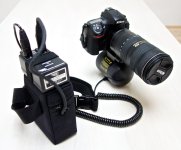
Since the late eighties I have filmed countless videos for the Royal Australian Navy. From subs, from inflatables, from warships, from rescue craft, counter insurgency boarding craft, choppers and fixed wing. Without a shade of doubt if you have to film handheld from surface craft and keep it smooth I have found nothing comes remotely close to the Kenyon Labs Gyro Stabilizer. You would only need to hire the small one. They deliver some quite amazing results. Originally they were designed for large naval binoculars for very stable long range vision. Once wound up to speed , about 20,000 rpm you will find any attempt to move the camera jerkily or abruptly will be cancelled and smoothed out. This is what a Kenyon does to any involuntary erratic movement that gets input to your shooting. Pans become a very smooth deliberate action and work very well. Check around a few places will have them for hire... well, well worth it!

Here are some good examples in some pretty choppy undulating water of how it could work for you. The second video set up is the real go to rig for long smooth shoots.

https://www.youtube.com/watch?v=I3yW3wrGuuA

https://vimeo.com/120505028

aa-gyro_DSC0003.jpg

https://www.ken-lab.com/

Chris Young
 
If you are filming boat to boat in close proximity Use an Osmo, shoot 4K. I've shot in some pretty Choppy conditions (3-4 foot swells) from a Kayak with my Osmo and the results were amazingly good.
I have also shot with my 300 on a well tuned ( for land) Helix gimbal and the results were poor. It takes quite a bit to optimize a gimbal profile for the marine environment and without spending a day doing that before hand in actual shooting conditions, you might have a largely pointless effort on your hands.

If you are in the boat with your subject, you could shoot with your 300 and something like a 17-55 IS lens. I'd do stripped down mode, no shoulder rig, becasue a rig configuration is going to be too unstable unless you are on flat water.

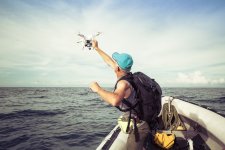
As for drone.... you can get some great shots and I love drone shots over water, but this is a high risk area if you are launching off a boat. The risks are damage to aircraft and or crew when landing or taking off, and or loss of the aircraft. Landing is especially hairy because you are in a confined space and the drone is likely in GPS mode so its stable. When the drone gets close to landing you'll see ho much the boat is heaving, pitching and moving which can a landing really dicey. I usually make emphatic landings on boats, get close, a couple of feet off the deck and then just slam the thing down. Hand recovery can be less nerve wracking but also carries increased risks to crew. Constantly updating home points is a given while shooting off a boat for obvious reasons. YOu wouldn't want the aircraft to auto home to some place that you were but aren't now.150618_Day7_laurie_raw_CF-96 copy.jpg

Photo of hand capture of drone launched from a skiff in open ocean. Great shots and high risk all around.
 
I recommend you attach your camera to the boat. Going handheld, you will have everything in the viewfinder moving about; the subject, the boat, the horizon. By attaching it to the boat, you eliminate the movement between the camera and the boat. I would go with multiple small 4k cameras (GoPro, Sony FDR-X3000, etc). If handheld, then the Sony FDR-AX53 has the BOSS stabilizer and will take out lots of the shakes that will be unavoidable in such a small boat and handheld. With multiple 4K cameras attached to the boat, you could do pans in post and have multiple angles to keep it interesting. Get the clamping tripods to attach to the boat edges, very flexible mount. I doubt there's room for even a small tripod, but that would also keep the camera tied to the boat and eliminate movement, and you could use whatever camera you want, doesn't need IS in the case where it is on a tripod. I film on boats a lot and have found that movement between the camera and the horizon is not such a big deal as long as the camera and boat are moving together. Your subject (the person) will move of course, but not like the boat will move.
 
If you are filming boat to boat in close proximity Use an Osmo, shoot 4K. I've shot in some pretty Choppy conditions (3-4 foot swells) from a Kayak with my Osmo and the results were amazingly good.
I have also shot with my 300 on a well tuned ( for land) Helix gimbal and the results were poor. It takes quite a bit to optimize a gimbal profile for the marine environment and without spending a day doing that before hand in actual shooting conditions, you might have a largely pointless effort on your hands.

If you are in the boat with your subject, you could shoot with your 300 and something like a 17-55 IS lens. I'd do stripped down mode, no shoulder rig, becasue a rig configuration is going to be too unstable unless you are on flat water.

As for drone.... you can get some great shots and I love drone shots over water, but this is a high risk area if you are launching off a boat. The risks are damage to aircraft and or crew when landing or taking off, and or loss of the aircraft. Landing is especially hairy because you are in a confined space and the drone is likely in GPS mode so its stable. When the drone gets close to landing you'll see ho much the boat is heaving, pitching and moving which can a landing really dicey. I usually make emphatic landings on boats, get close, a couple of feet off the deck and then just slam the thing down. Hand recovery can be less nerve wracking but also carries increased risks to crew. Constantly updating home points is a given while shooting off a boat for obvious reasons. YOu wouldn't want the aircraft to auto home to some place that you were but aren't now.View attachment 128962

Photo of hand capture of drone launched from a skiff in open ocean. Great shots and high risk all around.

I get terrified by this hand capture. I have seen several videos of Colin Guin (Ex-3DR, ex-dJI) smoothly lowering the drone and catching it and then killing it. I am planning to fly a 3DR Solo from a boat, but not sure if I can get it back. :)
 
Hand capture isn’t that hard but its a skill that needs to be practiced. I chose to use this method when launching out of a skiff or flying surrounded by jungle and without a level patch of ground to land on. I would just bring the aircraft down to a level where I could reach it but not without reaching well above my head, let it hover, grab the body ( I was flying an Inspire) NOT the legs and dump the power with my left hand on the controller. Obviously - lots of risks involved but doable. Even though the propellers are plastic, you can stil get a nasty cut if something goes wrong. Drones with folding propellers present less danger from the props and I think small drones are somewhat harder to hand catch as there is less to grab as compared to an inspire.
 
Gimbal could be your friend for a shoot like that.

Yep. I haven't shot on a boat, but on a school bus on dirt roads multiple times. It's surprisingly similar. I wouldn't attempt it without a gimbal. I'd say if you want your C300 rent a gimbal. Otherwise a handheld Zhiyun Crane with SLR.

Drone is awesome but not being an expert drone operator I wouldn't attempt it unless I thought it was worth the risk of losing the drone.
 
After over 50hours of flight over water(dji p4), i can assure you, it becomes easy to hand catch your drone. Ideally you ask someone else to it, its very simple. The biggest problem with drones on boats is starting it - drones need a period of relative stability before starting to calibrate the gimbal. There have been times where i just could not start it because the boat shook too much. Aside from that, go for a drone. Even a used phantom 4 non pro will do wonders for your project.
 
Back
Top