Ties are Stupid

... did you just discover Foucault or something?

"Knowledge is power" I think most people discover on their own? Sometimes we're aware of things, including consciously or unconsciously, yet this awareness doesn't really have a high priority in our daily lives, so we don't look too closely.

There are things happening in our world today that once you become aware of them, cause you to become very interested as a great deal of things suddenly make sense. You know, the 'aha' moment, the epiphany. What's happening in the real world right now is more fascinating than any Tom Clancy novel or action/drama, and what makes this real-world story so compelling is it's happening right now and we are living it! We are part of it! I now realize that IN-SHADOW unconsciously woke me up to ties and suits. I never liked them (own them, spent way too much money on them), and only recently did the idea Ties are Stupid drive a deeper look into the symbolism of the tie and the suit. Going back and watching IN-SHADOW again combined with life experience it's now so clear. Which motivated the exercise to start looking at symbolism in other aspects of society, and how that symbolism affects our lives, how we live, and how symbolism can be used to manipulate and control us.

In terms of philosophy, I'm a student of Taoism, Buddhism, and Zen (which to me Zen = Taoism + Buddhism), and Alan Watts really opened my mind to many deep concepts. Never really studied Foucault and have never been interested in power (or politics) until the last few years due to real world events that affect us all. In other words, I've recently been paying very close attention as things are going on that affect and will affect everyone in significant ways. Significant on the level of world-changing events significant.

I'll be honest, I've kept busy working, creating tech and art, and while user interface design, game design, sound fx, music and film/visuals are languages of emotions (all forms of metaphors and symbolism), I never thought about ties and suits and what they really mean symbolically. So maybe I'm a little slow to the party- I'm awake now! :)

If you're a filmmaker and into Foucault and real-world events as symbolism, IN-SHADOWS is genius level work on symbolism, covering dark happenings and predicting world-changing positive shifts as global consciousness raises awareness.

And that is my intent by pointing out that Ties are Stupid. If anyone else who was asleep feels like waking up, welcome! :)
 
Needless to say, I have nothing against your opinion—you own that.

But I do feel you are pushing your own opinion/interpretation as fact here. I have no disturbing associations with suits or ties on my part.

Do you mean what the parallels are or what the connection is? It's all about dress code to me. Some of the reasons you already mention: respect and participation. The dress code isn't the same for an Indian wedding as it is for a customer facing bank job position. But the expected behaviour is the same: like the man with the Indian women—show respect/understanding.

Since I mentioned jeans and hoodie, I feel this is directed at me. But I was the one who brought up some of the benefits of formal attire for people who don't have much money.

Is this directed at me?

Andree you should know after all these years on dvxuser I'm very direct and specific with intention. It's a general statement - and based on Alan Watts comments about not taking oneself too seriously, and about people taking unimportant things in life too seriously (like a pointless dress code*) and getting upset about it. Laughter is more fun, and healthy too! I don't believe that hierarchy of power/value/professionalism warrants a *uniform dress code (pun intended). How much experience do you have prosecuting lawsuits, patents and other legal matters? Maybe I have a different perspective, however my experience in that field doesn't generate respect for the people wearing suits based on their intentions and behavior, rather the opposite. It's the same reason there are so many lawyer jokes: people who lie and scheme for a living aren't very well liked. Wearing a suit/uniform doesn't immediately command respect- respect must be earned based on the individual's actions- there are good lawyers, businessmen, and politicians. Law enforcement and military do command immediate respect due to the life and death nature of their work. Lawyers, businessmen, and politicians- they must earn respect from their actions, not because of the clothing they wear.

I do write in a direct manner which can rub people the wrong way as I'm confident of the accuracy of what is written. I have supporting evidence+logic to back up the narrative and if you've read some of the debates here you'll see I never give up- and when I'm wrong I immediately accept the truth and move on. Probably too many years writing code/logic, dealing with legal matters, and writing patent claims, which is Boolean algebra in language describing machines. Guess I need to develop a different writing style that doesn't generate disagreement or resentment (perhaps perceived as arrogant- it's not; at best I'm guilty of being too lazy to develop a more patient and persuasive writing style- a la Dale Carnegie or Napoleon Hill).

I apologize to you and everyone else I've debated with if my writing style came off as arrogant or unkind- the goal was and still is always a search for truth, and to convince others of the truth if there's disagreement, while being open to learning new things in the process of the discussion, which almost always happens! Thanks for your feedback and I'm curious what you think about IN-SHADOWS (hopefully there'll be more discussion in the other thread).
 
Andree you should know after all these years on dvxuser I'm very direct and specific with intention.

That's all good! The post I quoted lacked some clarity then. You quote me to begin with, and later you include things I said and ask open questions followed immediately with other questions without including any formatting to indicate that you're not referring back to me.

I do write in a direct manner which can rub people the wrong way as I'm confident of the accuracy of what is written. I have supporting evidence+logic to back up the narrative.

No rubbing here. But I'm missing the logic of why suits and ties are stupid. I think I've understood your opinion about them, but that's not quite the same.
I get that some people "have to" wear suits. Of those people, some are nice and some are mean. Of those people, some might attribute abilities, properties or behaviour to themselves (or even to the suit), thanks to the suit. A suit and or tie can be seen as a symbol.

But these loose statements don't constitute any logical reasoning so far. If anything, I fear this thread feels a bit more prone to false logic, such as:

"All lawyers wear suits. All lawyers lie. Therefore all people who wear suits lie".

I apologize to you and everyone else I've debated with if my writing style came off as arrogant or unkind.

No need to apologise to me. I felt something you wrote wasn't clear, so I asked you a short direct question (perhaps much like you would yourself?) and now you've explained what you meant.

As long as we stick to discussing opinions and clarifying facts from fiction, all should be good. We don't comment on people's appearance or ridicule beliefs, but anyone is very welcome to explain their point of view.

In fact, as long as people stick to describing their own feelings instead of telling other people what they think, few things can go wrong.
 
@Andree- ties are stupid- they provide no useful function and the symbolism (leash) is not appealing.
Suits do a nice job hiding out of shape bodies, however they are hot and restrict movement. Their symbolism of uniformity (pun not intended) and servitude when combined with a leash says slave or drone. Along with monkey suit, these descriptions are intended to be dramatic to wake people up, not to put anyone down, really the opposite- to empower people to be free.

Comments about lawyers et al are simply that a suit should not by itself give power or respect- must be earned. Otherwise people are trusted for the wrong reasons and abuse can happen. That’s why there’s so much burden on LEOs and MIL leaders as they must be immediately respected due to life or death situations they manage.
 
@Andree- ties are stupid- they provide no useful function and the symbolism (leash) is not appealing.
Suits do a nice job hiding out of shape bodies, however they are hot and restrict movement. Their symbolism of uniformity (pun not intended) and servitude when combined with a leash says slave or drone.

This is highly opinionated and not fact, agreed?

I don't wear suits to work either, so I'm not vested in the topic (pun intended), but since we are in general disagreement I can play the Devil's advocate.

A fashionista might say that the tie (and napkin) are some of the few possibilities a suit bearer has to express themselves, since the rest is pretty streamlined. Let's not go anal with the significance of a 2-button, vs 3-button or any other minutia that a connoisseur might find to make or break the outfit.

With the tie, you can work with shape, texture, material, colors and patterns. Depending on how you tie it, you can position yourself this way or that. So, at least as a popular embellishment, the tie fills that role.

You're right that suits aren't as flexible as sports clothing. There's a video where they visit a prestigious tailor in London to discuss the realism of Daniel Craig's relative freedom of movement in the latest Bond movies. As it turns out, his suits are significantly modified to allow for the fighting scenes.

But, the suit's relative stiffness and sharp lines are also some of its strengths. It allows for the "sharp" look, and as you say: even a person with a more average build can look good in a suit if the overall fit is good.

Anyway, personally, I feel you read way too much into the subliminal meaning of the tie and suit. This is the first time I've heard a tie called a leash. OK, I get it. But in that case I can come up with similar 'names' for things ranging from wedding ring to moustache... the list would go on forever.
 
Last edited:
I reserve the right to judge people on their appearance, especially their suitability for doing the role they hold. I expect a soldier to look like a soldier, same with uniformed public servants. I expect the lower classes in the UK to wear their 'uniform' - backward baseball cap, ridiculously expensive trainers, but filthy, with track suit bottoms and very fleecy tops from Primark. I expect them to have badly spelled tattoos. I expect banks managers to look like bank managers. I want to tell a doctor from a nurse, and I want to be able to spot somebody in a crowd who stands out for the wrong reason. If I go to the supermarket I need to tell who is staff and who is not. I need my roofer to wear clothes that show he's a real roofer and not somebody moonlighting as one. If you have to wear a tie as part of a uniform or perceived uniform, then not doing so IDs you as the anomaly. In business, some roles require you to stand out, or blend in. There is NO evidence that shows properly fitted clothing causes any negative health conditions. Wearing tight underwear probably does more damage!
 
This is highly opinionated and not fact, agreed?

Agreed, IMO the fact that ties serve no useful function makes them stupid :) Agree also that those who find drink umbrellas useful are equivalent to those who find ties useful- as decoration (ignoring any symbolism ;).

Now hats too are decoration and they can also provide a useful function.

Ties are stupid. Hats are cool! Sunglasses too :cool:
 
Agreed, IMO the fact that ties serve no useful function makes them stupid :) Agree also that those who find drink umbrellas useful are equivalent to those who find ties useful- as decoration (ignoring any symbolism ;)

Well, no further objections! :)

I guess we all have our lists.... an item high on my 'not-so-useful' list is YouTube tutorials made by people who only yesterday became experts themselves, by watching another YouTube tutorial.
 
Look around and see what else we're doing that doesn't make sense.

The point of a tie isn't that it's practical. Clearly it is not. So... why do you think we wear them? Hmm....??? Saying it doesn't make sense (to you) only means that you haven't figured it out yet.

If practicality and/or safety and/or health is the only arbiter, we'd all (men and women) be wearing the same practical jump suits. For example, look at what the inhabitants of the Space Station are wearing. Up there it's practical or nothing -- it costs way too much to boost a tie into near Eaarth orbit.
 
Ties and suits are nothing more than costumes. As costumes they need to be taken in the context of who, what, why, where, when and how.
To reduce them to being symbolic of one thing, and deny the value of their various functions based on a concept of practical function as necessarily superior, seems a bit myopic to me.
 
Last edited:
Ties are silly, but then why is every actor director, cinematographer, cameraman, at the Oscars wearing ties or bowties?
 
I don't know about dress having to be functional, or about symbolic conspiracies, and I do understand judging people by appearances.

I just think it's interesting the way our psyches develop and our expectations, judgement, and characterization of clothing and associations.

In the end today, it's all rather arbitrary. If we had a chance to "redo" good business dress with a clean slate, I think we could nix the tie. And would we come up with a different style of jacket and shoe? Ties are annoying, limiting, and just kind of goofy when you think about it. I mean it's a high maintenance piece of fabric dangling off your front side like a fancy napkin or failed scarf.

It could of all been reversed to. Twilight zone for ya. What about a world where dressy business attire had developed to be considered Nike shoes, stretch pants, and a front zipped sweater? Where a suit was averaging $40-$50 at target, but the designer clothes above totaled around $800. If you worked at McDonalds, you wore a suit. If you worked as a lawyer, doctor, banker, successful business man, in an office, whatever, you could afford to express yourself in high end clothing.

I think that's what i mean by it's arbitrary. It so happened to be that the suit and tie become culturally indoctrinated as dressing well or professionally, but it could have been anything. In some cultures, nose piercings are a sign of royalty and dignity. Show up as white western American man to a financial firm for a job interview with a few facial piercings and wearing attire that, in another culture, signify utmost respect.... well, good luck! (Of course, a negative reaction is to be expected - because playing to cultural norms *is* important).

But I am just pointing out: the clothing itself, in this case the tie, is arbitrary and objectively a rather stupid/silly decorative item. The concept behind it, of course, is sound. But why do we associate the concept we do with the current object itself?

In a more practical, balanced example: I find it frustrating that wearing a very nice pair of $100+ jeans (well fitted, good condition), a nice pair of $200 shoes (whatever they may be, lets say non dress shoes, conservative styling), a well fitted, un-tucked button up (or sweater), etc. is not considered dressing up as nicely as an arbitrary, stuffy suit and tie and particular style of shoe and pant. Even worse, the former example could end up costing MORE, using better materials, made by a great clothing designer and it'd considered sub-tier to even a cheap mass produced suit from overseas!

The power of cultural associations is amazing, because at the end of the day, I don't equate a silly piece of fabric that's obnoxious to tie with more prestige or better dress sense - but most people do. Personally I associate it with old hat thinking and stuffy, uncreative individuals trying too hard. (TO BE CLEAR - I am not advocating this viewpoint, I am only expressing how I've always actually felt about it - no offense intended, obviously I'm in the minority here and not trying to inflame, just communicate my internal thoughts honestly).

I once went to run through a creative proposal for a potential client at a business firm wearing what I described above - some brown leather lace dress boots, casual gray button up untucked, nice jeans, etc. Brown leather tote bag etc. They were all suits and ties types. I didn't end up working with them and later heard they thought that I showed up dressed poorly. I just lol'ed, literally, (luckily I didn't need the gig) and felt like I dodged a bullet. That way of thinking to me has always seemed pretty narrow minded, unable to think outside the box or question paradigms, and really stuffy - emphasizing, for my personal tastes, all the wrong things.

But I guess like most people, we're products of our culture and take culture for granted. And even when conceptual topics get brought up ("why the tie?"), most people seem to almost necessarily force themselves back to a less abstract point of reasoning ("appearances are important").
 
Last edited:
  • Like
Reactions: jcs
I read that the tuxedo was once considered casual. Silly reasons like fashion and cost affect others' judgment of your clothes.

If you don't like ties and don't have to, don't wear one! I myself ain't crazy about them. But I can't deny that some clothes complement the human figure better than others.

peacock.jpg louis-copeland-navy-flannel-three-piece-suit-p139380-45998_thumb.jpg

There are objective reasons:

  1. Clothing has lines. Either those lines line up with the human body's natural lines, or they don't. For example, there is a natural line at your waist. If the top of the pants are in a different spot, then something looks off. Likewise, the chest forms a triangle. A jacket or vest can likewise form a triangle and go along with it. A shirt with lines going in very different directions will fight with the human figure's natural lines. For the same reason, rumpled clothing looks a little more chaotic than clothing with a few, decisive folds.
  2. Color. Bright, rich colors can cause many points of interest. Dark, subdued colors let the interest go back to the person's natural points of interest, like their eyes. Likewise, people have different skin tones, and green may look good on one person and bad on another. People with high-contrast faces (black hair, white skin) look better in high-contrast clothing (like black and white stripes). People with low-contrast faces, where the hair and skin are similar, generally look better in low-contrast outfits (This is straight out of Dressing the Man).

I think this is why certain outfits have a timeless look, and others don't. The current business suit may not be the perfect complement to a man's body, but it's very close.

Now about ties in particular, I think they don't look quite right unless there's also a vest. Then they emphasize the heart. It makes sense why they are the best item to show a little personality.

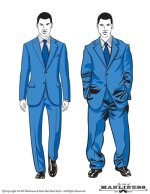
Something I learned later in life was the importance of fit. It can make a big difference.

Good-Fit-vs-Bad-Fit-400-AOM.jpg

That being said, the same principles can apply to other types of clothing, like a tee shirt and leather jacket.

styles-how-to-wear-a-leather-jacket-mens-leather-jacket-outfits-styles-v-neck-t-shirt-and-jeans.jpg

Maybe in another world, this is what bankers would wear. But you can't work at a bank dressed like this, even though it looks just as good on you. Besides pure visuals, tradition plays a part. Flouting tradition provokes questions like, "Why didn't you get the memo?" or "Why do you think you are exempt from the memo?" If you can't afford it, that's one thing. But if we know you can afford it (because you work at a bank) then ignorance and arrogance are not desirable qualities.

But I think you would look just as dumb wearing a suit if you're not a banker but some other person who needs durable, flexible clothing, like a farmer, a plumber, or a member of a film crew. (All of these people I hold in the same regard. In fact, especially in this day and age, a farmer might make a better first impression than a banker.)
 
Last edited:
I’ve started wearing a small barrel of Kentucky distilled spirits around my neck instead of my normal ascot because the last year has taught me that at any moment I may be summoned to a Swiss chalet to help form a rescue party or emergency fondue shindig.
 
I had to wear a tie in high school but we could get by with slacks and jackets/sports coats, sometimes sweaters. Electronics retail was "tie required" also in the Midwest. In LA, some chains required it; others had store brand attire; others still let you wear a t-shirt and a pair of shorts.
 
If you don't wish to wear a tie, don't. No conforming is allowed. Dictating modes of dress, or worse, telling others they are wrong is insulting. If you wish to do certain jobs, then uniform, and make mistake, ties are uniform components is mandatory. Uniform - as in all looking the same, conformaility to the 100% mark.

I respect anyone who doesn't want to wear one, but for years people did for virtually every job. In the UK in the 50s, railway linesmen, the people walking the tracks, the engine drivers, the porters and everyone wore ties.

Ou police woren ties - clip on one eventually when criminals decided to try to grab them, but so many professions wear uniforms. In the UK, Barristers wear wigs like the judges. It's a badge of office.

Indeed - I find it fund spotting the people who only wear tes for weddings and funerals. The chafing around the neck, the loose fit, the simply dreadful knots - all indications of casual tie wearers. The people with the properly tied knots are so obvious.

There is also a degree of subliminal authority. In one managerial role I do, if I walk amongst the public perhaps in the foyer of a theatre - people come up to me and ask questions, they smile, and take the shrt and tie as a sign of seniority. If the next night I walk through the same area in black trousers and a black Polo shirt, I get ignored.

Long live the tie - as long as it is properly tied and worn. It is NOT restrictive and only dangerous if you stupidly wear one in the wrong circumstances.
 
Back
Top