
Navigation
Install the app
How to install the app on iOS
Follow along with the video below to see how to install our site as a web app on your home screen.
Note: This feature may not be available in some browsers.
More options
You are using an out of date browser. It may not display this or other websites correctly.
You should upgrade or use an alternative browser.
You should upgrade or use an alternative browser.
F3: The NEW PMW-F3 s-log footage collection
- Thread starter Shoots56
- Start date

starcentral
Veteran
It is fabulous stuff.
Color is thin in S-log samples I have played with. For the internal camera codec, it is difficult to get to normally saturated color without breaking the images. Except for the bird sample recorded to 10-bit uncompressed and the last commercial sample, all of these look pale. Even those look a bit thin. The skin tones look flat and plastic. Certainly a valid look if that is what you want, but rich saturated color and nicely modulated value scales are very difficult to get at the same time with S-log.
Personally I like the cine gammas better.
Personally I like the cine gammas better.

Nate Weaver
Veteran
...but rich saturated color and nicely modulated value scales are very difficult to get at the same time with S-log.
You need a good LUT. For original S-Log, I never had one or managed to construct one when I had an F3. Only came along after I got the 55.
Just playing around with a 3-way corrector doesn't cut it. I think you already know this and that's what you're saying (apologies if I've got that wrong), but to look truly good it's got to be a mathematically correct LUT, with a highlight roll-off built in.
For bonus points, the LUT would have some color magic built in to coalesce yellow through red and make skin tones more pleasing.
If you know how to read scopes, there is nothing that a LUT can give you that you cannot achieve fairly quickly yourself if you know your way around a grading app.
Funny never had a problem getting saturated colors if I needed them. Even in 422.
I think a lot of people never look at the system settings in many apps like Resolve. They make a huge difference.
Further, saturation is part of the process of seperating out values, but most people are too afraid to play with it.
The guys face in the 4th video from the top is an example of this for me.
It's either a stylized choice or a lack of balls. Only the maker really knows.
Lastly a lot of these vids look grey because they often do not have real black and white points. It's the very first thing you do before you even begin grading.
Once again it is hard to say if this is a conscious choice or not, but I know I could correct that issue in a matter of minutes.
Last edited:
Nate Weaver
Veteran
If you know how to read scopes, there is nothing that a LUT can give you that you cannot achieve fairly quickly yourself if you know your way around a grading app.
This is technically true, but I disagree about the "quickly" part.
The most involved LUTs I've seen have multiple transforms going on. Putting Slog2 footage through ACES could be compared technically to a LUT, but have you seen the contents of a .CTL file and the transforms involved in both the IDTs and the RRT? It's not simple stuff. And the results bear it out, it takes very Sony looking SLog2 footage and transforms it into something else entirely. ACES pretty much replaces the entire color science of S-Log2, and I have a 3D lut that I created that essentially does the same. I couldn't even begin to recreate that in a grade by hand. I'm not meaning to be combative, but do you understand what I mean?
Then there's the film print LUTs going around right now. There's complex color channel crosstalk going on, that completely changes color rendition. At first blush, some of them look like "oh, there's some blue green added in the shadows, and all the red/yellow/oranges are boosted", but there's more than that at work in the ones that are created by scanning real color targets shot with real film. Saturating/desaturating different color vectors, shifting other vectors around, gamma curves, white/black point washes, I mean, I could spend all day trying to replicate it and still not get it 100% authentic.
People place too much faith in math, but ours is not an objective science.This is technically true, but I disagree about the "quickly" part.
The most involved LUTs I've seen have multiple transforms going on. Putting Slog2 footage through ACES could be compared technically to a LUT, but have you seen the contents of a .CTL file and the transforms involved in both the IDTs and the RRT? It's not simple stuff. And the results bear it out, it takes very Sony looking SLog2 footage and transforms it into something else entirely. ACES pretty much replaces the entire color science of S-Log2, and I have a 3D lut that I created that essentially does the same. I couldn't even begin to recreate that in a grade by hand. I'm not meaning to be combative, but do you understand what I mean?
Then there's the film print LUTs going around right now. There's complex color channel crosstalk going on, that completely changes color rendition. At first blush, some of them look like "oh, there's some blue green added in the shadows, and all the red/yellow/oranges are boosted", but there's more than that at work in the ones that are created by scanning real color targets shot with real film. Saturating/desaturating different color vectors, shifting other vectors around, gamma curves, white/black point washes, I mean, I could spend all day trying to replicate it and still not get it 100% authentic.
In my experience there are two reasons why people use LUT's:
1) They don't have a lot of experience grading and it gets them close to what they would otherwise have difficulty achieving at this stage of their experience.
2) They can be a useful preset for a highly standarized shooting situation.
While I appreciate that ACES is a large step up from conventional LUT's, I personally find that I am able to achieve what I am looking for from an image using the tried and true processes of primary's and secondaries in relatively quick order. The goal is not to achieve or match what a lookup table provides. A LUT is just a preset amongst many others in a real grading suite. It is supposed to get you closer, quicker. However, this is not always the case as the real goal is to create a scene which an audience wants to look at and which is coherent with the shot before and after it. Whether you use ACES, 1D or 3D lookup tables, you will still have to address this. No LUT or machine can possibly understand the subjective nature of content. Otherwise we would all be using the Automatic setting on our cameras (if they even have one). I have found that even when I use a lookup table I still need to intervene after to deal with the subjective aspect. The actual time of interevention is in the end not that different than if I started from an SLOG image anyway. Believe me I have seen serious folks grade entire features in less than a day without a single LUT.
A LUT might save me 30 seconds, but the subjective nature of the grade is still going to take ten, twenty or a hundred times longer. Further I have found that most LUT's leave me with just as many unusuable images as not using them. In other words while they might compensate for SLOG, they do not take into account the infinite number of different ways in which an image can be shot or intrepeted. Just watch what happens to your LUT when a shot is exposed a stop to the left or to the right for instance. The most common problem I have seen (even with ACES) is that they leave me with TOO MUCH contrast. So if I am compensating for too much contrast, how is that any different than compensating for not enough? (As in an uncorrected SLOG image). In the end it is often simpler just to start with the latter, because at least I have all of my information in front of me and no unexpected clipping (albeit non-destructive) has gone on because of an arbitrary LUT being applied.
Anyhow, that is just my point of view. It's not gospel, just my own practical hands on experience as someone who has done a fair amount of grading for other people.
Last edited:
morgan_moore
Major Contributor
I think some of this is wooden but not the sports advert.
As for luts/looks/presets, I think there is value, simply we are viewing delivering 709 and that has a curve, a log to 709 transform seems a logical place to start, as long as is does not involve un-recovorable clipping.
BTW this is "math .. an objective science."
S
As for luts/looks/presets, I think there is value, simply we are viewing delivering 709 and that has a curve, a log to 709 transform seems a logical place to start, as long as is does not involve un-recovorable clipping.
BTW this is "math .. an objective science."
S
Last edited:
Personally I like the cine gammas better.
Weird because I thought you didn't like the plastic skin thing. When s-log is done well it's the only time they don't look that way. The grade is up to the creator.
I am quite sure the looks above were carefully managed. (The Ginny Luke couple looks plastic to you?? Desaturated some but professional results nonetheless)
I am sure part of it is creative choice in the grade, but these people all look like airbrushed cadavers. The thing is you will have a hard time finding S-log grades that go the other way with rich color and fine tonality that brings out the translucence and texture of skin. Most of it just looks flat and lifeless. It is a legitimate look, but really more of a contemporary fad.
Show me a log grade that can reproduce rich color with the fine tonal differences of color temperature between highlight and shadow playing across skin like this non log example:

You give up a lot to get nice highlight roll off with these log LUTS. There are other ways of getting there without giving up so much of the tonal range.
S-log works better if you record to a deep color data rich codec via external recorders, but when you add the long GOP compression of the internal codecs on top of the log compression. you wind up with too little data to get you there.
Last edited:
morgan_moore
Major Contributor
I agree with you Razz sort of. I have not tried the camera enough yet.
Simply IMO rec709 puts the rate of change of tone quite high. Now a grade to make a punchy 709 will need more graduations than 709, but 709 is 8bit so one can in 10bit have a curve 4x more flat because you can ramp up the curve by 4 without inducing banding. But the log curve is so flat that can one hit the 1-4 gradient? - in fact a punchy image is harder than 709 curve so you probably need a tonal change curve not at 1-4 but 1-3, is this data there in 10bit Slog - and up to what exposure level? I dont know yet.
It is interesting that your normall graded still seems over saturated, I dont know why - maybe it is the 2013 visual language of log and instagram filters. I find a lot of my old stills now seem over saturated, even though my normal start point with the nikon D3 in Capture One is saturation 90%
S
I may not be able to record out to something heavy until late Jan. so I have to wait to till then to start really using and testing log properly with actors. I'll be doing some shots with several actors at that time and hope to have a 7Q by then so I'll see what is what! I plan on doing a few in uncompressed so that will be interesting. I still don't know which lenses we get to rent out but likely some older Zeiss (since I try to avoid new, super clean lenses for digital cameras like the plague!)
And I like what these guys did above and I don't think it's necessarily a fad but maybe more a result of what an affordable wide dynamic range camera can do now, unlike a few years ago. Or it could be seen like slo-mo is now... overused like hell, kinda like shooting into the sun- that sh*t is getting OUT OF CONTROL! Maybe that is why we see a lot of desaturated s-log... the lenses are packed full of direct sunlight!
What gets me is that I can use a red camera and get richer color "range" but I still feel like I'm looking at plastic or digital faces. Maybe the dragon upgrade will finally help to put it to rest but I doubt it. Film rules the color game and still absolutely owns "mojo".
I am sure part of it is creative choice in the grade, but these people all look like airbrushed cadavers. The thing is you will have a hard time finding S-log grades that go the other way with rich color and fine tonality that brings out the translucence and texture of skin. Most of it just looks flat and lifeless. It is a legitimate look, but really more of a contemporary fad.
Show me a log grade that can reproduce rich color with the fine tonal differences of color temperature between highlight and shadow playing across skin like this non log example:
You give up a lot to get nice highlight roll off with these log LUTS. There are other ways of getting there without giving up so much of the tonal range.
S-log works better if you record to a deep color data rich codec via external recorders, but when you add the long GOP compression of the internal codecs on top of the log compression. you wind up with too little data to get you there.
I do record to external recorders and I agree that the internal codec is a bit thin.
However, the image you are showing above is in a highly controlled circumstances with limited shadows and highlights. Take that same girl out there in the middle of an LA street looking down a long thouroughfare with the sun peeking over the edges of houses and lighting up the facades on the other side, add a little movement and a couple of people with different skin types and I would say that it would be a different ball game all together. The SLOG starts to be pretty helpful in those circumstances.
morgan_moore
Major Contributor
but I still feel like I'm looking at plastic or digital faces. .
I know people dont like science, but to me 'plastic' look is simply a lack of tonal graduations aka contrast.
Let us imagine a face maybe with one stop of brightness across it.
That is about 40steps of graduation in 709. (assuming 7stops=256 levels)
But a face with punch graded in could have the contrast upped to 50 or 60 steps. (in magazine still I mainly add a little Scurve to a face giving it more contrast)
It would seem that as long as your camera/grade applies 60 graduations across a face it will not look plastic.
I feel that Red is fully capable of delivering that. Slog 10bit - maybe but where on the curve?
Of course to some extent my numbers are dependent on lighting, but where one to meter the forehead highlight and maybe nose shadow one could have a concept of the tonal range one would b looking for given my 40steps per stop maths. So a face with 2 stops would need up to 120 steps in 8bit to really sing.
S
A different sample from Jochen Rysavy shot with a BMCC.
I always feel there is something grey and pastel with the transitions in BM footage.
It's as if B&W footage has been colorized. Very strange.
I also defintely feel a lack of color information in the skin tones, a bit like old footage from the Red One.
There is no nuance in this girl's face for instance. This is not just the makeup, there is missing information
there.
morgan_moore
Major Contributor
I grabbed something from my resolve timeline - Im concerned this face does not have enough tonal punch.
Looking at the scopes (on the face only) we can see that the face goes across nearly 40% of the scopes which kind of matches my estimates above..
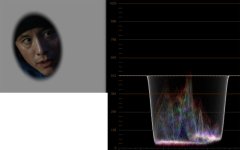
Looking at the scopes (on the face only) we can see that the face goes across nearly 40% of the scopes which kind of matches my estimates above..
morgan_moore
Major Contributor
I do record to external recorders and I agree that the internal codec is a bit thin.
However, the image you are showing above is in a highly controlled circumstances with limited shadows and highlights. Take that same girl out there in the middle of an LA street looking down a long thouroughfare with the sun peeking over the edges of houses and lighting up the facades on the other side, add a little movement and a couple of people with different skin types and I would say that it would be a different ball game all together. The SLOG starts to be pretty helpful in those circumstances.
Slog may be good to help record the wide DR scene you describe, but simply if you don't ramp the contrast up to 7stops from black to white it will be wooden. Such a curve would obviously crush/clip a wide DR scene but then it has to be pulled back in secondaries. If the curve is not steep enough you get wooden, end of.
morgan_moore
Major Contributor
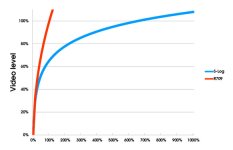
I created a 'notional' 709 curve.
68 maps to 100, which actally hits published data well.
This means that a LUT should be so harsh that any value above 68 should be clipped, if it is not, the image does not have proper contrast and will look wooden.
Of course that does not mean data above 68 is useless, because you can bring it back with secondaries, I think it just demo how harsh a correction needs to be to get back a realistic look.
Of course doing an ETTR stunt in an attempt to escape the noise floor will need even more odd corrections and to carry them out in a naturalistic manner is doubtless somewhat of a challenge..
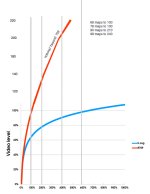
68 maps to 100, which actally hits published data well.
This means that a LUT should be so harsh that any value above 68 should be clipped, if it is not, the image does not have proper contrast and will look wooden.
Of course that does not mean data above 68 is useless, because you can bring it back with secondaries, I think it just demo how harsh a correction needs to be to get back a realistic look.
Of course doing an ETTR stunt in an attempt to escape the noise floor will need even more odd corrections and to carry them out in a naturalistic manner is doubtless somewhat of a challenge..
Attachments
Nate Weaver
Veteran
People place too much faith in math, but ours is not an objective science.
In my experience there are two reasons why people use LUT's:
1) They don't have a lot of experience grading and it gets them close to what they would otherwise have difficulty achieving at this stage of their experience.
2) They can be a useful preset for a highly standarized shooting situation.
I get what you're saying. I might have said the same at one point. I place no faith in math. I place faith in my eyes. What I was trying to say is that their math has a lot more going on than just a gamma curve and a saturation boost. It's modeling a camera's image processing chain. Go look at the Ritz piece I posted, and tell me if it looks anything you've seen from a Sony camera, especially the exteriors.
Suffice to say, I have found a 3D LUT (the ACES derivative I made) and ACES to give me the image I want as a starting point. It's the closest I've gotten to an Alexa without an Alexa. For a colorist to walk in and say "Oh yeah, I can replicate what's going on there in 30 seconds" based on 1 or even 5 images in a timeline probably isn't seeing the same subtleties I'm seeing, and being a bit brash.
Regardless of all this, I consider the LUT to be director of photography's prerogative in the same way a DP might have chosen a film stock in the past. It's the look that was in my mind when I previsualized the images, and that's an important creative step. I can't pre-vis in log space if the final look isn't anything like untreated log.
If the colorist insists on tossing my previs tool to the side because he's too macho and doesn't understand the subtleties I see of the LUT I'm using, then he does so at his risk.
As far as your argument with exposure...ACES is effectively re-exposing log images like a raw decoder stack does, so I find that I get the best results in a true ACES situation. The 3D LUT, if you gain up or down before the LUT, gets somewhat close to the same results. If you have too much contrast, I think you should check your input clip levels scaling (video vs. data).