The New Cinema Camera

  • Thread starter Thread starter Guest
  • Start date Start date
And of course, there is more to a camera than dynamic range.... just that dynamic range seems to be one of the more noticeable and important ones ;)

I agree that DR is important.

But I do feel the elephant in the room with all these +/- 6 stop tests is that while they might be good to show the differences at the extreme end of the spectrum, I've never (well, with very few exceptions) ended up with an image looking like anything but the +3 faces or better. And this is since shooting with the 5D mkII basically...

Of course, cameras with limited DR then show their warts in the shadows/highlights, but that's not nearly as drastic as, let's say, a blown out face like we see here. I think subconsciously we expect highlights to become very bright—but a face? Not so much. That is not to say that beautiful highlights isn't a thing.

But: just shoot the normal exposure with all these cameras and look at that in various lights. Are some of the shots hard to tell apart in a blind test then? Well, that's reality catching up right there. Even so, there might be a bunch of reasons to choose one camera system instead of another, but in terms of IQ comparisons, that's the one that counts.

The shootout Teddy_Dem links to above is OK I think (my focus is on the exterior scenes).
 
What I want is: my talent looks good, and the highlights are not blown. This is often very easy, but sometimes I find myself in situations where it is not, e.g. if I put the talent in the shade so light is more pleasant, but background is sunlit (original a7S+slog2 levels of DR were often good enough for this), or shooting inside a train with window to the countryside (recently did this with the p4k and it worked great; I think my old Sonys would have broken here; it was just one person so I could put her close to the window, if I had to work with, say, four people, then I would have needed big lights or ND on the window, and since these are usually not an option for me in such locations, it would have meant blown highlights on the p4k).
The "ramp on skin" test is very useful for this because we have a very good eye for broken skin highlights, not so much for other types of objects.
 
I agree that DR is important.

But I do feel the elephant in the room with all these +/- 6 stop tests is that while they might be good to show the differences at the extreme end of the spectrum, I've never (well, with very few exceptions) ended up with an image looking like anything but the +3 faces or better. And this is since shooting with the 5D mkII basically...

Of course, cameras with limited DR then show their warts in the shadows/highlights, but that's not nearly as drastic as, let's say, a blown out face like we see here. I think subconsciously we expect highlights to become very bright—but a face? Not so much. That is not to say that beautiful highlights isn't a thing.

But: just shoot the normal exposure with all these cameras and look at that in various lights. Are some of the shots hard to tell apart in a blind test then? Well, that's reality catching up right there. Even so, there might be a bunch of reasons to choose one camera system instead of another, but in terms of IQ comparisons, that's the one that counts.

The shootout Teddy_Dem links to above is OK I think (my focus is on the exterior scenes).

Then you might have noticed the actor’s white T-shirt gets a little weird with the cameras that have less DR.
 
A studio mixed lighting skintone ramp test will further show true color performance. RGB lights will be helpful. Some colors such as strong primaries can be challenging e.g. blue.
 
A studio mixed lighting skintone ramp test will further show true color performance. RGB lights will be helpful. Some colors such as strong primaries can be challenging e.g. blue.

I kind of like it when a camera picks up the weird shift of some lights. But that is more for when i have artisitic liberty to do so. Most work seems to benefit from the colour forcing profiles of cameras like Alexa, Black Magic, or Venice. One reason being, that most people don’t pay attention to subtle colour shifts in real life, so, when a camera is too passive, it doesn’t really capture what most people see.
 
I kind of like it when a camera picks up the weird shift of some lights. But that is more for when i have artisitic liberty to do so. Most work seems to benefit from the colour forcing profiles of cameras like Alexa, Black Magic, or Venice. One reason being, that most people don’t pay attention to subtle colour shifts in real life, so, when a camera is too passive, it doesn’t really capture what most people see.

The best tools are predictable and reliable. Some cameras have serious problems with mixed and RGB/pure lights. Helpful to know which cameras do what before using them for a shoot.
 
The best tools are predictable and reliable. Some cameras have serious problems with mixed and RGB/pure lights. Helpful to know which cameras do what before using them for a shoot.

I’ve been burnt by not fully understanding a camera properly on a project. Finally got tired of it, and just going to start sticking with one camera again. I enjoyed the 1DC, as i could carry it around, once i got used to the weight, and then the camera i could work with, was also the camera i shot with everywhere. Was liberating to be able to meld with a camera like that.
 
I’ve been burnt by not fully understanding a camera properly on a project. Finally got tired of it, and just going to start sticking with one camera again. I enjoyed the 1DC, as i could carry it around, once i got used to the weight, and then the camera i could work with, was also the camera i shot with everywhere. Was liberating to be able to meld with a camera like that.

Yeah, if the rumors are even slightly correct, the EOS R5 could be that camera again: good enough IQ, DR, IS, AF, and detail (4K oversampled, possibly 8K (which could be downsampled in post- perhaps same or better results as in camera and also allow for detail-holding post cropping)), uses commonly available lenses, is reliable, and is as compact as currently possible. Even with the current limitations, the EOS R has been super useful for run & gun / doc / verite, and has done well in mixed / uncontrolled lighting. With a little COB LED cube light + CMIT5U + $30 preamp and the RF 24-105 L IS, handheld shooting has been really liberating and fun. For more motion, the single-handed Crane 2 has worked well with this setup + don't need extra support gear to manage the weight: have shot a few fun projects using the 16-35 F2.8L II on the gimbal. The A7S III/IV could also be an amazing compact tool if/when it's released.
 
Here are some screenshots compiled from the camera comparison:
49498043922_527f25923e_b.jpg

Edit:
Join Date
Dec 2006
Location
SoCal
Posts
4,412
Default Yesterday, 11:41 PM
Probably not a big surprise but here's the order, I'll have a labeled video up in a few days, just go booked for the weekend though.
1. Arri Alexa Mini LF
2. Canon Eos C500mII
3. Red Monstro
4. Sigma FP
5. Sony FX9 (S-Cinetone)
6. Sony FX9 (S-Log3)
7. Sony Venice
8. Red Gemini
9. Red Helium


While #1 was perhaps the best overall, #3 had a good warmth and saturation which looked nice to.
#7 averages pretty consistent through all the scenarios, but perhaps skewed a hint green comparatively.
 
Last edited:
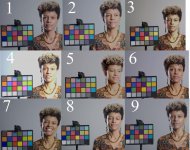
OK, as we wait for the reveal, here's the +6 set
plus6.jpg
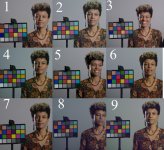
And just for completeness, the -6 set
minus6.jpg
 
Last edited:
1. Arri Alexa Mini LF
2. Canon Eos C500mII
3. Red Monstro
4. Sigma FP
5. Sony FX9 (S-Cinetone)
6. Sony FX9 (S-Log3)
7. Sony Venice
8. Red Gemini
9. Red Helium
 
My notes from just before coming here and seeing the results:

+6:
1 - perfect highlights
2 - broken highlights in half of his face, and her cheekbone and neck
3 - just as broken as 2 in the highlights but with nicer rolloff
4 - the worst in the highlights, half her face is broken
5 - broken highlights on him but less than 2/3 and her face is almost OK
6 - just slightly broken highlights on him, her face is perfectly OK
7 - perfect highlights, I still like 1 better but this is pretty close
8 - similar to 6, her face is perfectly OK
9 - similar to 5, her face is almost OK

-6:
1 - perfect shadows, not a lot of noise, some in his jacket but even that would be usable
2 - ugly noise in shadows and his jacket, but bearable otherwise, and background is OK
3 - slightly more noise than 1, but not really too far
4 - flicker is a killer here, but in the moments when the image is OK, shadows are bearable and background is OK
5 - perfectly fine for the most part, then awful noise in the darkest shadows
6 - ugly noise in shadows and his jacket, but bearable otherwise, and background is OK
7 - slightly worse than 2 or 6
8 - the noisiest one, ugly noise in shadows and his jacket, and visible noise in background too
9 - slightly worse than 2 or 6

So, with the results out, my ranking is:
Highlights: Alexa >= Venice > FX9slog = Gemini > FX9cinetone = Helium > Monstro >= C500II > sigmaFP

And in the shadows, as long as sigma can fix the black level flickering, I would say:
Alexa > Monstro > C500II = SigmaFP = FX9slog > Venice = Helium > FX9cinetone > Gemini

Not having the full ramp, I can't make an accurate guess for the whole range (highlight range plus shadow range), but if I assign any numeric value to each ">" and half as much for each ">=", then the ordering I get is:
Alexa >>> Venice = FX9slog > Monstro > Helium >= C500II >= FX9cinetone = Gemini >= sigmaFP

The winner, as always, is the Alexa. The Venice did great, and the FX9 seems to be pretty much tied to the Venice in terms of range. Monstro would fall behind those. And then the rest are pretty close. The Sigma is the worst in the test but it did great: there may be less range difference between the FP and the Monstro than between the Monstro and the Alexa.

Now , for the part that's most imporant to me: comparing with my graph from page 1, I think the fp, XT3 and p6k must be pretty close to each other... as long as sigma can fix the jumping black level thing.
 
  • Like
Reactions: jcs
The irony of #8, is that is Gemini, one of the cleaner cameras out there. I’ve put it up to the Alexa mini, and even at 1600, the Gemini in standard mode wasn’t breaking a sweat, and the Alexa mini was already showing noise. Then in the Gemini’s LL mode, there was just no comparison.

So, i guess that was just really down deep on the Gemini, seeing how it managed to retain a good amount of highlights in the over. I will say, despite the hue shift on the under, the details and mount of noise is still quite nice.
 
The LF (1) just averaged so well. It look acceptable on all of the actors, and in all of the lighting situations. It feels like this camera can do no wrong under iso3200.

The Venice (7) skewed a certain bias. And i liked it less than other cameras in some situations. It averaged extremely well, and as a tool, that is a big deal. Very predictable results through the exposure range. A little noisy in the shadows, but generous in the highlights. Really, the only place it faltered, was in the studio on the woman. In general, digital cameras are week in green, so i am usually happy to have a little green bias, but in this test, was hard to unsee how pretty the LF and the Monstro were in the colours. In any case, the Venice is crazy good. The issue for me is, are Venice users just people who’d rather be shooting Arri, for the most part?

The Monstro (3) i didn’t like all that much. I could see the appeal, was more saturated and it maintained nice colour on all of the actors in all of the light scenarios. But it felt midtier, at first. Until i saw the under exposure test, and then i reallized it is over exposed by maybe a stop. Which is more a stmptom of the how Red rates the camera than the DP’s fault. Actually, Eric Coughlin recently mention how he like to ETTR for cleaner shadows, so, Red is not wrong, it is just not my preference. I’m more similar to Sam H in that i’ll take highlight roll off at the expense of some noise. Though, my taste for noise gets less every year it seems.

But if you look closer at the under exposure, the Monstro (noise reduction or not) is the cleanest on the list. The camera has some serious DR. It also scored really high on pleasing skintones and colour. A few comments were made about that. So, i can see why some people love the Monstro, and may even prefer it over the Alexa Xt or Mini. As the MiniLF becomes more available, we’ll see how that changes the perception of the Monstro.


#5 did well for me, as far as a dark horse favorite.

Helium(9) surprised me in how good it looked when exposed correctly. Not just good, but really good!

All the cameras, in real life are fantastic.
 
Last edited:
JCS posted this on another thread, but it think it is worth a repost here.

The Fx9 is a formidable mid range camera. The the consistency of colour through the exposure range, and the warmth in the slog3 to Venice LUT and it’s highlight roll off are looking to be raising the bar for this price segment. Perhaps the Varicam LT and the Ursa Mini Pro are the other two that stand out as well, but different sensor formats, so, not exactly apples to apples.

https://vimeo.com/383382022

https://www.youtube.com/watch?v=_HvMSBwXV6s

Relinked the vimeo, which seems to have better looking compression.
 
Last edited:
The auto focus on the fx9 is also kind of a great equalizer for low budget new film makers who don’t have access to experienced 1st AC’s. As well as making gimbal work less stressful.

49532608141_e6ca396133_b.jpg
 
Recently got to shoot with the Canon C500ii. Got to say, for being i camera i never asked for, it is really great to use and shoot with. I have a few specific preferences in camera design, and lately Canon has been the farthest from it.... on paper anyway.

Using the thing is another matter all together!

Between the touch screen led, the oled evf, the bnc out, the audio controls in the right place for the audio person to access, and the internal ND, and the relatively conservative battery draw, and quick ~5second boot up times, i was never waiting on the camera. Never frustrated with the camera, and never limited by the camera. And yeah! It makes fantastic pictures!!!

For full frame 35 sensor, the rolling shutter was fantastic. I felt up to iso 3200 i didn’t even question if i should or shouldn’t by iso 6400, i did hesitate, not having a lot of experience with it. My question being, will this match the iso 800? Luckily, i thought ahead and just shot everything at iso160 to start and spread out my baseline knowing i’d have to cheat later on. The internal ND’s are great. Was easy finding a good exposure to iris setting. Especially earlier in the day when i was pushing the stock at iso 1600 and needed to adjust ND a bit more than usual.

For me, seeing as i already have bought a red, i won’t need another A camera, but the C500ii was a breeze to pickup and start shooting with. The DR is not where i prefer, but even the Alexa doesn’t have enough for what i like, but the C500ii still has plenty of latitude. I felt that wide DR made it look like the image was clipping a little sooner than the camera really was. The raw had at least an extra stop. The EVF has a nice big 1080p image that is very confidence building, and the LCD touch screen is flexible for any use.

Would you say that it's clean enough at 1600 ISO to intercut seamlessly with 800 ISO?

With the 2-stop jumps in ND filter steps, it'd be nice if the ISO performance is close enough that you could simply go up or down a stop in ISO (when you change NDs) in order to give you 1-stop precision in exposure (so you can keep aperture at the same setting).
 
Back
Top