The New Cinema Camera

  • Thread starter Thread starter Guest
  • Start date Start date
Would you say that it's clean enough at 1600 ISO to intercut seamlessly with 800 ISO?

With the 2-stop jumps in ND filter steps, it'd be nice if the ISO performance is close enough that you could simply go up or down a stop in ISO (when you change NDs) in order to give you 1-stop precision in exposure (so you can keep aperture at the same setting).

I’m not sure what your goals are, so, i wouldn’t recommend it. Changing the iso can match though.

I think Canon iso is baked in, even in raw.


With the Red Gemini, changing iso feels more like changing the personality of the camera. Since the captured exposure between iso800 and iso1600 is the same data, that means iso1600 is just digging into the shadows and moving a stop to the highlights. That is really cool, because now at iso1600, the Gemini starts looking more like the Venice or the Alexa. However, then the 800 looks like that ultra clean RED video look we are accustomed to and many love. The odd thing is, i didn’t feel the same big personality shift in the C500ii. It could have been because the wide dr lut maps in a certain way. Could be that Canon applies gain at each iso stop and some how that keeps the shadow to highlight ratios more consistent? I would have to go back and dig into the raw to know for sure.

As far as getting away with matching iso1600 to iso800, certainly. But match cutting the same shot of the same face, might be a slight shift.

We shot in mostly chronological order, so the shots get progressively noisier and more shallow dof. Will be a big old stress test once edited together.

It was one of those projects i knew i was going to have to fake some day light at the end, and we ended up going farther than i felt comfortable, as i am not very familiar with it. We’ll know in a couple weeks once the director and editor can get to the edit.

I shot a clip of iso6400, and felt that was the limit before i started feeling like had to hold back without more in depth testing. So, 1600-3200 were very much iso’s i’d use frequently, and everything under 3200 felt really clean. Having also just shot on an old C300mk1, i can say they are in different worlds. C500ii is cleaner, and miles ahead of the original C300 in every way. ....i was still kind of impressed with the C300, but it was pretty noisy and the personality changed a lot by iso3200.
 
My buddy owns the C500ii, maybe i’ll get him to do the iso/ND match cuts, and see how it looks.

With a lot of the newer cameras iso1600 is just not even a worry any more. Makes the Alexa and the F55 feel like slow cameras these days.


One of the things i notice though, is that going from iso800 to iso1600, is that under pressure, if iso1600 is underexposed, that is where it may behave differently from iso800. Definitely worth testing.

Good to know, thanks. And if you can get you buddy to test it out, it'd be super interesting to see the results.

I really wish they'd gone with a different combination of NDs to allow for 1/2/3/4/5 stops (instead of 2/4/6/8/10). Having that precision to flick between in an instant would be so much more useful than having the wider spread of NDs with less precision. It's no big deal to add an external ND at the start of a scene to set a baseline (from which you can adjust in 1-stop increments with internal NDs), but it's quite a big deal having to constantly switch an external 1-stop ND in and out in order to maintain a particular stop for depth of field control.
 
That is the beauty of the Sony Fx9 and Venice.

I’m very curious about the Kippertie revolva, as well. Since there is the option to go in increments of 1 stop ND. Although, it isn’t shimmable yet, for the Ranger body.

Maybe Canon will introduce the C500mkiiB with 1 stop increments.

It is kind of true. These cameras like to slap on the “cine” badge, but they often seem to be trying to appeal to wider markets. In the cinema camera sense, anything but internal 1 stop, or less, increments makes little sense to me.
 
Last edited:
Would you say that it's clean enough at 1600 ISO to intercut seamlessly with 800 ISO?

With the 2-stop jumps in ND filter steps, it'd be nice if the ISO performance is close enough that you could simply go up or down a stop in ISO (when you change NDs) in order to give you 1-stop precision in exposure (so you can keep aperture at the same setting).

Pretty much! Looks like iso1600 is very similar to iso800. Might lose a half a stop in the shadows to noise at the very bottom, but all of that could be averaged out. Looks like there is also a very subtle amount of shift in the mid point. Which whithoit more thorough testing, just feels like margin of error stuff. Could have been anything. But any shift is much much more subtle than say the Red Cinema Cameras, which are not subtle at all. Everytime i change the iso on a Red, it feels like a different camera (for better or worse).

From iso6400 to 12,800 it is very usable. And 25,600 is usable in a pinch. But docu shooters could keep going.

We shot in log so we could really see the extremes. Iso3200 starts to see a character change in the shadows. Some faint noise. Iso1600 does show a tiny bit of noise compared to iso800, which is super clean. But compared to the Alexa classic or F35, then iso1600 is very clean.

The image stays very similar looking from iso800-3200.


Obviously, you are a fantastic DP and you’d be doing your own stress tests, but for most things, i think 800 vs 1600 is totally interchangeable. Would be interested in your observations of the camera when you get hands on.
 
Last edited:
Good to know, thanks. And if you can get you buddy to test it out, it'd be super interesting to see the results.

I really wish they'd gone with a different combination of NDs to allow for 1/2/3/4/5 stops (instead of 2/4/6/8/10). Having that precision to flick between in an instant would be so much more useful than having the wider spread of NDs with less precision. It's no big deal to add an external ND at the start of a scene to set a baseline (from which you can adjust in 1-stop increments with internal NDs), but it's quite a big deal having to constantly switch an external 1-stop ND in and out in order to maintain a particular stop for depth of field control.

After shooting the FX9 for a week going back to regular NDs on the Canons is tough. Probably overall the coolest feature on the FX9. You can do a lot of fun, creative things with it.
 
After shooting the FX9 for a week going back to regular NDs on the Canons is tough. Probably overall the coolest feature on the FX9. You can do a lot of fun, creative things with it.

Can you set two points of ND and choose when to move between them? I'm guessing auto would probably pretty damn good anyway.
 
The way I work with Canon cameras is to actually ride the ISO for exposure rather than ND or the iris. You can shift between 800 and 3200 without any noticeable impact on the noise or gamma of the image. For example, if I need additional depth of field for some reason, I will just close down the iris and raise the iso and nobody will notice a change in the image other than additional detail in the out of focus areas. If you need a stop less light, it is fine to just drop in two stops of ND and bump the iso from 800 to 1600. It would be nice to have a variable nd, but Canon has designed the camera so that there is no reason to feel that you are stuck at the base iso.
 
Not that I could find in the menus but remember, we are talking Sony menus here, so it's possible that you could set the ND between two values? I'm back at Sony next week for a workshop, I'll ask the Sony trainer if that's possible.
The Sony menus are like decoding ancient Egyptian hieroglyphics ;-) I did try a handheld shot where I carried the FX9 low by the handle and walked with it straight into the sun
and the FX9 ND tracked my exposure pretty nicely. I also tried panning on an off the sun peaking around a rock. I was laughing thinking that my Canons would have been useless in those shots.

Interesting too that Z CAM introduced their E ND Filter yesterday for almost all of their models at $399.00. Not as sophisticated as the Sony system but still allows adjustment in 1/3 stop increments allowing for 1.7 to almost 7 stops of ND.

I predict variable electronic ND is the next autofocus, it's too handy and too good. This feature alone, from a shooting perspective, makes the FX9 almost more attractive than the C500 MKII to me, even though I like Canons.

Lol who would've thought vari-nd would shake things up so much! It makes sense though when images are really nice across the board then it comes down to things like size and certain features.

If sony/lens control product could map their vari nd to replace the iris on a FIZ, you'd have a FI, hold the Z, but without motors.

I know adjusting ND is different to iris but I assume the ability to change exposure through aperture happened because of the designs of the lenses, as well as high ISO shooting and vari-nd not existing, rather than being the most ideal way to control exposure in a cinema environment. A director of an event with a camera on the end of a long jib wouldn't care but I imagine cinematographers would prefer the ability to maintain T-stop if all else was the same, or close enough.

I'm not talking about creating a product that makes money, just speculating about an advance in tech that eliminates hardware and set up time.
 
After shooting the FX9 for a week going back to regular NDs on the Canons is tough. Probably overall the coolest feature on the FX9. You can do a lot of fun, creative things with it.

Does the FX9 use normal "0.3, 0.6, 0.9" nomenclature for ND densities?
 
Does the FX9 use normal "0.3, 0.6, 0.9" nomenclature for ND densities?

No, I saw "1/4 stop" all of the way to "1/128th" is the way it displays it. You can operate it traditionally with fixed steps,
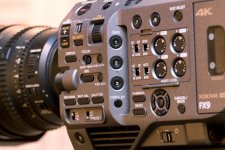
or flick the switch to variable. It's really nice. I don't have a shot of the readout on the display but here are the switches.

01.jpg
 
Looking at that picture, I see that stupid ISO switch from ancient history. Dear camera manufacturers, Please, please get rid of that idiotic L,M,H ISO switch and replace it with and up/down toggle switch. This is an example of how dopey vendors can be. It's one of those "It's always been this way" things that needs to go away. Who needs to go into a menu and set up three ISOs when it would be so much more convenient to have it toggle up or down.
 
Looking at that picture, I see that stupid ISO switch from ancient history. Dear camera manufacturers, Please, please get rid of that idiotic L,M,H ISO switch and replace it with and up/down toggle switch. This is an example of how dopey vendors can be. It's one of those "It's always been this way" things that needs to go away. Who needs to go into a menu and set up three ISOs when it would be so much more convenient to have it toggle up or down.

It is the LMFAO iso switch. The Black Magic ursa pro has it as a spring loaded toggle switch, so the operator can push up or down infinitely until the desired iso setting is hit. Surprisingly good!

Also, A reduser Gemini vs Fx9 thread just popped up, and as one would expect, the redusers prefer the Red sensor. still, good reading, and actually kind of proves how cool the Fx9 potentially is.

http://www.reduser.net/forum/showth...n-with-the-new-Sony-FX9&p=1892249#post1892249

Shot by the same chap that did the FF35 cinema camera shoot out recently.
 
Last edited:
Looking at that picture, I see that stupid ISO switch from ancient history. Dear camera manufacturers, Please, please get rid of that idiotic L,M,H ISO switch and replace it with and up/down toggle switch. This is an example of how dopey vendors can be. It's one of those "It's always been this way" things that needs to go away. Who needs to go into a menu and set up three ISOs when it would be so much more convenient to have it toggle up or down.

That's one thing our Canons do that I like, no dedicated ISO/gain toggle switch, it's a button but I use the + and - quick button and then the joystick.
Although I wish it didn't take two separate buttons and multiple steps, but it's still faster than diving into the menus.
 
It is the LMFAO iso switch. The Black Magic ursa pro has it as a spring loaded toggle switch, so the operator can push up or down infinitely until the desired iso setting is hit. Surprisingly good!

HD Video Pro just posted my review of the BMD Ursa Mini Pro G2. It's a cool camera but has some puzzling omissions. Great slow motion, build quality, image quality
but the lack of waveform and weird location of the XLR inputs makes me scratch my head?

https://www.hdvideopro.com/gear/cameras/hands-on-review-blackmagic-designs-ursa-mini-pro-g2/
 
Last edited:
Hd Video Pro just posted my review of the BMD Ursa Mini Pro G2. It's a cool camera but has some puzzling omissions. Great slow motion, build quality, image quality
but the lack of waveform and weird location of the XLR inputs makes me scratch my head?

https://www.hdvideopro.com/gear/cameras/hands-on-review-blackmagic-designs-ursa-mini-pro-g2/
Interesting camera, for sure. So many features and options, and the IQ i’ve seen from my friends is fantastic, regardless of price. Yet, it feels sort of home made when i pick it up. Like someone built their own PC on a budget, but got the best GFX card. I really like the Pockets though. Had a loaner, and kind of missing it.
 
All cameras should have a Bluetooth app for the AC that they can use on an iPad. It would be so much easier. They just hang the pad from a lanyard around their neck and away you go.
 
All cameras should have a Bluetooth app for the AC that they can use on an iPad. It would be so much easier. They just hang the pad from a lanyard around their neck and away you go.

Ah, i deleted my post before seeing you replied. I meant to write something constructive, and then went on a meandering rant about camera design. Haha.

Yes, wireless camera control is one of the many new modern conveniences that are being implemented. I still like the menus to have a screen built into the camera body.
 
Last edited:
Back
Top