
Navigation
Install the app
How to install the app on iOS
Follow along with the video below to see how to install our site as a web app on your home screen.
Note: This feature may not be available in some browsers.
More options
You are using an out of date browser. It may not display this or other websites correctly.
You should upgrade or use an alternative browser.
You should upgrade or use an alternative browser.
G
Guest
Guest
the panasonic trio: gh5/gh5s/g9 are not on this list because they are not new?
(not being argumentative, though not beyond me!)
just asking.
thumbs up.
rob
smalltalk production/nyc
Good question. I am a little unsure if any of the hybrid cameras should be on a cinema camera list. Perhaps i’ll swap out the 1D with the S1H.
Do the GH cameras shoot raw now? I guess i view the g and gh cameras as hybdriv video cameras, and not as hybrid cinema cameras, even if they have V-Log. That’s the problem with the XT3, as well.
The Nikon Z6 was only up there because it is kind of a raw hack cinema camera. But it feels more like the outsider or fake cinema camera on this list.
Last edited:
G
Guest
Guest
How about EVA1, and just for reference/benchmark among the corporate DPs, FS7 and FS5 (mark I and II)?
I knew i was overlooking some great cameras!
G
Guest
Guest
What did you go for?
How about I post a few frames or clips and see if you can guess?

Retrospective
Well-known member
Game onHow about I post a few frames or clips and see if you can guess?

nyvz
Veteran
The flaws are continuous autofocus that use to be reliable was ruined in their 3.0 and above firmware. Fujifilm zooms have visible exposure shifts during zooming. Essentially making them variable primes. The video portions during the zoom action are mostly unusable.
Quirks include a round about way of getting to 180 degree shutter angles. In video mode you can get to the correct shutter speed but you have turn both the dial and then the wheel to get to shutter speeds that would line up with corresponding 180 degree shutter. The 601 to 709 colorspace issue in premiere pro. Final Cut and Resolve have this worked out, but still it's a quirk to record 2020 HDR, and 709 UHD but use a 601 color matrix. Why do that? A couple more minor things but those are the ones that bug me.
Interesting, I haven't encountered any of those issues. What's wrong with the AF-C? I haven't used Fuji zooms much and haven't seen that shifting in the one I have, but does turning off peripheral illumination correction not help? Clearly this doesn't happen in any of my 3rd party zooms. Not sure I follow about the shutter angle thing. Selecting 1/48th sec shutter seems pretty easy and I'm not sure I get the color space issue you're referring to. Eterna and flog I've shot seems fine in ppro so far but Im somewhat new to the camera so I'd like to hear more about what you mean. Really impressed with the way h265 all-i holds up even pushed several stops compared to competing formats.

NorBro
Major Contributor
Check out the thread below which covers (random pages here and there) most of the issues mentioned.
The AF change is well-known after the 3.0 update (and the color space quirk has been noted a lot by those whom it affects).
http://www.dvxuser.com/V6/showthread.php?361802-Fuji-X-T3-released
The AF change is well-known after the 3.0 update (and the color space quirk has been noted a lot by those whom it affects).
http://www.dvxuser.com/V6/showthread.php?361802-Fuji-X-T3-released

AndreeOnline
Veteran
LensProToGo clips…
Just looked at some of these. You don't have to look hard to see something like this:

These are two of the "normal" exposures. Reference frames, so to speak. P6K on the left and C200 on the right.
This P6K shot would be unusable to me, and it's supposed to be the sweet spot? I own this camera and this is not how my normal exposures look.
With this, I only want to point out some of the difficulties in drawing too big or over arching conclusions on simplified data.

Samuel H
Major Contributor
I don't have the p6k, but I have the p4k, and my guess was that they were doing something wrong with that particular clip. My measure, then, was that it looks approximately the same when you go to the +4 clip than it does with the "properly exposed but actually overexposed" clip.
But you're right: people mess up in different ways, and even using different software or settings to work with the footage will create meaningful differences. Even using the same software (say, Resolve), the DR will be different if you import your cDNG/BRAW clips and apply a LUT (which many people do) or instead go to the raw setings and crank up the contrast (which is what I do). And yes: I have no idea what LensProToGo is doing here.
In the end, the measure that's important *for you* is the one you take, using the camera as *you* will in a real project and processing the footage as *you* will when it's not just a test. I can't afford getting all these cameras around for a detailed comparison, though, so I'm thankful that lensprotogo runs these tests that give me a meaningful, though imperfect, measure of how the camera would perform.
G
Guest
Guest
One thing is for sure, DYNAMIC RANGE, is a huge factor in what makes a camera best.
In the top cameras in the high end, you could practically put them in order of dynamic range, and it would reflect how people value the cameras.
In the top cameras in the high end, you could practically put them in order of dynamic range, and it would reflect how people value the cameras.
G
Guest
Guest
I have a p4k, and it's great, but definitely inferior to the p6k, namely because almost everything is identical but the p6k has 1.5 stops more DR, which I definitely didn't expect but is clear if you watch the lensprotogo latitude tests. I think the p6k should be 11th on your list, and the p4k should be 12th.
View attachment 137805
Just found two other video tests that show the C700FF to be lower in “usable dr” than Boyle suggests. One of the tests was from a CML test, so, especially odd that Boyle would rank the Monstro so low, and the C700 so high.
They also show the Monstro to be at least 2 stops better than what Boyle thought it was.
So, i went ahead altered the DR list until there is something that changes that view.
I’ll post some reference screen shots below.
Last edited:
G
Guest
Guest
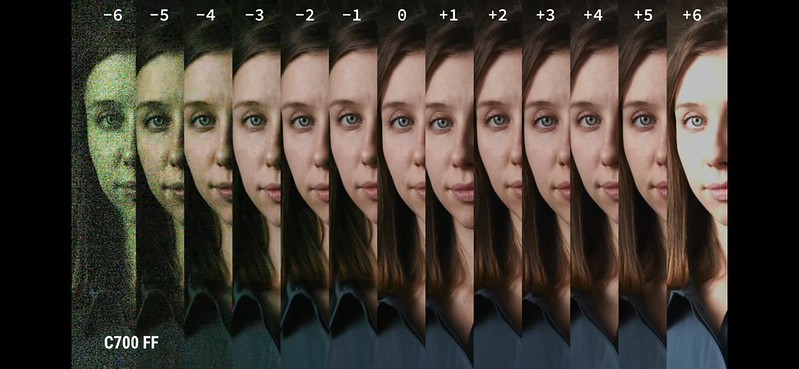
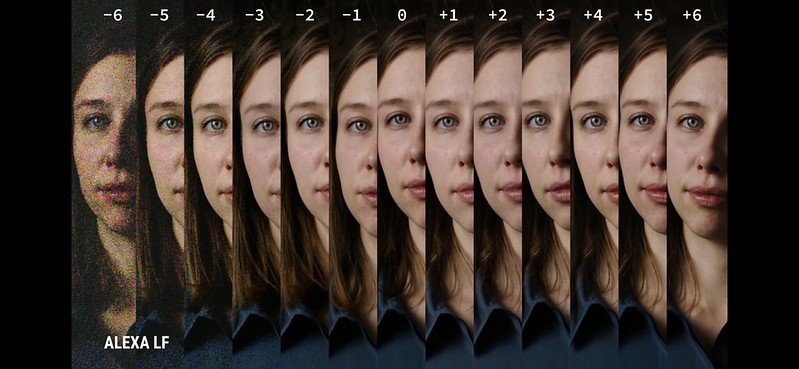


Last edited:
G
Guest
Guest
If we cut out the 5 sweet stops in the middle, and just look at the extremes, the Monstro seems to be around 1.5 up to 2 stops better than the C700FF. Annnd of course the LF is at least a stop better than the Monstro and the Venice.

Shadows: Canon is applying some noticeable noise reduction, the chroma noise spilling through a little. Looks like what the Monstro would be able to achieve with NR, except at two stops darker. Could be argued for more or less though, so just guessing two.
Highlights: the clipping doesn’t appear to be falling within an even stop. But without seeing the actual files and knowing all the variables, it is rather not worth getting too exact about it. At +5 Canon C700FF seems to be holding on, but seeing some colour shift and how blown out the following stop is at +6, i’d say it is only just holding +5 in this comparison. The Monstro seems very comfortable at +4 and at +5 is retaining some good details, but ultimately crap for recovery. So, i’d guess the C700FF is 1/2 a stop better in the highlights in this comparison.
But it is a video online and these are all just casual observations. I am still interested in all of these cameras.
Obligatory Disclaimer: All of the cameras look nice, by today’s standards, and they all are better than their predecessors, and we all know millions of amazing images were capture on much less capable video cameras. And really, until anyone really uses a camera and learns it well, one can never trust a test done by others. And of course, there is more to a camera than dynamic range.... just that dynamic range seems to be one of the more noticeable and important ones
Last edited:
Monstro did surprisingly well in the shadows. Not 17+ (claimed) stops of usable DR though lol. These tests IMO aren't very helpful if planning to shoot people/skintones: http://www.reduser.net/forum/showthread.php?165811-RED-Monstro-Dynamic-Range-Examined
Save the $3800 for the Xyla chart, put some of that towards a model and shoot an exposure ramp to find the truth.
Save the $3800 for the Xyla chart, put some of that towards a model and shoot an exposure ramp to find the truth.
Samuel H
Major Contributor
Indeed. These exposure ramps on a face are the perfect test for this.
@James: Nice test, very easy to compare things here. I searched for the source online and found more cameras tested here, and this seems to be the original source. Off of those reduser screenshots, let me rate these and then compare with my previous numbers to see how close I end up...
Alexa LF - 8 (-2 to +6)
Venice 500 - 7 (-2 to +5)
Monstro - 7 (-3 to +4)
UMP - 6.5 (-2.5 to +4)
Venice 2500 - 6 (-1 to +5)
Mavo LF 6 (-3 to +3)
C700FF - 5.5 (-1 to +4.5)
A7S II shogun - 5 or 4 (-5 to 0 if you’re fine with NR, -4 if you insist on a clean and sharp image to begin with)
Apart from the Alexa, which is always confirmed to be awesome, and the Venice and Monstro that find themselves pretty close to the gold standard, the winners here for me is the UMP, which is very close to the top and not showing issues like the huge color cast in the shadows of the C700.
Now comparing with my graph on page 1: my new numbers fall reasonably close to what I had there, with differences of around half a stop at most. It's Geoff Boyle's numbers for the C700 and Monstro that seem very far from what we are seeing here.
(I need another one of these to compare the p4k and p6k and see if I want to upgrade or not...)
G
Guest
Guest
Thanks for doing that! I’ll update the list with your numbers.

Teddy_Dem
Well-known member
Reposting from the Sony FX9 vs Canon C500 mkII thread as it is relevant:
There is a Full Frame Cine Camera Shootout on Reduser right now. Results will be revealed on Thursday, Feb 6th:
http://www.reduser.net/forum/showthread.php?180359-Full-Frame-Cinema-Shootout-2020
https://vimeo.com/388857434
4K 10 Bit Prores version can be downloaded from here:
https://vimeo.com/388805758
And to copy and paste the details:
"This comparison is between the following cameras (not in this order)...
Red Monstro
Red Gemini*
Red Helium**
Sony Venice
Sony FX9 S-Cinetone
Sony FX9 SLog-3
Arri Alexa Mini LF
Canon C500mII
Sigma FP
*Gemini used for studio and low light test only
**Helium used for studio only
All cameras were shot in their RAW codecs except the FX9 which was shot in XAVC-I 10bit. All cameras were lightly corrected using RAW controls in Resolve on a single timeline and split screened on a common calibrated Rec709 monitor for a neutral rendering. The AF capable cameras were shot with AF set to facial tracking.
The whole test was shot on Sigma 50mm T1.5 cine and 50mm 1.4 ART AF lenses except for the Canon C500mII which was shot with a 50mm 1.2 EF since there was no PL mount or EF Sigma available at the time of shooting.
Internal ND's or Firecrest NDs were used for exposure control. All exposures were set using a common waveform and native low/hi ISOs.
We intend this test to explore the subtle tonal and color differences between these cameras. Please watch and vote on your favorite in the poll, in a few days we'll reveal the actual cameras and see if your preferences line up with our expectations."
Last edited:

niki
Active member
This is more a list of great speculation that based on any scientific testing.
This list is based on SamH’s list. Sam H has not personally tested these cameras, and is going in part from online tests for several camera models. These rankings are not final.
Cameras ranked by dynamic range:
1. Arri Alexa LF
2. Arri Alexa
3. Sony Venice
4. Red Monstro
5. Red Gemini
- Kodak Film -
6. Varicam 35/LT
7. Canon C700FF
8. Canon C200
9. Black Magic Ursa
Ok, real quick, this is similar to the ‘New Lens’ thread, except, i’ll be rating cameras.
All these new cinema cameras, and they are all good. Long gone are the days of complaining about 8bit.
Below is the running list, and the cameras will be rated on their overall average benefits
I’m familiar with most of these cameras
Still my cinema camera is Super 16 mm with Kodak film
Super 16mm is such a magical format
Thanks for your post and list
Samuel H
Major Contributor
There is a Full Frame Cine Camera Shootout on Reduser right now. Results will be revealed on Thursday, Feb 6th:
...
Sigma FP
"
Oh wow, Sigma fp in together with those big boys. Intriguing. It's a pity that we don't get to see all the middle stops, just +6 and -6.
BTW, working link: http://www.reduser.net/forum/showthread.php?180359-Full-Frame-Cinema-Shootout-2020