C200: The new Canon C200 with 4K

I do a lot of color grading for a living. I have seen almost every kind of footage come in and I can tell you that most of what people are seeing from an Alexa has more to do with higher production values than the camera sensor. Where the sensor has something different is that essentially it has a baked in HDR. The highlight rolloff appears better because it is approximately 1.5-2 stops of subtle HDR/2nd exposure. Not enough to look fake and HDR, but enough to give a sense of a soft shoulder towards the highlights. But if one thing the Zacuto shoot revealed, it is that when you know the limits of your camera and light towards it, the results are convincing enough that even Francis Ford Coppola may prefer it.

After that, the real reason why higher end productions use ARRI is because they are generally simple and more reliable. The quickest way to a satisfying look. That's it. Not because they are magic in a box or because the image is that much better than anyone else's. A lot of people weave a kind of mystical brew around the Alexa. End of the day, it's just a camera and the operator makes a HUGE difference.

One thing is for sure. If anyone here believes that owning an Alexa (or any other camera) is going to make their career take a large step forward, they are sadly mistaken.

Nialed it. Finally.
 
…
P.S. You can't use the CFast/SSD adapter that the BM cameras use because the door needs to be closed to record.

I'll have to look at both the CFast/SSD adapter and the C200's media door. There is a possibility that a cut-out can be made on the media door to allow the use of the adaptor.
 
I've used my mkii alongside a rented Alexa Mini on a couple of studio shoots and once it's graded I agree you can get them close in this setting.

However, there are many scenes in productions where ultimately you can't do much (e.g. a vast exterior shot where you essentially just have a location and talent in the frame) and I think this is where you lean on the inherent mojo of the camera and lens to sell the shot. There were a few shots like that in the Cloakroom clip which just would've looked better on an Alexa... even if they shot 2k prores on the Alexa it would beat the C200 raw for feel.

I think I'd be disappointed if I embarked on a painful raw workflow and still felt there was something missing in the image that can't be put in through any amount of grading.

Perhaps Canon is cooking up a global shutter for their future lower models and that will all change...
 
I have no illusions that the C200 will be capable of looking much like an Arri camera. Even with Cinema RAW Light, that's an unrealistic expectation. I feel the C200, with good lighting and competent operation, with skilled coloring/grading, will be capable of beautiful images that punch far above it's modest price. Not sure why so many DPs/Ops are so pedantic about "what good is"? By all means, a $7,500.00 camera should not look as good as a $50k camera. I think the EVA 1 will be the same way, I hold high hopes for it's Varicam-like colorimetry, the Varicams are beautiful cameras that make quite lovely images in the right hands. It does seem pointless to compare every low end camera to the Arris and the production values have a lot to do with it, I agree. Most of the situations I personally see the Arri used in are lit by some of Hollywood's most skilled DPs with budgets in the many millions of dollars. I point my C300, C100 or rental C300 MKII at the same images with the same talent and lighting and while my stuff looks good, you'd never mistake it for production's B or C camera angles.

I guess the real point is, digital cinema cameras are a prime example of the law of diminishing returns. High end cameras look better than low end cameras. But the differences are becoming more and more subtle and to our audiences, largely imperceptible. To me, the most exciting thing is that the low end cameras keep getting better and better and the spread between what they can accomplish and what a $30k to $60k camera can accomplish is getting narrower and narrower. This is much more exciting than, "My $7,500.00 camera can look identical to an Arri".
 
One thing is for sure. If anyone here believes that owning an Alexa (or any other camera) is going to make their career take a large step forward, they are sadly mistaken.

+1000000

Give the same C series camera to a competent operator with budget for lighting and a good gaffer and see the result. Similarly give the alexa to me and I can take it to a night wildlife shoot or to a place where a person is meditating with just one single 10w bulb and then you see the result. Obviously the alexa result will be s***.

On another note, from one of the links that was posted here earlier I see more details in the C200 shots than the C300II. The ML hack to shoot raw in Canon DSLRs had 90% of the indies excited. They all used one card to record using a painstaking workflow (I shudder even thinking about it). So C200 should come as a boon for many indies.
 
.... I feel like a lot of people are talking like the C200 is the first lower priced RAW camera that's come out. We've already had many cameras in the C200 price range with RAW, such as the C500, C300 Mark II, FS700, every Blackmagic camera, AJA Cion, FS5, FS7, various older Red cameras that are cheaper than a C200 now. None of those camera have an image as good as Arri, nor have high end productions switched to using those cameras thinking, "With a basic tweak in post this RAW from any of these cameras can be made to look just like Arri." It can't and it hasn't, so the high end continues to use high end cameras.
The comparison would be incomplete because those camera sensors didn't have the numerical parameters of Alexa. C200, on paper, does.

And the difference that one might see of the YouTube clips is more of a pragmatic quality - you're shooting a TV show with a $80,000 camera, a $50,000 lens, a multi-million dollar studio and ten days to do a 42 minute episode compared to a $7,500 camera with a $5,500 lens with a small crew and (mostly) natural lighting under severe time constraints.

Now, of course, Canon could hire a professional cinematographer who's shoot a decent narrative short off a decent script. But they can't even find a decent script. Or actors. And everything else.
 
The comparison would be incomplete because those camera sensors didn't have the numerical parameters of Alexa. C200, on paper, does.
Numerical parameters? What does that mean? All of those cameras I had mentioned shoot 4K RAW like the C200. I thought we were talking about RAW being what is needed to match to an Arri, with RAW having been available in all those other similarly priced cameras since before the C200.
 
Numerical parameters? What does that mean? ...
It means that those camera sensors did not have the same dynamic range as Alexa's. Now, with Canon claiming 15 in Raw on C200 and Alexa easing in with 14 - though, in reality, they're very close to being identical - that constraint is no longer there.

Like Yoclay said a few posts above, Alexa didn't clip its highlights as harshly due to having more head room compared to other cameras. Even then, one could achieve similar look depending upon lighting and the exposure. Now, the specs on C200 are about the same (with more pixels) and getting the same look should be a lot easier.
 
I do a lot of color grading for a living. I have seen almost every kind of footage come in and I can tell you that most of what people are seeing from an Alexa has more to do with higher production values than the camera sensor. Where the sensor has something different is that essentially it has a baked in HDR. The highlight rolloff appears better because it is approximately 1.5-2 stops of subtle HDR/2nd exposure. Not enough to look fake and HDR, but enough to give a sense of a soft shoulder towards the highlights. But if one thing the Zacuto shoot revealed, it is that when you know the limits of your camera and light towards it, the results are convincing enough that even Francis Ford Coppola may prefer it.

After that, the real reason why higher end productions use ARRI is because they are generally simple and more reliable. The quickest way to a satisfying look. That's it. Not because they are magic in a box or because the image is that much better than anyone else's. A lot of people weave a kind of mystical brew around the Alexa. End of the day, it's just a camera and the operator makes a HUGE difference.

One thing is for sure. If anyone here believes that owning an Alexa (or any other camera) is going to make their career take a large step forward, they are sadly mistaken.

I wonder aloud....... If I have an Alexa and the other guy has a 5D, who gets the job?
 
Pop quiz!

The opening and closing scenes (and many other shots throughout the film) from the Golf Channels new feature, Summer of 76, were shot with two cameras, an Amira and a C100 mk1.

http://www.golfchannel.com/video/summer-76-sneak-peek/

Footage from both cameras are in this preview, can anyone tell me which shots were which?

From what I'm reading here, it should be pretty easy right?

10bit ProRes 4444, 14 stops of DR vs 8bit AVCHD 4:2:0, 12 stops of DR

Good luck.
 
Last edited:
I had a chance to mess around with C200 at Canon's HQ in Burbank today. We shot some footage and messed with it in post. Here are some things I learned. Firs though, I should preface this post and state that I am writing this all down from my memory of our 2 hour session with the camera...

-You can ditch the top handle and mount the monitor directly to the body. In that configuration, I'd argue to say the C200 has the best run-n-gun ergonomics of any camera out there. It's only around 3.2 pounds, which is incredible. It just feels fantastic.

-The DPAF is very good, but in lowlight it hunts a bit or gets confused (as to be expected). If you are shooting a subject in good light and that subject has good contrast, it's rock solid.

-You're gonna want newish lenses with DPAF. Older MK I lenses are slower and have delays. So if you have old Canon lenses you were hoping to use with the C200, the DPAF just won't work as well. It'll work, but it'll be more in line with the standard video autofocusing results from yesteryear (well maybe just a little better still).

-When recording Internal Raw, the HDMI and SDI outputs are disabled, which is weird. This is what one of the reps said to me yet we had a camera hooked up to a monitor and were rolling so I'm not sure what he meant. He said since the Raw image has not yet been debayered it cannot be monitored on the SDI/HDMI output. Also, when shooting, you can only choose HDMI or SDI, but not both so maybe this is what he really meant. The output signal from HDMI/SDI is 4:2:0 in 4k but it is 4:2:2 in HD.

- The C200 uses two DIVIC 6 processors. These are new processors that no Canon cinema camera currently has. This is why the C200 can do more things than the C300 MK II or the C700. It has to do with the new processor technology. Those of you hoping for a C300 MK II firmware update that enables some of the C200's features won't get it. Instead, Canon will release either a C400 or a C500 MK II in a year or two that will be what we all wish the C300 MK II was to begin with.

-It's got 13 stops of USABLE dynamic range when shooting in 12 bit Raw and around 11 stops in 8 bit MP4. The other two stops cited by Canon are barely visible on the chart. I would not say it has 15 stops at all. Your eye will see 13 stops in real world use. You are only allowed to shoot in Canon Log in MP4 mode, not Canon Log 2 or 3.

- You can record Raw to the CFast and MP4 to the SD cards simultaneously, but the MP4 files cannot be used as true proxies to the Raw files. The MP4 file names & data do not match with the Raw files on the CFast. This is totally stupid to me. Why didn't they treat the Mp4's as usable proxies to the Raw files and make the data sync up? The Burbank Canon rep made a point to inform us of this issue and said they like to call the simultaneous MP4 recording to the SD cards "Subrecording" instead of "Proxie Recording". So there's that.

- Though there is no Timecode in, the Canon rep mentioned that there are 4 channels of audio and one could presumably use a 3rd party accessory to pipe the timecode in through the minijack port.

-In the Canon Raw computer software where you process the Cinema Raw Light files, you cannot choose a middle ground 4k ProRes codec to export to. You can only export ProRes 444. You can choose to export proxies at ProRes 422 LT, but only in 1080p, not 4k. So Canon is really trying to protect the C200 MK II's 4k middle ground codec, even in the C200's post processing software.

-When processing the Raw files for export in Canon's software, you must choose either Canon Log 2, Canon Log 3, Rec 709 or Wide DR. Those are your only options. You can adjust the White Balance but not the ISO. The "brightness" setting is not the ISO. It's just a crappy brightness setting.

-The Canon Rep walked us through their post workflow using DaVinci Resolve 14 which was able to handle the Cinema Raw Light files natively. That being said, they were editing everything off this crazy fast fiberoptic array with top of the line hardware. When I asked him if this would be possible on a standard prosumer home computer system (that most consumers will edit off of), the rep sidestepped and changed the subject. I asked him exactly how long it would take to transcode 1 minute of 12 bit Cinema Raw Light footage on a standard quad core system and he said he's never tried it and doesn't know, and then quickly changed the subject again. I have a feeling working with Cinema Raw Light files on laptops or iMacs is going to be painfully slow.

-The footage looked fantastic. Even the 8 bit slow motion footage at 4:2:0 looked great and people gasped at some of the sample shots of both the 120p and 60p stuff. The colors popped and it was razor sharp. Honestly, the footage really looked like the best stuff I've ever seen come from a Canon video camera. As an original C300 owner, the image was very familiar. I still think that Arri, Red and Blackmagic create the most "cinematic" images to my eye. I'm a Red user and shoot with the Alexa Mini from time to time. Footage from those cameras just look like movies to me, even with little to no post processing. But that's my opinion. That doesn't mean you can't get a cinematic image from other cameras, it's just that I think it comes easier with Red, Arri and BM. The raw footage from the C200 looked like classic Canon video to me. They really capture accurate, sharp colors that lean towards the red/magenta spectrum. The C200 definitely will have its place, especially among the big 3 (Sony, Canon, Panasonic). The FS7 still wins in dynamic range and mid-range bitrate & codec. The C200 wins with colors, autofocus, and 12 bit Raw (having 12 bits at this price level is really something). It will be interesting to see where the EVA1 stands in latitude and color. I imagine it will sit firmly between the Canon and Sony.
 
Last edited:
thankyou for that great little run down, useful info at least for me - when you say newer lenses for the dpaf to work best do you mean the generally slower stm lenses?
 
-When recording Internal Raw, the HDMI and SDI outputs are disabled, which is weird. Also, when shooting in MP4, you can only choose HDMI or SDI, but not both. The output signal from HDMI/SDI is 4:2:0 in 4k but it is 4:2:2 in HD.
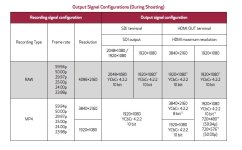
So if I'm understanding this correctly, when shooting RAW, there is no way to send a feed out to a monitor? That would be a pretty big omission. RAW is heavily aimed at the commercial and narrative world, of which you often have an AC pulling focus wirelessly off of a monitor, a larger monitor on the camera, and a client/director monitor. Steadicam would also be very difficult with no monitor out. So, no monitor out for RAW would rule the camera out from so much work that its RAW codec essentially seems aimed for.

It makes it more of a simple, stripped down b-roll camera, but for those run n gun b-roll shoots, you often don't want RAW anyway.

No SDI and HDMI out at the same time is a pain, but at least with that you can use converters to get what you need.
 
Was the sdi port as well as the hdmi port connected?
That would explain why you didn't get a signal.


From the manual:


NOTES
• Signals cannot be output from the SDI terminal and HDMI
OUT terminal simultaneously
. To output signals from
the SDI terminal, make sure the HDMI OUT terminal does not have an HDMI
cable connected to it.
• Depending on the external recorder, you may not be
able to record at the desired video configuration.
• After you connect the camera to the external recorder
, make a test recording first to check that audio and
video are recorded correctly on the external recorder.
• You can set
>
[
Æ
$
Recording/Media Setup]
>
[Rec Command] to [On] to use the camera’s
REC button to control also the recording operation of
an external recorder connected to the SDI terminal.

manual is available for download at canon :thumbsup:
 
Last edited:
Back
Top