FS5: Sony PXW-FX6

As far as I'm aware the base sensitivities are always 800/12,800. This would appear to be different from predecessors like the Fs5, where base sensitivity varied depending on the gamma.

It's 800 or 12,800 for S-LOG3 and HLG
It's 320 or 5000 for any of the other gammas.

Edit: Looks like Matt beat me to the answer while I was replying.
 
I stand corrected! Very useful; so the values do change.

Doug (or others) are you shooting in dB to more easily be consistent about shooting at base ISO or a certain distance from base? I've done that with my Fs5 for years now and like not having to remember different values.
 
I stand corrected! Very useful; so the values do change.

Doug (or others) are you shooting in dB to more easily be consistent about shooting at base ISO or a certain distance from base? I've done that with my Fs5 for years now and like not having to remember different values.

Absolutely. I always use shutter speed (fractions) and dB Gain, which are the FX6's default settings. Thank you Sony for getting back on track.
Never ISO or shutter angle.
 
Absolutely. I always use shutter speed (fractions) and dB Gain, which are the FX6's default settings. Thank you Sony for getting back on track.
Never ISO or shutter angle.

I always use gain as well. No matter what the
base ISO is, if you are at 0db gain, you are
not going to be adding noise/grain to your
image. But shutter angle can actually be
useful if you are switching frame rates a lot
during fast paced shooting. Set it to 180 degrees
and when you switch from 24fps to 60fps to
120fps, the shutter speed will automatically
switch from 1/48 to 1/120 to 1/240. Which
is usually exactly what you want all without
you having to dig into the shutter menu to
switch the shutter speed because it just keeps
it constantly at 180 degrees or twice your frame
rate. So if you want something different as a
creative decision than you can switch it but
otherwise I usually set it to 180 degrees and
don’t worry about ever messing with the shutter.
 
I was very fortunate to snag an FX6 last Monday from Texas Media Systems. I’m replacing my FS7II with it and so far I’ve been blown away.

I have a question concerning the base ISOs of this camera. I’ve read that it essentially has two like the A7SIII, one being ISO 800 and the other being ISO 12,800. My question though is this: Is the base ISO the same in Cine EI mode as well as Custom mode? I’ll likely shoot in Cine EI most of the time like I did with my FS7II, but I’ll definitely still use Custom mode and S-Cinetone for certain projects and want to make sure I know the base ISOs for both.

Use Gain instead of ISO and you dont need to remember any value from now onwards.
 
Great info. Another thing I’ve ran into this week is that the FX6 doesn’t have as many Custom options as the FS7 had. For instance, I can’t seem to find a way to set the FX6 to a Cinema color matrix. In fact, I don’t see any preset color matrices.

When I shoot multi-camera livestreams with my FS7II, A7SIII and A7RIII, I always shoot in HyperGamma2 on the FS7 with the Cinema color matrix option. This is basically the same as shooting in Cine2 Cinema on the Sony mirrorless cameras and gives me a great out of camera match between all three cameras for livestream work.

On the FX6 I have S-Cinetone which is a spectacular option for WYSIWYG shoots like live-streaming, but my A7SIII and A7RIII don’t have that option. Therefore I wanted to simply set my FX6 up for HyperGamma2, Cinema just like I did on my FS7II to give me a relatively close look between all three cameras. But, the FX6 doesn’t really appear to have those options (unless I’m looking at it wrong).

Allister came out with a HyperGamma2 LUT that you can use on the FX6 in either CineEI or Custom modes so long as you’re in Slog3/S-Gamut3.Cine. But I’m not sure what color matrix it’s supposed to be emulating. And since I don’t see the preset color matrix options that used to be in the FS7 series, I’m not sure how to get my FX6 to match my mirrorless cameras when shooting projects like a livestream where you need a baked in look. Am I missing something here with the FX6?
 
Last edited:
I usually set it to 180 degrees and
don’t worry about ever messing with the shutter.

Yep, there is that argument for shutter angle if you adhere to the 180 degree shutter rule. FYI, the shutter has a dedicated button on the side of the camera so zero menu-hopping is necessary for changing the speed.
 
Yes +1 on broughtonfilm's suggestion. A couple of us here have tried the A7Siii settings that Paul from Extrashot has posted on that Youtube clip. They are a very close match to the FX6 Cinetone. His settings are a great starting point for a Cinetone match for sure. They also work well on the A7iii for a match so may also work well on the A7Riii. I did make some small adjustments. Mainly to the Black Level because for any 709 video level delivery for broadcast you don't want vision below 0 IRE. At -10 it was a fair bit below Black on the Tektronix waveform monitor. Old school here, I still use external WFM and Vectorscope for final QC. Setting the Black level to -4 puts it right on the blanking (black 0 IRE) on the waveform monitor.

Chris Young

a7siii fx9.jpg
 
Yes +1 on broughtonfilm's suggestion. A couple of us here have tried the A7Siii settings that Paul from Extrashot has posted on that Youtube clip. They are a very close match to the FX6 Cinetone. His settings are a great starting point for a Cinetone match for sure. They also work well on the A7iii for a match so may also work well on the A7Riii. I did make some small adjustments. Mainly to the Black Level because for any 709 video level delivery for broadcast you don't want vision below 0 IRE. At -10 it was a fair bit below Black on the Tektronix waveform monitor. Old school here, I still use external WFM and Vectorscope for final QC. Setting the Black level to -4 puts it right on the blanking (black 0 IRE) on the waveform monitor.

Chris Young

View attachment 142278

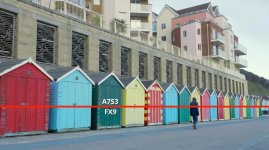
If every city had a street like that, X-rite would be in trouble.
 
Am I interpreting it correctly, that you should think about jumping from Low to High Base when the Gain starts to exceed 10DB when in Low Base?
 
Am I interpreting it correctly, that you should think about jumping from Low to High Base when the Gain starts to exceed 10DB when in Low Base?

6dB gain increase is an equivalent of 1 stop, so if 800 ISO is 0dB, then 1600 ISO is 6dB more from that. 10dB would therefore be 1 and 2/3 stops from base ISO so that is 2500.

Now what may be the most important thing to understand is the concept of Exposure Indexing. At some point it may be more beneficial to use higher ISO base and do an EI offset down. Personally, I would not EI offset the high ISO base of 12800 more than +2 stops (giving EI of 3200). Therefore the 10dB boost from lower base ISO of 800 which equals 2500 ISO sensitivity is too early to switch to high ISO base. BUT, this really depends on your scene's contrast, tonality and desired effect (whether you want to under or over expose and by how much).

The jump between low and high sensitivity bases is 24dB (4 stops).

I hope I did not screw up the math!

EDIT: I read again and you said "exceed" 10db. Therefore in the context of my answer, yes, that's about right as the next one is 12dB (3200 ISO equivalent when the base is 800 ISO) being +2 stops overexposure EI offset from 12800, which typically in case of LOG gammas is beneficial. Again, it depends on how you want to allocate dynamic range, this depends on the scene. 3200 EI in low base is 2 stops underexposure so 2 extra stops allocated into highlights at the expense of shadows. 3200 EI in high base is 2 stops of overexposure so 2 extra stops allocated into shadows at the expense of the highlights.
 
Last edited:
Gain is a silly metric to use unless you only ever work solo. Likewise the fractional ND values Sony have decided to use (instead of simply counting out the density in stops).

There are very firmly established standards that we use on sets, that allow us to communicate clearly with gaffers, camera assistants and operators. And if you ever expect to be working with a crew at any point in your career - it’s pays to put in the time to wrap your head around ISO, shutter angle and optical density values (the numbers used to label NDs). It’ll make the difference in getting what you ask for from people on set.

Asking a gaffer for T/4 at 0Db isn’t going to end well.
 
@broughtonfilm Thanks - your maths looks right to me and it is in line what I read from Chapman who suggested to swap at 11+db to high base to keep the noise floor low.
 
Gain is a silly metric to use unless you only ever work solo. Likewise the fractional ND values Sony have decided to use (instead of simply counting out the density in stops).

There are very firmly established standards that we use on sets, that allow us to communicate clearly with gaffers, camera assistants and operators. And if you ever expect to be working with a crew at any point in your career - it’s pays to put in the time to wrap your head around ISO, shutter angle and optical density values (the numbers used to label NDs). It’ll make the difference in getting what you ask for from people on set.

Asking a gaffer for T/4 at 0Db isn’t going to end well.

I agree with it generally speaking and personally think in ISO terms too, not gain. True, easier to communicate with a gaffer (but perhaps not with a broadcast engineer on a tv gig). Unfortunately the standards we'd want to believe are "firmly established" are not always followed. Specifically, in terms of ISO values provided by Sony there is a discrepancy between what they claim and what is true. I remember when measuring the actual base sensitivity of FS7 by using a grey card, light meter and a waveform monitor (by trying to hit the Sony recommended IRE values and then compering it with light meter reading), the FS7's sensitivity was between 1250 and 1600 ISO if I remember correctly, not the claimed 2000. Of course, dB value does not help in this case either. I'm quite certain that in a situation where cameras of different models, even when they are of the same manufacturer, have to be matched you would not trust their claimed ISO without testing what the discrepancies between them are (or more likely by looking at each on a waveform monitor) and THEN using ISO as some reference. Not to mention when we mix cameras of different manufacturers...

Now, I'm very jealous you are likely in Australia where you have this year's first Grand Slam and the restaurants are open!
 
I agree with it generally speaking and personally think in ISO terms too, not gain. True, easier to communicate with a gaffer (but perhaps not with a broadcast engineer on a tv gig). Unfortunately the standards we'd want to believe are "firmly established" are not always followed. Specifically, in terms of ISO values provided by Sony there is a discrepancy between what they claim and what is true. I remember when measuring the actual base sensitivity of FS7 by using a grey card, light meter and a waveform monitor (by trying to hit the Sony recommended IRE values and then compering it with light meter reading), the FS7's sensitivity was between 1250 and 1600 ISO if I remember correctly, not the claimed 2000. Of course, dB value does not help in this case either. I'm quite certain that in a situation where cameras of different models, even when they are of the same manufacturer, have to be matched you would not trust their claimed ISO without testing what the discrepancies between them are (or more likely by looking at each on a waveform monitor) and THEN using ISO as some reference. Not to mention when we mix cameras of different manufacturers...

I agree completely.
 
@broughtonfilm Thanks - your maths looks right to me and it is in line what I read from Chapman who suggested to swap at 11+db to high base to keep the noise floor low.

I think it is higher than that. Personally, i'd go at least to +15dB in the low mode before I'd switch over to 0dB in the high mode. And even then, I wouldn't assume the high mode would look better. Yeah, HIGH is four stops more sensitive than LOW, but it is also 2-3 stops noisier so there is very little to be gained with it. This whole dual sensitivity thing is a bit of a sham if you take the time to do some serious testing with proper scopes.
 
Back
Top