
Navigation
Install the app
How to install the app on iOS
Follow along with the video below to see how to install our site as a web app on your home screen.
Note: This feature may not be available in some browsers.
More options
You are using an out of date browser. It may not display this or other websites correctly.
You should upgrade or use an alternative browser.
You should upgrade or use an alternative browser.
F3: Sony F3 Resurrection - The New Chapter
- Thread starter starcentral
- Start date
EXACTLY.
LUTs are NOT shortcuts. I was saying to Sam that log images are not to be used without a curve (LUT) applied.
They are an ESSENTIAL part of a REAL colorist toolkit.
You start with a CINEON log image, like the ALEXA files which are CINEON, the new REDCOLOR4/REDLOGFILM R3Ds which are much comparable to CINEON, or...well an slog (F3/F35) image with the SLOG TO CINEON LUT by macgregor applied as an INPUT LUT!
Then you set an output LUT like REC709 or a Print Emulation LUT if you are going to print it OR you want to achieve a specific look.
And finally you start the color correction, and after that the grading (aka look).
As said by Dennis, you work in the middle.
This is done because the LUT permits all your controls to behave like working on a linear image.
This is what this thread is about. LUTs. Specifically the use of the macgregor LUT as input LUT to convert slog files to cineon.
Clayton, apart from being quite presumptuous in your tone and derailing the main topic of the thread, you completely disrespect the standard procedure which professional colorist use the most!
It's like you have LUTfobia!
You have adopted a completely didactic approach.
It is entirely possible to linearize an image without a LUT.
I agree that it is essential to linearize an image, however whether that comes through a particular LUT, a set of personal presets or simply by hand depends on the project and the intrepretation of the colorist.
I see other professional colorists use a variety of curves, LUT's or whatever gets them where they need to go when they evaluate the base image.
Sometimes they use a LUT, sometimes they do not. They are part of the toolkit, but not every job requires the same hammer.
Often they try several different forms of correction on a few sequences and then go with what seems to work best for them on a particular project.
Sometimes I use a LUT, sometimes I don't. Sometimes they are helpful, sometimes they get in the way.
Making statements like "LOG images are not to be used without a LUT applied" and then delineating one particular workflow process as the only "right' solution is rigid, false and dictating YOUR approach.
Sorry if the rest of the world doesn't feel the need to fall into line with your absolutist statements.
But then again you obviously have decided that you have the corner on THE truth, so I would guess that presumptous behavior is also in the eyes of the beholder.
Last edited:

Doug Jensen
Carbonite Member
I agree. I shoot LOG all the time, and I never use LUTs in Resolve or Premiere.
morgan_moore
Major Contributor
Personally Id like to see proper Luts for the F3, Ive had issues with non recoverable clipping etc but Im getting there I hope.
Doug - any examples?
S
Doug - any examples?
S

starcentral
Veteran
Ah, PS, I worked directly on LOG images without using output LUTs for years...then an insanely good colorist told me I was wrong, and I was indeed.
Well to be fair not all colorists work by the same method or process and some colorists work in different industries where they may be different processes established irregardless of even their own methods or secrets in coloring. So I think we should be careful assuming there is only one way of coloring or working and acknowledge that it really will depend on who you talk to.
The point of this thread was to share some insight to how others are managing to work with slog footage in an easier manner, and quite possibly methods which are useful for de-slogging the F3 footage and more importantly getting rid of that "Sony look". For those image-philes like myself, Sam, Nate, and a few others it will come down to skin tone reproduction, highlight renditioning, and what higher contrast scenes look like which make use of wider dynamic ranges.
Regarding those specific elements I still stand by my original statement in my first post that "a simple curve" adjustment is not going to cut it based on what some of us are really looking for from the slog footage. I think that's why there is such a disconnect here in this discussion because some of us are merely looking for a way to get slog back to something like HG2 or HG4 but then there are those who are looking for more "filmic" properties and characteristics that go far beyond what one single curve adjustment can provide.
If you disagree or feel it can then please post examples, let's see the before the after.
Personally Id like to see proper Luts for the F3, Ive had issues with non recoverable clipping etc but Im getting there I hope.
My opinion is that working in cineon space is as good as it is going to get, and maybe good enough considering that cineon is somewhat 'standard'. What would have been better is an IDT for slog in Resolve but no idea why this hasn't been supported.
Last edited:
morgan_moore
Major Contributor
So I've been shooting stills for a mag today - my D600 - the palette is wildly different - maybe too much for some but there is punch in the face, that is what I am used to and look to replicate (before adding any art looks)
C1/D600 is pretty much out of the can like this with a mile of shadows and highs to recover if desired..

C1/D600 is pretty much out of the can like this with a mile of shadows and highs to recover if desired..

Nate Weaver
Veteran
One thing I am not seeing discussion of, in this LUT or not debate, is the fact some LUTs are doing much more than applying a curve.
In the case of a SGamut to 709 LUT, there are a lot of decisions to be made about what happens to chroma that's scaled to make a saturated image, but then you have chroma that's outside 709 that needs to be roped into 709 in a pleasing way.
Also, some LUTs are doing work on skin tones.
I think it's fine if some people want to work with the image from scratch, but they should know that some LUTs are conceived and designed to be used as "the other half" of the camera's color science in post. I feel Sony has definitely taken this approach, although the distribution of the tools and info necessary leaves a lot to be desired.
ACES as a workflow and a color science approach definitely subscribes to the idea that you wouldn't want to repeat their work on the RRT by hand each and every time you want to color correct footage from a camera. The RRT (i.e. "look") has gone through 3 revisions that I know of.
I myself am starting to think of on-set LUTs as film stocks. I need and want a tool that helps me visualize a final image...a log image on set or as a starting point for color in post is of little use to the visualization process.

ChristianMoriarty
Well-known member
I'm in agreement with everything discussed here. To LUT or not to LUT is a personal preference. I also think the thread started here is and excellent discussion. To note: Game of Thrones uses LUTs to keep scenes (looks) consistent and actually writes the LUT on the slate.
starcentral
Veteran
Thanks Nate for jumping in, I was counting on it. 
It's true that not all LUTs are equal, and on that note here's a great link to an article written by Light Illusion discussing various types of LUTs. Light Illusion specializes in providing consultancy within the creative fields of digital film and video imaging, including Production, Post-Production, Broadcast and equipment manufacturers. (I have zero affiliation to them.)
http://www.lightillusion.com/luts.html
Here's an extract:
Here's an article with the colorist for the TV show 'Elementary' which similar to Game of Thrones also made use of using matching LUT's in post and in CDL files for on-set look management;
http://www.motionvfx.com/mblog/edit...ntary_colorist_on_blackmagics_tool,p2074.html
Elementary TV show trailer: https://www.youtube.com/watch?v=6YvuZ4Msh50
It's true that not all LUTs are equal, and on that note here's a great link to an article written by Light Illusion discussing various types of LUTs. Light Illusion specializes in providing consultancy within the creative fields of digital film and video imaging, including Production, Post-Production, Broadcast and equipment manufacturers. (I have zero affiliation to them.)
http://www.lightillusion.com/luts.html
Here's an extract:
Calibration vs. Technical vs. Creative Look LUTs
LUTs can be used and applied in a number of different ways, and the three most common applications are Calibration, Technical, and Creative...
Calibration LUTs
Calibration LUTs are used to 'correct' display inaccuracies, ensuring any images shown on the calibrated display as accurate as possible - allowing for the underlying capabilities and/or limitations of the display. These are the most important LUTs as their generation has to be performed with very high levels of accuracy, or all images sheen on the 'calibrated' display will be incorrect, causing the inaccuracy to ripple back down the workflow chain.
This is a critical reason as to why LightSpace CMS is seen as the de-facto standard that all other calibration systems aspire to match - it is the most accurate of all.
Technical LUTs
Technical LUTs are used to convert between different 'standards', such as from one colour space to another, which should make the LUTs simple to generate accurately.
Surprisingly, many Technical LUTs are not at all accurate, and can cause major problems when attempting to convert images between different standards. All technical LUTs generated via LightSpace CMS are accurate!
Creative LUTs
Creative LUTs are often referred to as 'Look LUTs' as they are often used to set a look by a DoP on-set during filming, as well as to endow images with a specific look emulation, such as specific traditional film stocks.
LightSpace CMS has all the tools to generate any Look LUTs required, from ripping creative grades form DI systems, to using Photoshop to set styles, to using the internal creative tools within LightSpace CMS, including the emulation of film stocks.
I'm in agreement with everything discussed here. To LUT or not to LUT is a personal preference. I also think the thread started here is and excellent discussion. To note: Game of Thrones uses LUTs to keep scenes (looks) consistent and actually writes the LUT on the slate.
Here's an article with the colorist for the TV show 'Elementary' which similar to Game of Thrones also made use of using matching LUT's in post and in CDL files for on-set look management;
http://www.motionvfx.com/mblog/edit...ntary_colorist_on_blackmagics_tool,p2074.html
Elementary TV show trailer: https://www.youtube.com/watch?v=6YvuZ4Msh50
Lenilenapi
Carbonite Member
If anyone has the material I would love to see some examples of footage corrected with a LUT and "freestyle" for want of a better term, and also footage that has been corrected in a way that maintains the dreaded Sony look vs a more filmic look.
Please though make it a complex shot with a wide dynamic range and a wide range of color and details to look at. Window is good to have .
Basically a good test shot.
This could be a good learning experience and provide for a more centered discussion.
Unfortunately the examples shown here have been too limited to learn much from.
Thanks
starcentral
Veteran
I feel that the guy in the car footage I posted in the first post is pretty good for testing.
You have portions of the talent getting into the car under direct sunlight, then inside the car he shifts between shade and direct sun again. There are some good reflections of the sun on the metal of the car to really test out highlight clipping and renditions. Lastly the subject has dark skin so in my mind its a pretty wide range shot. I think I used some fill on the subject when getting in the car but can't remember since it was 2 years ago.
A link to the slog footage in ProRes MOV format is available on the first post if anyone wants to give it a go. Abelcine has some slog to HyperGamma LUTs so it'd be quite easy to see what it does to the footage and how it looks and if it preserves that "sony look" versus grading the same clip with and without use of LUTs for a different look, etc..
Of course if anyone else has some DPX stills or footage to provide, that would be great too. The more the better.
So I've been shooting stills for a mag today - my D600 - the palette is wildly different - maybe too much for some but there is punch in the face, that is what I am used to and look to replicate (before adding any art looks)
C1/D600 is pretty much out of the can like this with a mile of shadows and highs to recover if desired..
View attachment 86316
Sam, if that is the look you are going for, then I am going to be a little bit heretical here and say that I actually think you might be happier with a hacked 5D Mark III.
The look you have there is the result of much greater resolution and bit depth. Outside of actually shooting something like the RED Dragon, the raw file from a 5DMIII offers incredible bit depth. Plus ACR tends to yield this kind of "grittier image" - one that has more tooth. I definitely think it is a great camera and I am certain that it's going to get a little closer to your above image than a 10bit Full HD output from the F3.
starcentral
Veteran
For what its worth, here is 'slog' to 'ABNorm profile matrix off' LUT, no additional grading. The ABNorm profile / LUT consists of the Cine3 gamma which is most suitable for mid tones.
LUT courtesy of Abelcine http://blog.abelcine.com/2012/03/27/s-log-and-the-f3-–-part-5-3d-look-up-tables/
It reminds me of the type of look I would get from the F3 using Cine1 or Cine3 before any grading; very videoy and has 'Sony look'

LUT courtesy of Abelcine http://blog.abelcine.com/2012/03/27/s-log-and-the-f3-–-part-5-3d-look-up-tables/
It reminds me of the type of look I would get from the F3 using Cine1 or Cine3 before any grading; very videoy and has 'Sony look'
Last edited:
Nate Weaver
Veteran
I'm in agreement with everything discussed here. To LUT or not to LUT is a personal preference. I also think the thread started here is and excellent discussion. To note: Game of Thrones uses LUTs to keep scenes (looks) consistent and actually writes the LUT on the slate.
Any production shooting Alexa is using LUTs. But it's likely the standard alexa 709 LUT with CDL mods included/overlaid. I know GOT plays around with other cameras like Epic/Dragon, but I assume the Alexa is still their workhorse.
I just finished color correction on a relatively high profile web/PSA series (they called me, the DP to do it because they were getting low on money), and I tell you, I don't think he Alexa and F55 couldn't have been matched so closely (really, perfectly) without LUTs or ACES.
Maybe I'll post links here later, I think the first goes live tomorrow.
[edit: Call it what you want I suppose, but I don't feel the sensors of log recording modes of the Alexa and the F55 could have been matched so well without the prior work of some very talented people making LUTs. Posting the first of a series mixing Alexa and 55 below. I shot and colored this]
Last edited:
morgan_moore
Major Contributor
Yoclay
I think that is what any camera should look like properly linearised. You can get that look with stills cams shooting omboard jpg 8bit - just when shooting jpg you don't get any wiggle room in post. My mums Nikon j1 has punch and saturation in jpg mode. My d600 has nice colour in video - just the other aspects of d600 video are total turkey- it is soft moire hell. I'm sure it is therefore not a limit of 10bit video per se.
I was watching someone's reel here and it had a shot of a kid on blue sky with a red kite - the image was so flat that as a normal client I would have been baffled. The shot in the state presented would only work as a flashback or dream sequence.. I need images that work for normal people.
There are a million reasons for me not to shoot with a 5d - Nd xlr being the main ones - data rate is a factor too - the biggest data rate I could handle would be compressed 444 on the f3 - which I will move to if odyssey 7 gets dual link working for the f3 in a compressed form and I save a few buck to change recorder
Shooting baked might be a concept.. That is certainly where I went with my fs100 and Dslrs before as i have no time for log 420. 8bit which just creates banded muzz. 10bit should do it though..?
Coming back to the 5d2 - I did like the look from that camera out of the box. Good punch. But also zero wiggle room and all the known artifacts - but scaled to 480 the pallete was nice - I'd like to get that pallete at close to moiree free 1080 - shooting men in suits the 5d is no good as a work tool. Also baked allows no exposure error on set which is not realistic - we all need a little space to wiggle. 10bit should buy that wiggle.
Last edited:
Yoclay
I think that is what any camera should look like properly linearised. You can get that look with stills cams shooting omboard jpg 8bit - just when shooting jpg you don't get any wiggle room in post. My mums Nikon j1 has punch and saturation in jpg mode. My d600 has nice colour in video - just the other aspects of d600 video are total turkey- it is soft moire hell. I'm sure it is therefore not a limit of 10bit video per se.
I was watching someone's reel here and it had a shot of a kid on blue sky with a red kite - the image was so flat that as a normal client I would have been baffled. The shot in the state presented would only work as a flashback or dream sequence.. I need images that work for normal people.
There are a million reasons for me not to shoot with a 5d - Nd xlr being the main ones - data rate is a factor too - the biggest data rate I could handle would be compressed 444 on the f3 - which I will move to if odyssey 7 gets dual link working for the f3 in a compressed form and I save a few buck to change recorder
Shooting baked might be a concept.. That is certainly where I went with my fs100 and Dslrs before as i have no time for log 420. 8bit which just creates banded muzz. 10bit should do it though..?
Coming back to the 5d2 - I did like the look from that camera out of the box. Good punch. But also zero wiggle room and all the known artifacts - but scaled to 480 the pallete was nice - I'd like to get that pallete at close to moiree free 1080 - shooting men in suits the 5d is no good as a work tool. Also baked allows no exposure error on set which is not realistic - we all need a little space to wiggle. 10bit should buy that wiggle.
Sam, I was speaking about the 5D Mark III not the II. ML hacked, the RAW image is 14bit. Which is far more color info than what we are getting. You have a huge amount of legroom with it and processing in Adobe Camera Raw tends to yield an image very close to the kind you showed in the photo. However, there is no moire or aliasing, like with the 5D2. So you could in fact shoot those men in business suits with it. It does not have a log function, but all the info is there and without having to compress in the mid-tones to achieve it (like SLOG), thus the skin "pops" with detail. Personally, I like the smoothing and roll-off of the F3, but it is not for everyone.
Last edited:
morgan_moore
Major Contributor
I know what you were talking about - hacked raw - it steps/skips does it not? Anyway the data rate/workflow/camera is completely impractical for commercial use (IMO).
I was just saying that even the 5d2 video was rich and saturated (over its minimal DR) so that look does not have to come from a raw shooter.
Id like to get that rich look with a LUT/Look but have recoverable (with secondaries) highlights - which should in theory be possible with a log/10bit camera, more so with 444 than 422, but still 422 should be a step up from 420
Id love a raw camera but the F5 is IMO the cheapest 'viable' option and at $20k and 1TB per day it is out of my budget as both a cost and data load
I don't consider nonXLR, nonND, moire cameras 'viable' for A camera work -read 5dmk3, BMC etc etc.
S
I know what you were talking about - hacked raw - it steps/skips does it not? Anyway the data rate/workflow/camera is completely impractical for commercial use (IMO).
I was just saying that even the 5d2 video was rich and saturated (over its minimal DR) so that look does not have to come from a raw shooter.
Id like to get that rich look with a LUT/Look but have recoverable (with secondaries) highlights - which should in theory be possible with a log/10bit camera, more so with 444 than 422, but still 422 should be a step up from 420
Id love a raw camera but the F5 is IMO the cheapest 'viable' option and at $20k and 1TB per day it is out of my budget as both a cost and data load
I don't consider nonXLR, nonND, moire cameras 'viable' for A camera work -read 5dmk3, BMC etc etc.
S
No stepping or skipping (yielding banding in skies for instance) with the ML hacked 5DMIII.
The stepping or skipping you referred to comes from ACR's application of automatic exposure compensation if one begins to get too complex with the sliders.
Certainly understandable that you want a camera better adapted to video production.
I would like to point out though that not everything is an issue with LUT's and camera info.
It is also how an application treats an image to begin with.
For instance, you will find far more detail from the same image from a ML RAW 5DMIII (which requires no linearization) processed in Adobe Camera Raw, than Davinci.
It may just be that the "wooden quality" you speak of, which is essentially a lack of nuance in faces is as much a function of the application as the LUT's.
So the issue may be also how an image is debayered, rather than just profiling.
morgan_moore
Major Contributor
ACR - pah! - Capture One is what you want for raw
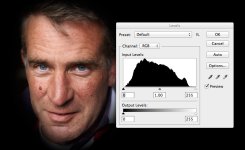
'Wood' is simple - a flat curve does not provide enough 'micr0 contrast' to specific portions of the scene.
With stills we start with a punchy image and use secondaries to pull everything into a legal range.
From this you can see that a punchy face has values from about 30 to 230
Simply to get that look from Slog one need a huge jump in contrast which is, theoretically, almost possible..
'Wood' is simple - a flat curve does not provide enough 'micr0 contrast' to specific portions of the scene.
With stills we start with a punchy image and use secondaries to pull everything into a legal range.
From this you can see that a punchy face has values from about 30 to 230
Simply to get that look from Slog one need a huge jump in contrast which is, theoretically, almost possible..
Last edited: