Sony announces FX9 4K camcorder with 6K fullframe sensor

Each process shrink is an order of magnitude more expensive, to the point where only companies like Qualcomm, Apple, AMD, Intel, ect. Can afford to do it. I wouldn't be surprised if most cameras ran on much older processes, even most sensors are made with larger older lithography processes, Canon especially.

I'd be very surprised if Sony couldn't do it (and profitably too). It's probably the sales scale isn't worth it (less profit) for cameras vs. phones (how many phones/devices/cameras use Sony's sensors?). Or people keep buying the old tech and until there's a significant sales drop they won't bump to the next process shrink.
 
The 1DX II has good 4K60; I think I've got a good CLog emulation working on it (developed on the EOS R first). The point being that I can shoot the same scene with both cameras (EOS R in CLog and 1DX II with Filmic Skin: CLog) and apply the exact same grade in post and have them match. CLog on the EOS R will likely have a touch more color retention near highlight clipping (e.g. blue sky). That was the case on the EOS R with CLog vs. the custom profile (unless the 1DX II has more usable hardware DR). Yeah, the 1DX II isn't mirrorless and it's much larger & heavier (flies fine on e.g. the Crane 2 however will put extra load on the arms and low back).

It's pretty clear the market is controlled to generate revenue as people move back and forth between brands as features are ping-ponged.

2 out of 3. No C-Log.

No, your "Filmic Skin" profile is not the same.
 
2 out of 3. No C-Log.

No, your "Filmic Skin" profile is not the same.

No it's not the same (this is a new version not shown yet), however it's a lot closer than I thought possible. I'll post examples when I have time for a side-by-side test and see if you can tell them apart (EOS R CLog vs. FS-CLog, and EOS R CLog vs. 1DX II FS-CLog).
 
@jcs : All of the phone footage I've seen looks great when it's on a small screen, but it looks very 2nd rate when viewed on a large screen. If you start pixel-peeping the phone footage it's nowhere near as good as hybrid or cine camera footage. So I would not use phone footage as any kind of image standard. I saw Steven Soderbergh's last iPhone film "Unsane" and thought the cinematography was horrible, and I'm sure a good portion of this was the result of shooting with iPhone 7 cameras.

As for Sony hybrid cameras competing with Panasonic, I can't see Sony pulling a rabbit out of it's hat when it comes to dealing with heat. Most likely they are going to have to produce FF bodies closer to the size of the Panasonic S1 cameras to deal with the heat of a full day of production shooting. Also given the feature set of the Sony FX9 camera, I can't see Sony producing an A7SIII that is going to compete with the FX9 in any way, so it might arrive as another 4K 8-bit camera like the rest of them.
 
@TheDingo- agree re: phone footage quality, however Apple is now using their AI chip for color and NR with the new A13 based phones- we might see some decent improvements. If we could connect a FF camera sensor and lens over USB C / Lightning (sending raw Bayer data) we could git a glimpse of what's to come with 7nm processing high quality video.

Agree it's possible the A7S III might be stripped to protect other cameras. Schrödinger's Camera says we won't know until it's released and we look in the box. Until then it's both a superstar and a stripper.
 
So instead of buying the bulky RAW recorder add on you can just use an Atomos to get the 16 bit RAW. Thats a pretty cool work around for less money.

@jcs : All of the phone footage I've seen looks great when it's on a small screen, but it looks very 2nd rate when viewed on a large screen. If you start pixel-peeping the phone footage it's nowhere near as good as hybrid or cine camera footage. So I would not use phone footage as any kind of image standard. I saw Steven Soderbergh's last iPhone film "Unsane" and thought the cinematography was horrible, and I'm sure a good portion of this was the result of shooting with iPhone 7 cameras.

As for Sony hybrid cameras competing with Panasonic, I can't see Sony pulling a rabbit out of it's hat when it comes to dealing with heat. Most likely they are going to have to produce FF bodies closer to the size of the Panasonic S1 cameras to deal with the heat of a full day of production shooting. Also given the feature set of the Sony FX9 camera, I can't see Sony producing an A7SIII that is going to compete with the FX9 in any way, so it might arrive as another 4K 8-bit camera like the rest of them.
I agree with you there. I think Sony is going to bypass the A7S3 and just do an A74, with 8 bit 4k 60p and hopefully venice color.

I doubt we'll see 10 bit.
 
Last edited:
So instead of buying the bulky RAW recorder add on you can just use an Atomos to get the 16 bit RAW. Thats a pretty cool work around for less money.

Is this right? Cause with the FS7 you have to have the bulky add on to even enable raw out. So the FX9 can do raw out without the extension unit?
 
Is this right? Cause with the FS7 you have to have the bulky add on to even enable raw out. So the FX9 can do raw out without the extension unit?

Just saw it advertised. Maybe you do need the add on to use the Atomos, though it seems like that would be pointless.
 
As far as I know, raw out from the FX9 is only via the bulky extension back. Just like on the FS7.
This, to me, is the biggest flaw of the FX9...
 
No it's not the same (this is a new version not shown yet), however it's a lot closer than I thought possible. I'll post examples when I have time for a side-by-side test and see if you can tell them apart (EOS R CLog vs. FS-CLog, and EOS R CLog vs. 1DX II FS-CLog).

Just chiming in to say that I'm looking forward to seeing these new tests when they're ready. I love my 1DX II, so anything that makes it look even better is something that interests me.
 
My iPhone-X shoots H.265 4K60 without overheating.

Agreed and Fuji, Panasonic, Canon and JVC do it well but that's not the point I was making. I wish it were so simple. I'm looking at it from Sony's point of view. Not defending their decision but trying to understand why they are going this way. With a bit of research it becomes abundantly clear why they are proceeding down the path they have outlined.

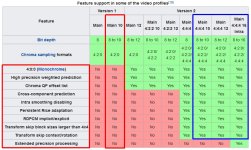
Sony have said they are not going to put H.265 in their cameras. One of the main reasons is that the commonly used Level 10 H.265 implementation does not support the necessary processing parameters to really deliver the best in motion cadence, prediction, smoothing, and precision processing to deliver the best in spatial and temporal resolution across everything from very high speed motion where really efficient motion prediction analysis is required right down to filming a still image. The reason for this is that HEVC Level 10 doesn't store the necessary temporal and spatial information required for high quality accurate decoding. Especially if you now want to grade the living daylights out of it. A graphic below showing the existing HEVC profiles outlines what applies to the existing Main 10 vs Main 444 10-bit. A massive difference between the two.

HEVC can deliver everything that is required and that is currently embedded in the latest iterations of H.264 that we see in Canon's XFAVC and Sony's XAVC. This though in HEVC 10-bit doesn't happen in 10-bit until you reach Main 4:4:4 Level 10. At this level it requires an enormous amount of computational power to process. A lot of the post production issues involving HEVC are based around the inability to get smooth playback at software level in NLEs. That problem is prevalent these days for many handling files delivered even at HEVC's most basic level which is the level we find in most of the cameras that support HEVC Main 10.

No doubt in time this will change with more advanced ASICs, FPGA's from the camera point of view but it will also have to matched by equivalent developments in codec handling in CPU's and GPU's. By the time these developments arrive I feel that H.265 will have been passed over for most widespread use by the AV1 streaming protocol that is royalty free and has been signed up to by nearly every major creation and distribution provider. AVI is the major threat facing the future adoption of HEVC to HEVC's disastrously complex and convoluted licensing policy.

Chris Young

References:

Video processing
https://www.researchgate.net/public..._Camera_Parameters_for_Super-resolution_Video

AV1 consortium
https://aomedia.org/

Existing HEVC profiles
https://en.wikipedia.org/wiki/High_Efficiency_Video_Coding

HEVC profiles text.jpg
 
Just chiming in to say that I'm looking forward to seeing these new tests when they're ready. I love my 1DX II, so anything that makes it look even better is something that interests me.

Ok Jaime thanks for the feedback. The 1DX II can look much better with custom picture styles over the stock settings. Once I optimized the 1DX II I also optimized the C300 II, and the 1DX II looked better for skin tones (C300 II still has more DR). The C300 II also provides 10-bit 422 and RGB 12-bit 444 (1080p), however I didn't need the extra bit depth and sold the C300 II (was used almost exclusively in the studio on a tripod). Another interesting aspect is the 1DX II's 4K hasn't aliased significantly as opposed to the C300 II which aliased on e.g. fine fabric (the C500 II and FX9 6K => 4K images shouldn't alias while finally providing True 4K).

I should have time tomorrow to test the 1DX II in daylight with FS-Log against the EOS R with CLog and FS-Log. The last test I did indoors I was getting fairly closely matched waveforms between cameras where the images matched as well, both before and after grading with same Adjustment Layer.
 
@Chris- have you graded / worked with X-T3 10-bit H.265 footage? I found that it looked pretty good and didn't have any objections to the motion. I've been waiting for Fuji to de-cripple the once decent AF to test it as another gimbal cam option (and smaller travel camera).

H.264 at higher bit rates is fine, media cards are plenty fast now. Sony could also use H.265 ALL-I re: motion issues. Perhaps it's also about patent license fees? AV1 is fine, however as with all new tech will take a while to percolate and get adopted everywhere.

The whole codec patent pool licensing mess is an example of another cartel that will hopefully unwind as the world changes with the coming big changes in things we can't talk about here lol.
 
Here is a summary of what has been reported about the RAW output from the FX9 so far:


So at least as of now, you'd be looking at spending at least $6500 (plus whatever the Atomos 8K MCU costs) to record a 4K Super 35 RAW output from the camera using a very bulky setup that involves a 17-inch external monitor.
 
Last edited:
So, if you want to shoot RAW, this is not the camera for you, go with the C500II instead. AF will brobably be better on the Sony, if you care about that. It reminds me of the FS7II-EVA1-C200 situation (but this time Canon's offering is not missing out on important recording options, its sin is that it's slightly more expensive).
 
Here is a summary of what has been reported about the RAW output from the FX9 so far:


So at least as of now, you'd be looking at spending at least $6500 (plus whatever the Atomos 8K MCU costs) to record a 4K Super 35 RAW output from the camera using a very bulky setup that involves a 17-inch external monitor.

Or just spend a pittance for a BMD PCC 6K. I can't imagine anyone jumping through all of those hoops and spending that much to shoot RAW from that camera.
 
No it's not the same (this is a new version not shown yet), however it's a lot closer than I thought possible. I'll post examples when I have time for a side-by-side test and see if you can tell them apart (EOS R CLog vs. FS-CLog, and EOS R CLog vs. 1DX II FS-CLog).

It is not about telling them apart, jcs. You have proved to me you can get great colors, great skintones, match cameras, etc.

My main interest - as I shared with you the last time we had a brief conversation about your profile - is dynamic range.

When you show me a nice-looking end-product online it is absolutely useless for me in terms of an evaluation. It's great to show that to the masses when you're selling something, but I need to see the raw files of over-exposed footage. Highlights on the edge.

Provide the same shots with C-Log and your profile with the same ISO, shutter and aperture. Show me how your profile handles DR and latitude because I imagine it will be much more blown out than C-Log.

In my opinion, this is a hardware limitation and these pseudo-LOG profiles do nothing but adjust the color(s) of the pixels.

Canon themselves require you to send the 5D Mark IV in so they can enable C-Log on non-C-Log units.

Have you cracked the code?

Because the skin, color...all good. But not the DR, latitude, or the recovery in post...at least so far.
 
Chris- have you graded / worked with X-T3 10-bit H.265 footage? I found that it looked pretty good and didn't have any objections to the motion.

Yes I have tried it because I was very close to buying an X-T3 and associated glass. Price was also very tempting. In the end though I stuck with the four letter word as I already had Sony cameras and E-Mount glass so ended up getting an A7III body. Also I am very familiar with editing and manipulating all flavors, shapes and sizes of XAVC-L and I so the whole XAVC workflow is second nature to me from out of camera color to grading SLOGs etc. Keeps life simple for me.

With regards to the quality color and behavior of the of the high bit rate files from the X-T3 I found the H.264 in both 25 and 50p to be far, far easier to work with than the H.265. Visually for my market which is part broadcast and part corporate part entertainment H.264 is totally adequate and as I can see no real quality differences between the material that started off as H.264 or H.265 so I stay with H.264 as it works well in my particular space. For the last doco series I shot on this year we used XAVC-I 50p at 500Mbps for the main camera format. For the broadcasters though 90% of that is still 50Mbps 1080i XDCam MPEG 2. This never ending quest for higher and higher bit rates and more difficult to work with codecs does not really pay many dividends in my situation especially as most my corporate clients material ends up on the web as 8-bit 420 .webm, the VP9 codec in other words. All the hard to work with DJI 4k 50p material and any H.265 immediately gets batch trans-coded to Cineform. If I could have a mainstream camera that shot Cineform that would be my preference.

Chris Young
 
So, if you want to shoot RAW, this is not the camera for you ...
One of the British lads had a conversation with a Sony poobah at IBC (IIRC, the ProAv dude). The poobah kept stressing that it was for the "documentary/quick turnaround" type workload. But it's pretty hard for me to believe that there will be no full frame 4K Raw recording other than to a stationary monitor (unless you're Flavor Flav and like having a 17" monitor/recorder hanging off your neck). The sole promo video released by Sony itself has a quick shot of a much smaller Atomos piece connected to FX9.

That said, the current version XAVC-I at 600 Mbps with the modern computational power ought to be enough for the low budget narrative work too. After all, those AF Cine zooms must have some application in mind. It may be FX9; it may be another model in the making,
 
Last edited:
Or if you want to shoot 6K. Or anamorphic.

The more I've been thinking about the FX9, the less I like the idea of buying one. The way it's priced and the way you
end up with certain options like RAW just seem convoluted. It feels like Sony really didn't even want to come out with
this camera, they just did it because they had to because the FS7 MKII is getting long in the tooth.
If was in the market for a Sony lower end camera today, used FS7s are getting pretty cheap, I've seen 5K and lower now.
 
Back
Top