
Navigation
Install the app
How to install the app on iOS
Follow along with the video below to see how to install our site as a web app on your home screen.
Note: This feature may not be available in some browsers.
More options
You are using an out of date browser. It may not display this or other websites correctly.
You should upgrade or use an alternative browser.
You should upgrade or use an alternative browser.
Sony A7sII Initial Impressions
- Thread starter paulcurtis
- Start date
paulcurtis
Veteran
Samuel, i'll give all those a go next.
In the meantime i've had it connected to the Odyssey 7Q.
It appears that it is no longer possible to record APS-C at 4K externally. Or i cannot find out how. The A7s would output a scaled APS-C size to the HDMI, which was about 2700 pixels across but i cannot find any settings on the Mk II that would allow this. As soon as you select 4K then APS-C is just not possible. It's damn fiddly with the menus now and what can and can't be done.
1080 50p appears possible, so i will try RS at 1080p25 and 1080p50 to compare.
In terms of highlight aliasing, looking at the O7Q monitor at HD and zoomed in on a high contrast backlit edge i do not see any sharpening artefacts. I cannot say whether this is the same for internal recording but i'll be trying for that. Those black highlights are a result of scaling artefacts, made worse by compression.
cheers
Paul

cpc
Well-known member
I'm curious if s-log3 has indeed less shadow noise than s-log2. Also, banding after dialing contrast: just looking at the curves implies s-log3 shadows, in particular, should break easier.
S-log3 has a higher midgrey point hence the need to increase iso with s-log2 to match the mid level.
S-log3 has a higher midgrey point hence the need to increase iso with s-log2 to match the mid level.
paulcurtis
Veteran
I've just done some more tests which i hope to get to look at later on this evening.
I've done shadows comparisons between Slog2, 3 and A7s Slog2
In terms of highlight artefacts, yes i can still see them but i don't think they're as bad. Also i recorded to external to compare the results there too. I will have direct comparisons to show though, same scene from different cameras and settings.
cheers
Paul
Very interesting!
* should have 1.33 stops more range in the highlights, and cleaner shadows worth maybe the other 0.66 stops.
.
Say what? lol samuel you know a lot of s*%t ...i'm guessing lol
Paul thanks for sahring... i'll wait for your further testing results. I'm getting kinda sorry i sold the 5d iii, but then again i hate buying all these cf cards
paulcurtis
Veteran
Next conclusions
Rolling shutter in 1080p is identical to the A7s, both 25p and 50p. This is faster than full frame. If you record 50p then you're putting that into 50mbits (so half the bit rate per frame) but it does output 50p on HDMI so if you need 1080p with the fastest RS readout then externally record that 50p would be best (and chuck half the frames away).
I've compared resolution wise with the A7s and as you'd expect it's pretty much the same. Of course you can now record UHD internally and downsample to 1080p yourself, this gives better results than 1080p straight from the A7, so if your destination is 1080p then the A7s will produce a better resolution image by recording 4K. The ProRes vs XAVC UHD, well the ProRes is clearly better, even on a static scene. The levels of prores don't match the XAVC (legal vs full range) but the underlying data would be the same. On moving scenes the ProRes would hold up considerably better.
If you take ProRes, denoise at 4K then downsample, that will yield the best image possible. Second best is doing that to XAVC. I would say on a static scene there's not that much in it. The blue channel appears to be worst, with some odd ringing artefacts. Of course the image is better than the A7s, not by leaps and bounds but a little.
So RS is identical between the models.
A7sII can do 100/120fps at a crop factor of 2.2 (i believe it is)
A7sII does FF at UHD
Resolution pretty much the same
Next is noise
cheers
Paul
paulcurtis
Veteran
One bit of news. If i look at a UHD -> 1080p Slog2 A7sII compared to the A7s Slog2 (same ISO 3200) there are no highlight artefacts on the A7sII version whereas there are on high contrast edges on the A7s. So that's a win for the MkII.
Also at the same ISO the noise on the A7sII is noticeably less.
And you can clearly see the benefit of downsampling. I'm enclosing a quick screenshot. The waveform shows the A7s 1080p XAVC on the left and on the right is the A7sII USD down sampled to 1080p. You can see the 8 bit banding clearly on the left but on the right it holds more tonality. The viewer shows the A7sII above the A7s and the A7s shows highlight artefacts clearly. Lenses were both 50mm at f5.6 and focus in the same place, allowing for slight DOF variations the highlights still seem much smoother on the A7sII.
(not sure how bad this site will compress the screenshot though)
Edit - here's a link to the file https://www.dropbox.com/s/gy0rxc3on1x4rxz/a7sa7sii.jpg?dl=0
cheers
Paul
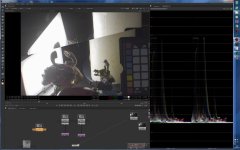
Also at the same ISO the noise on the A7sII is noticeably less.
And you can clearly see the benefit of downsampling. I'm enclosing a quick screenshot. The waveform shows the A7s 1080p XAVC on the left and on the right is the A7sII USD down sampled to 1080p. You can see the 8 bit banding clearly on the left but on the right it holds more tonality. The viewer shows the A7sII above the A7s and the A7s shows highlight artefacts clearly. Lenses were both 50mm at f5.6 and focus in the same place, allowing for slight DOF variations the highlights still seem much smoother on the A7sII.
(not sure how bad this site will compress the screenshot though)
Edit - here's a link to the file https://www.dropbox.com/s/gy0rxc3on1x4rxz/a7sa7sii.jpg?dl=0
cheers
Paul
adaptation
Active member
Excellent info Paul - keep up the good work. Do you plan on doing extensive slog 2 vs slog 3 tests? Thats the final Question i have. Great stuff man.


caseywilsondp
Well-known member
... The waveform shows the A7s 1080p XAVC on the left and on the right is the A7sII USD down sampled to 1080p. You can see the 8 bit banding clearly on the left but on the right it holds more tonality.
View attachment 106358
Could you explain this test to me? Seems a little obvious that a uhd image would be better than 1080?
My A7S II test results: http://www.eoshd.com/comments/topic/18425-a7s-ii-in-stock-at-samys-la-quick-review/
SLog3 has some banding issues which can be fixed using SLog2 + SGamut3.cine. Stock PP3 worked well in low/mixed light (see link above).
100Mbs is as other have stated way too low for 4K. Still not bad compared to 100Mbps GH4 4K (though GH4 has the edge with less macroblock artifacts).
The A7S II is a worthy upgrade from the A7S, IBIS is really good. It does overheat, though only so far on long takes (testing- I'd never shoot that long- see link for more details).
The new Sony FE 24-240 is a nice all-around full-frame lens, similar to the 18-200 on the A7S (APS-C mode) in versatility (except close focus).
The A7S II color is a really nice improvement, but not as good as Canon 5D3 RAW for skin tones.
paulcurtis
Veteran
Excellent info Paul - keep up the good work. Do you plan on doing extensive slog 2 vs slog 3 tests? Thats the final Question i have. Great stuff man.
Thank you, yes i'm working on that side too.
What's the verdict on the quality of HD video on the a7sii? does it still downscale from 4k in camera like a7s? One thing I really miss on my a7rii vs a7s is that I have to shoot 4k s35 or else take a big image quality loss in HD and/or FF.
HD from FF? Yes it downscales from 4K to 1080p and it's damn good. I've some other questions and tests i'd like to check first. One being the idea that is it better to record internal HD at 50mbits or UHD at 100mbits and scale under all scenarios. So on a static or slow shot clearly the UHD downscale is better. But on a high detail and moving shot does the UHD break up faster than the 50mbit of HD, bearing in mind UHD is 4 times the area for only twice the data rate.
cheers
Paul
paulcurtis
Veteran
Could you explain this test to me? Seems a little obvious that a uhd image would be better than 1080?
The reason for the screen was to see how the waveform on the downscaled version has better tonality than the HD version because of averaging the colours. So the waveform is less stepped. This is good because the source recording is only 8 bit YUV and many people believe this isn't good enough. What i've found is that if you can subsample the UHD then the effective depth is greater than 8 bit as you can see. This helps with banding and subtle graduations.
My A7S II test results: http://www.eoshd.com/comments/topic/18425-a7s-ii-in-stock-at-samys-la-quick-review/
SLog3 has some banding issues which can be fixed using SLog2 + SGamut3.cine. Stock PP3 worked well in low/mixed light (see link above).
The A7S II is a worthy upgrade from the A7S, IBIS is really good. It does overheat, though only so far on long takes (testing- I'd never shoot that long- see link for more details).
Great stuff!
You mention using the ARRI luts in lumetri, are these being fed correct data levels? Sony have a habit of changing black levels in different cameras. It's very easy to clip blacks and also whites. Just bringing a stock file into PPro will usual give clipped highlights (those 100 -> 109% moved above 1) and the lumetri panel does exposure slightly differently, it's under a S curve, not a gain, and >100% it does something different. The HDR stuff isn't quite there yet. So you generally need to massage your levels into 0 to 100 using an old effect and then work in the panel.
I've started looking at Slog3 vs Slog2 as well
You can see clearly that the Slog3 container is too big to hold the range from the camera, so we never use the whole bucket which can lead to banding. However the shadow response in Slog3 is considerably better than Slog2 - so there's the irony again. It's too early for me to draw conclusions because i need to see the container in action in lots of scenes. What you could be seeing as banding in subtle areas could well be compression.
Also there's a huge difference between comparing in RGB space and the original YUV space. I can get the YUV data only when it's recorded externally as i've not been able to get into the XAVCs original data. The reason for doing that is to confirm whether the container is storing the same number of levels as Slog2. Does anyone have a way of extracting source level data from XAVC? That way we can tell whether all the same data is in SLog3 vs Slog2 but just under a different curve...?
I would say though that even Slog2/SGamut is considerably better than the A7s. The colour science here especially is very different. Reds are, well, red. So i don't know what SGamut3.cine is offering yet.
So certainly so far it's a solid upgrade. There's nothing magical in here, it's kind of what the original should have been but from shooting video viewpoint it's very very welcome. So far i can see better colour science, IBIS making some shots possible and 4K internal allowing gimbal use more easily.
I've not compared RAW stills yet either.
cheers
Paul

Samuel H
Major Contributor
RAW stills should be identical, no hurry on that front.
An improvement using slog2+sgamut is something I didn't expect. Very welcome anyway, but I'd go straight to slog3+sgamut3.cine anyway: banding is easier to fix and less bothering than clipping (denoise, downsample, add grain, banding should be gone) (also: there are many reports of image issues on the a7S that in the end turned up being a result of the LUTs used or the software used to apply them).
All this is looking pretty good, thanks again to everybody sharing their results.

squig
Veteran
The A7S II color is a really nice improvement, but not as good as Canon 5D3 RAW for skin tones.
Bummer. Yeah that's how it's looking to me, big improvement on the A7s but not quite 5D raw good with skin. I've only kept the A7s in case the 5D explodes.
The Arri log Film Convert LUTs aren't too far off with the sLog3 files.
Back to basics
Which cards will handle well 4K internal recording?
For instance are the Lexar SDXC Card 64GB 633x Professional Class 10 UHS-I enough, or do you need the (double price) Lexar SDHC 64GB 2000x Card and UHS-II Card ?
None of the A7's support UHS-II (really sucks with the large file sizes from the A7rII, writing stills to the card is painfully slow), just need U3, 64gb minimum, SDXC. The additional speed of the 2000x will only help when transferring files with a card reader.
This guy has tested a ton of cards with the A7rII, you can see it tops out at about 36 MB/s:
http://www.cameramemoryspeed.com/sony-a7r-ii/sd-card-comparison/
Last edited: