paulcurtis
Veteran
RAW stills should be identical, no hurry on that front.
An improvement using slog2+sgamut is something I didn't expect. Very welcome anyway, but I'd go straight to slog3+sgamut3.cine anyway: banding is easier to fix and less bothering than clipping (denoise, downsample, add grain, banding should be gone) (also: there are many reports of image issues on the a7S that in the end turned up being a result of the LUTs used or the software used to apply them).
All this is looking pretty good, thanks again to everybody sharing their results.
Samuel,
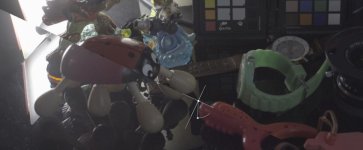
Here's a side by side of A7s and A7sII both at 3200. Both Slog2/SGamut. You can see clear differences for the reds. The two 50mm lenses flare differently hence exposure differences, the A7sII had a voightlander 1.5 and the A7s had the contax zeiss 1.4. Needless to say the A7sII looks like how the scene was.
So i think this may well evidence that the A7s had some seriously screwed up SGamut science. To be honest so far i'm not seeing that much difference between SGamut and the .cine version.
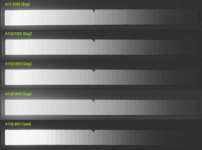
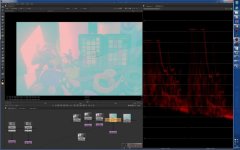
In addition here's a screen showing the YUV comparison between Slog2 and Slog3 both recorded off the A7sII on the O7Q. You can clearly see the encoding difference. The waveform is just displaying the Luma, the Y part. The Slog2 is making more of the space and given the same clipping point you can see that Slog3 could hold a lot more range than this camera can deliver.
Now the big question is internally how is this encoded, especially in the XAVC files. Is it as simple as 0 to 255 integer values for the luma channel? Or is the encoding done differently? In other words is Slog3 only using code values 30 to 210 out of a possible 0 to 255? If this is the case then Slog3 will not be able to represent tonal values as well as Slog2 (which in turn is only borderline good enough compared to the cines).
This is made more difficult with the ProRes from the O7Q because these are 10 bit files, so 8 bit stuffed into 10 bit files but in order to read them via QT the pixel format is r4fl (that's 32bit YUV) but when you ask QT for that format it always dithers the image. If you ask for 16 bit YUV the range is different and it dithers. Only in 8 bit will it not dither but then you're not actually asking for what's in the file. Does that make sense?
So if we cannot work out the encoding scheme then we need practical image tests to eyeball.
https://www.dropbox.com/s/okxbj74xrvxig5u/yuv.jpg?dl=0
cheers
Paul