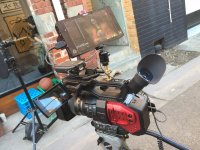
So there's no AF100 Successor - Now what?

In my experience the LS300 is the step up every previous AF100/101 owner was waiting for :
* still compact and sturdily built
* better dynamic range, better roll-off
* the image has more definition even in 1080p
* obviously there is the 4K
* The sensor is larger, maximising the use of different lenses
* due to the higher definition VSM is possible, so 16mm lenses are possible too or just extending your range of a zoom.
* a lot more image control
* it is way, way, way cleaner than the AF100 - finally get rid of the noise generator the AF is in comparison
* better low light capabilities
* finally no longer a consumer/prosumer codec, but a real broadcast spec 4:2:2 50Mbps compression. 150Mbps in 4K (incidently, the Sony PMW-F5 just makes do with 100Mbps in 4K)
* 3G HD-SDI - so you can also really output progressive.

Totally agree and I add:
- better focus assist
- the capability to use the zoom buttons to control the focus
- more intelligent use of the dual slot
- better look (AF100 remains horrible to see)

The real downside?

The lack of waveform and histogram, but at least one of them should be added in a future firmware release

Regards

Gary
 
Last edited:
Comparing the JVC to the Af100 is sorta pointless. It's a 5 year old design. Of course it's going to be a better.

But having owned the Panasonic, I was looking to move on to 'bigger and better'. So I chose the LS300 as my next camera. After spending a week with it, it is better, (as it should be) but it's not head and shoulders over the old AF100.

Image-wise, it's maybe what you would have expected from a camera 2 or 3 years ago.

If you want to compare it to anything, start by comparing to it's 'contemporaries'. By that, I mean any camera released or being released this year.

Personally, I don't think it stacks up against the the latest slew of video cameras.

I took a chance and bought a demo model from the NAB Show. I put it through it's paces, thinking the footage I had seen on the internet was improperly exposed or graded.

I was thoroughly unimpressed. Highlight clipping, lack of waveform or VFR, etc, they were real letdowns to me. Luckily the company I purchased it from, graciously allowed me to return it.

I'm not saying you won't get good images from the JVC. Im sure you can, just as plenty of people got good images from the AF100.

You will just have to work for it...
 
Last edited:
That sums up my thinking pretty well also. And, I haven't been pulled in by the look of any of the footage except the one with
the dogs...that one had a little something going for it and just when I was about ready to stop looking at it and to just start taking in the 'experience'...the scene switched to the road and the strip of what appeared to be ultra bright green fuzzy grass....
back to looking... :-/
 
It would be great if someone having both cameras -AF100/LS 300- could possibly post a couple of frames w the same subject. Skin tone, dynamic range, highlights...
It might be the last chance before leaving m43 train. The only thing that really worries me is selling my digital zuiko zoom lenses.
 
It would be great if someone having both cameras -AF100/LS 300- could possibly post a couple of frames w the same subject. Skin tone, dynamic range, highlights...
I've used the AF100 for three years and just recently took delivery on an LS300. I haven't yet completed testing the JVC, but I've seen enough to give you some practical answers:

1. AF100 highlights turn yellowish when exposure is pushed into the knee. LS300 highlights have much better color balance with fully recoverable superwhites.
2. AF100 built-in tone curves are stunted and inflexible. LS300 gives you tools to roll your own tone curve, though not what SLOG fans are looking for.
3. AF100 waveform monitor lets you accurately gauge manual exposure settings. LS300 has nothing but zebras, useful only for gauging highlight exposure.
4. AF100 has only limited manual ISO settings. LS300 manual ISO works similarly, but its auto-ISO/exposure comp features are a major saving grace.
5. AF100 dynamic range sucks, usable only from ISO 200-1000. LS300 DR sucks less, usable range of ISO 400-3200. Extended ISO tolerable up to 12800.
6. AF100 electronic lens controls are glitchy and focus is a *****. LS300 not much better, has power-zoom rocker, but Panasonic OIS support is really spotty.

Nice list of Zuiko digital lenses you got there, too bad the LS300 flops on legacy Four Thirds lens support. Like AF100, the LS300 has LCD numerical aperture, focal length, and focus distance read-outs, but it's mostly MIA with legacy Four Thirds lenses. The Olympus lenses I tested work only manually, but the legacy Panasonics were DOA. Support for the 14-35mm f2 is barely adequate, no auto control or read-outs other than manual aperture setting.

I'll post a more detailed report after I sort out all the exposure options and controls. Colors are well-balanced, shadows are highly gradable, and highlights are not hard to manage at all. This camera has way finer sharpness and image quality than the AF100, but the way it works best is with a hybrid of manual and auto-exposure settings combined. Ironically, the LS300 is more adept at auto-exposure of manual lenses than it is with manual control of electronic MFT lenses.
 
... It might be the last chance before leaving m43 train. The only thing that really worries me is selling my digital zuiko zoom lenses.
I'd wait until GH5 comes out or, perhaps, a new EM1 MKII with 4K recording. I would anticipate a major jump in quality for the cams in the $1,400-$1,800 range soon.

Just an opinion, mind you. I believe that MFT is going to stay in the "budget/entry level" niche of the 4K market but that even that niche will deliver very decent performances even compared to the products of the last 2-3 years. Anything in the $3,000+ range will likely trend toward APS-C/s35 at the least.
 
It would be great if someone having both cameras -AF100/LS 300- could possibly post a couple of frames w the same subject.
Here's a link to my JVC GY-LS300 portfolio on Vimeo:

http://vimeopro.com/fallenstarfeatures/jvc-gy-ls300-tests

I uploaded four comparison videos, all shot with the LS300. Same subject in each shot, an outdoor scene with sunlit highlights and dark shadows. I used a Sigma 50mm f1.4 lens at f10 and 1/60 second shutter, 5600K white balance, and Standard Color Matrix and Gamma settings. I set the exposure a bit hot to evaluate the LS300's handling of superwhite highlights. My aim was to improve on the LS300's default 1080p image quality, by post-processing and downsampling a customized 4K video down to 1080p. Each file is five seconds long and downloadable from my portfolio (streaming versions have been re-encoded by Vimeo at reduced bitrates):

1. LS300 Default 1080p EC-0.mov - Original unedited footage shot at 1080p with Default settings, Exposure Compensation: 0
2. LS300 Default 1080p EC-3.mov - Original unedited footage shot at 1080p with Default settings, Exposure Compensation: -3
3. LS300 Post Process 4K.mp4 - Processed footage shot at 4K, gamma corrected and downsampled to 1080p
4. LS300 Pre Process 4K.mov - Original unedited footage shot at 4K, settings customized for post-processing

 
Last edited:
No disrespect to Lpowel. These videos only confirmed what I saw with my LS300; detailed 4k image, but video-like with sub-par highlight handling.
 
No disrespect to Lpowel. These videos only confirmed what I saw with my LS300; detailed 4k image, but video-like with sub-par highlight handling.

That's completely ***NORMAL*** for a clip shooted in VIDEO gamma and VIDEO color matrix (REC709) and this is the best way to test a camera, but the camera is fully configurable and you can achieve any look you want. I will post my tests soon
 
These videos only confirmed what I saw with my LS300; detailed 4k image, but video-like with sub-par highlight handling.
The LS300 has configurable superwhite and knee settings, which I set to 108% and 100%. I also set the zebra to the same range, so I could see exactly where highlights were getting flattened in the frame. For this shot I wanted to see how recoverable the LS300's superwhites were, and adjusted the highlights to range all the way up to 108%. After loading the 4K clip into After Effects, I used Color Finesse to lower the master gain down to 100 IRE, and lifted the brightness back up with gamma adjustments. This produced smooth beige gradients on the swing cushions, all the way up to 100% white. That satisfies my requirements for a live event camera capable of recovering details from the occasional blown highlight, something I could never rely on the AF100 to handle predictably. As far as the LS300 looking "video-like", I'm not expecting anything magical from a workhorse like this; clean shadows and accurate color balance will suit my needs just fine.
 
To me, this footage looks much better (video will need some sort of a LUT to make it more "film like" anyway).

Now this needs to be repeated by the public, aka LS-300 owners, at large.
 
I uploaded four new LS300 test videos to my Vimeo portfolio:


http://vimeopro.com/fallenstarfeatures/jvc-gy-ls300-tests


This set of four comparison videos shows the same scene and exposures as my first set of LS300 videos here:

http://www.dvxuser.com/V6/showthrea...w-what&p=1986554830&viewfull=1#post1986554830

The difference is that these videos show objects in motion, allowing you to evaluate the camera's aliasing and motion artifacts in H.264 footage.


5. LS300 Default 1080p EC-0 motion.mov - Original unedited footage shot at 1080p with Default settings, Exposure Compensation: 0

6. LS300 Default 1080p EC-3 motion.mov - Original unedited footage shot at 1080p with Default settings, Exposure Compensation: -3

7. LS300 Post Process 4K motion.mp4 - Processed footage shot at 4K, gamma corrected and downsampled to 1080p

8. LS300 Pre Process 4K motion.mov - Original unedited footage shot at 4K, settings customized for post-processing

 
Ive just had a prerelease engineering version of the DVX200 for a couple of days. May be well worth a look for those still with AF100's or GH4's looking at something with a new sensor and everything built right in. I have a first impressions vid coming.

IMG_9906.jpg

DVX200-1.jpg
 
Cant wait to hear what you think and see some footage Noel. At $5K US this could be a very interesting camera for a lot of uses. Having a large sensor in a all in one camera is intriguing for sure.
 
Back
Top