VaricamLT: Panasonic VariCam LT

Status
Not open for further replies.
Awesome, Noel!

Would be interested to see if you can help us put the does it look like film or video debate to rest here ;) Not much demo footage at all, and most of it's just scenic stuff. We already know what the camera can produce on a technical level... hoping to see some new content from this sensor!

Menu systems and ergos would be interesting. Quality of the LCD monitor when used for live viewing is a curiosity. Size/weight ergos when run'n'gun.

Looking forward to your review!

 
... Could someone explain to me the difference between the Sony A7s ability to show at crazy high ISO and still have a clean image VS Panasonics dual ISO setup ...
Panasonic has dual analog amplification. Sony has twice (or slightly more than twice) the sensor size and correspondingly larger pixels, which are capable of receiving more light (all other technology being equal ... which is not but that's the rough explanation).
 
Thank you for this. Learned something new and piqued further interest on the topic

To try to show you what I mean, here are some still images I graded from the Varicam 35 video:

varicam-ungraded.jpgvaricam-graded.jpg
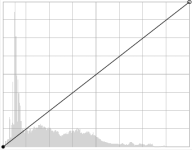
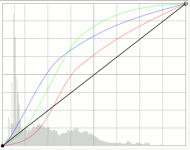
curves-before.pngcurves-after.png

Here you can see I steepened the curves, raising the contrast. I also tweaked each color separately. I think the image had a red cast, as most video images seem to do, to my eyes at least. You might also notice that I let blue dominate the shadows a smidge too. This is an expressive interpretation, not necessarily dead-on accurate.

varicam-soccer.jpgvaricam-soccer-graded.jpg
varicam-skyline.jpgvaricam-skyline-graded.jpg

The red cast is gone, the different colors speak out more clearly, and it's closer to the film look, I think. I doubt they're perfect. They were somewhat quickly graded from screenshots of 8-bit 4:2:0 footage on the Internet.
 
Nice chat. But to say Arri has a problem is a stretch. I doubt the Alexa has to worry about a Panasonic camera. The industry would never embrace it. They can't even embrace Sony. Arri has the industry cornered because they are Arri.

Sony F55's used on "Big Bang Theory", highest rated sitcom on television, and others. So, I wouldn't say Sony is having any problem finding acceptance in Hollywood.
 
Last edited:
I have no proclivity for ranting on message boards. I just saw your string of threads that contained a string of absolutes: "that looks nothing like film"... "Arri has the industry cornered". I personally believe that absolutes are best reserved for indisputable facts, and that opinions require careful and distinct wording.

I would never suggest that the Arri name has NO influence in a DP's choice (oh hey, another absolute); it is a brand that is familiar to every cinematographer. My contention is that when large sensor cameras began to replace 35mm film, many DP's explored their options rather than stubbornly retaining their allegiance to a single manufacturer, and many found the Alexa to their liking for what it could do.

I'm have no intention of passing judgement on the Varicam based on the Panasonic badge, I'm forming my opinion by consulting with those who have used it and by testing the camera, evaluating the footage and weighing it against Alexa footage (my personal baseline).

Even today, just in terms of capability, the Alexa still has the best 2K sensor. It's just that the 2K era is passing. More resolution, like higher color bit-depth, is just too useful. Even Deakins shoots open gate.

Sony F55's used on "Big Bang Theory", highest rated sitcom on television, and others. So, I wouldn't say Sony is having any problem finding acceptance in Hollywood.

There's a lot bigger market than just features and MoWs that are now using large sensor cameras, I have no doubt with the FS7 Sony is starting to find Canon levels of acceptance in the broadcast/doc/sports world. Hollywood though, it's own world, but at least it's no longer the only market for large sensor cameras.
 
Last edited:
I have no proclivity for ranting on message boards. I just saw your string of threads that contained a string of absolutes: "that looks nothing like film"... "Arri has the industry cornered". I personally believe that absolutes are best reserved for indisputable facts, and that opinions require careful and distinct wording.

I would never suggest that the Arri name has NO influence in a DP's choice (oh hey, another absolute); it is a brand that is familiar to every cinematographer. My contention is that when large sensor cameras began to replace 35mm film, many DP's explored their options rather than stubbornly retaining their allegiance to a single manufacturer, and many found the Alexa to their liking for what it could do.

I'm have no intention of passing judgement on the Varicam based on the Panasonic badge, I'm forming my opinion by consulting with those who have used it and by testing the camera, evaluating the footage and weighing it against Alexa footage (my personal baseline).

Charles I have the impression we are actually in agreement and you are just getting hang up on the word cornered. What I meant by that is Arri dominates their market and they do. Their market is the very high end and they dominate. There's no Sony or Panasonic there. Look at the list of Oscar nominees for cinematography the last few years and there's not even Red. Only Arri and film. I doubt Panasonic would crack the high end market if Sony and even Red can't threaten Arri.

About the Varicam I can only pass judgement on their demo and I think it's the whole point. Why would they put a demo out specially so well produced if they didn't want you to judge it? They just hope the judgement would be positive and you end up buying it. But this is what a demo is right? But if you are bothered by my absolute statement that it looks nothing like film, may I ask what do you think looks like film in that demo? It's clean, looks digital and have shots that film could never do. So what looks like film?
 
I believe he meant for broadcast, not for Cinema.

Yeah I was talking cinema the very high end. But broadcast makes even less sense. Which network is taking only 4K? They can barely broadcast HD properly. I only know of Netflix and Amazon. This is not really broadcast as we define it and honestly they are the minority.
 
Sony F55's used on "Big Bang Theory", highest rated sitcom on television, and others. So, I wouldn't say Sony is having any problem finding acceptance in Hollywood.

Sure. But that's TV and I doubt they switched because of 4K. And this is not what I call high end. I was talking cinema.
 
Panasonic has dual analog amplification. Sony has twice (or slightly more than twice) the sensor size and correspondingly larger pixels, which are capable of receiving more light (all other technology being equal ... which is not but that's the rough explanation).

Thanks! I get that point, but not what I am getting at.

Wondering the difference between a $2000 camera that can shoot clean images @ 25,000 ISO.

VS a camera with a clean base ISO of 5000 that is useless again past 8K

Would seem Sony's approach is better on paper...

BUT... this camera has a ton of people excited about the feature so I do think I am misunderstanding something.

All things being equal, how does Panasonics approach to ISO (dual base) differ from Sony's ultra high ISO settings that still remain clean? I think I am missing or misunderstanding something. Unless the dual base ISO isn't that exciting and Panasonic would have been just as well off keeping the base ISO at 800 but making it clean all the way about through 10k. That seems to be what I don't get. What's the benefit of a dual base ISO if the overall ceiling from clean useable ISO is still significantly lower than what Sony is doing on a tiny $2k camera?

Not talking about S35 vs FF low light here, strictly about ISO
 
Sstratos: let's agree to agree then! :)

As far as what looks like film in that demo--I think that gets into the impossible-to-put-into-words category of subjectiveness, plus semantics. No digital camera looks exactly like film. I think what we are all interested in is a filmic look, meaning tones that we respond to as cinematic, vs the negative connotations of "video" (ugly highlights, over-sharpening, blotchy faces etc). I have grown accustomed to the current filmic look of digital cameras enough that I believe I view 35mm now in a different way than I used to--certainly I am more aware of the grain and other photochemical characteristics than I used to.

Perhaps what makes more sense, then, is to compare cameras and footage to a cinematic ideal, rather than to film itself. Which is why I promote the idea of shooting tests with the same setup between two or more cameras and comparing results, rather than drawing conclusions from a demo reel.

I just finished looking at my Amira vs Varicam tests in a high-end color suite. In terms of image quality, they are different but the Varicam looked quite good. There were some specific issues that I am discussing with the Panasonic rep before sharing publicly, because I know how these things can spread and I want to make sure we didn't discover an anomaly.

I do not believe that the Varicam looks like video while the Alexa (Amira etc) look like film. Too over-simplified. I feel confident I can make images on the Varicam that would be as satisfactory to me as the Arri cameras. Have talked to a few of my colleagues who are currently shooting series on the camera and are very happy with the results.
 
Charles, do you think there anything other than coloring that looks different between the arri and panasonic? any difference in the way motion looks to you?
 
Got the LT in my hands as we speak. Weather permitting shooting on it all weekend, Monday edit session, Tuesday with Colourist for grade and DCP, Thursday I will be in Sydney with the result.

Im not sure what I can add here right now. We already know what the sensor looks like, we know why they've produced a smaller / cheaper version. FWIW Im getting one soon as I have every faith in the system and sensor. Didn't think I would buy another camera TBH, but I'd love to shoot on this as an option as much as possible.

Review coming next week. I want to state it clearly that, yes I will be doing a short user experience presentation at the LT roadshows, however Pana pays me nothing when I talk about it.

I will be at the following in Aus. Grug and others come along and introduce yourselves, would love to say hello in person. The Thursday event is at ACS HQ, so it's limited on numbers and members get priority.

Thanks for the heads up on that Noel, I'm pretty keen to take a look at the camera - so I'll see you at the Melbourne event.

Cheers,

Mark
 
Can someone explain this to me:

Wondering the difference between a $2000 A7s that can shoot clean images @ 25,000 ISO VS Panasonics approach with a clean base ISO of 5000 that is useless again past 8K

Would seem Sony's approach is better on paper... Does the A7s have better lowlight than the VaricamLT??

This camera has a ton of people excited about this feature, so am I misunderstanding something?

All things being equal, how does Panasonics approach to ISO (dual base) differ from Sony's ultra high ISO settings that still remain clean? I think I am missing or misunderstanding something. Unless the dual base ISO isn't that exciting and Panasonic would have been just as well off keeping the base ISO at 800 but making it clean all the way about through 10k. That seems to be what I don't get. What's the benefit of a dual base ISO if the overall ceiling from clean useable ISO is still significantly lower than what Sony is doing on a tiny $2k camera?

Not talking about S35 vs FF low light here, strictly about ISO
 
The only thing I know of from first hand experience re the A7S is its not very useful at high iso. It may have ok noise but its colors are weird as. We have dealt with a bunch of A7S footage and its got many a issue with its high iso image. I'm guessing the high iso stuff on the LT would be clean and rock solid colors as well.
 
The a7s is compressed mush - (afaik) - so cannot be considered for 'cinema' a cam - most cinema a cameras are in the 500-800 region - there fore the vari 5000 is interesting
 
comparing a 2000 dollar prosumer mirrorless camera to a proper $20k professional digital cinema camera is just not in the realm of seriousness or reality... I saw The Witch yesterday, a stunning film, shot on Alexa with night interiors lit for the most part with candlelight - it looked absolutely stunning. Pretty sure the DP didn't push it past IE 800.
 
To clarify, this is not an A7s vs Varicam arguement this is a particular and targetted question on one metric. And I am genuinely curious to understand what the difference is and the "why" behind it.

I know the A7s gets mushy and unusable at the extreme range of ISOs - but I am talking about only at its midrange, many steps away from maxing out. Let's say A7s ISO 10,000 vs Varicam ISO 10,000? (A7s caps out at 400K ISO, which is crap, but supposedly clean down lower).

And so you're saying ISO 5000 on the Varicam looks cleaner than ISO 5000 on the A7s when output to external recorder, bypassing internal compression?

PS I don't own and don't have an A7s. I just want to understand what the fuss is and where Sony is "cheating", then.
 
To clarify, this is not an A7s vs Varicam arguement this is a particular and targetted question on one metric. And I am genuinely curious to understand what the difference is and the "why" behind it...
It's a "secret sauce" thing. It's easier to ask why some 4K cameras cost $600 and others $60,000.
 
Status
Not open for further replies.
Back
Top