GH5 Panasonic GH5s EBU – Tech 3335 Assessment

Screen-Shot-2018-04-27-at-9.50.16-AM-768x187.jpg
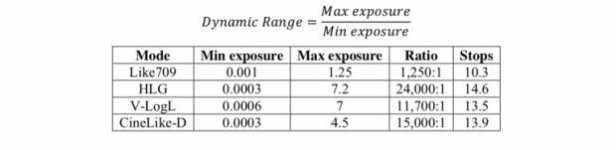
Like709 appears to have a residual knee at about 90% such that peak white (vertical = 1) is reached at about 1.3 times nominal 100% exposure (horizontal=1). CineLike-D clips at about 430% exposure, HLG doesn’t clip until exposure reaches at least 700%, and V-LogL
never goes above 80% which it reaches at about 650% exposure.

https://tech.ebu.ch/docs/tech/tech3335_s29.pdf

I'm calling foul on this rigged artifice of "nominal 100% exposure". It is a completely aribitrary, optically meaningless reference point that produces inflated marketing claims like "V-logL reaches 650% exposure", when in reality it clips at 80% of the 10-bit encoding range. The chart in figure 2 of the report, plotting linear light intensity vertically, versus so-called "nominal exposure" percentage on the X-axis, creates a totally misleading skewed portrayal of the measured data, making it appear that kneeless Like-709 has only "25% headroom" compared to 300-600% headroom with the other curves. That is the methodological fakery that produces Roberts' bogus Dynamic Range chart, listing "max exposure" as 1.25 for Like-709 versus 7 for HLG and V-logL. Those numbers are fabrications gerrymandered via artificial scaling of the gamma curves to coincide at an aribitrary reference point of 40% on the Rec 709 curve.

A more scientifically valid display of these gamma curves is shown in figure 3, where they are plotted on a logarithmic scale which matches the way our eyes actually respond to light. In this chart, all curves except V-logL* look practically identical until they reach the top end, where Like-709 appears to max out well before HLG and Cine-D. This is yet another way of skewing the data - in reality all curves max out at THE SAME POINT, where sensor saturation reaches 100%. THAT is the native reference point for measuring dynamic range, not "nominal 100% exposure" or "18% gray" or any other arbitrary point on these manufactured gamma curves.

Contrary to Roberts' systematic hedging of the data, Dynamic Range is not "a little speculative and subjective". It is a straighforward quotient of light intensity at 100% sensor saturation, divided by the level where detected light intensity is equal to the noise floor. It's not a chart of subjective interpretations, it should be a single, unambiguous number.

* Roberts finds the logarithmic V-logL curve "surprising", but it's no mystery, it's due to the master pedestal, a simple offset which he failed to properly compensate for in scaling the curve's dynamic range.
 
Last edited:
I have read people take exception with Alan Robert before, even such as Alister Chapman who respects him, but I have never read anything so defamatory as this.
 
Alan also does not seem to understand that the GH5S sensor is bigger than the GH5 and that although the 4:3 image is exactly the same that is not true for 16:9 or 17:9. The whole point of the sensor and which Panasonic has done a poor job of explaining as they just quote 4:3 information in the spec of the camera rather than being precise about the sizes for each image ratio. Many reviews have been confused by this spec reference so Alan is not the only one. Poor job in this regard by Panasonic. They talk about the sensor being bigger but have not clearly stated this in any of the information by saying the precise dimensions to identify that the sensor is clearly bigger than the GH5. This would have made it much easier to understand. Instead they quote 4:3 dimensions which of course are the same MFT size !!! NOT true for 16:9 or 17:9 though if one thinks of them as a crop on a traditional sensor. A little effort and one can understand that the diagonal for all these sizes is the same ( the image circle diameter ) so one can work out all the dimensions if one takes the trouble. To me Alan didn't do this.
 
Actually, when the GH5S was released, a BM manager did say the 5S sensor was larger and was multi-aspect, closer in size to the GH2 Sensor, which also was multi-aspect. He further stated thismlargermsensor was one of the reasons IBS was eliminated, no room and the other that major market Cinema shooters did not was IBS either, so by eliminating IBS they had room for the larger sensor. The AF100 also had an oversized sensor, specifically spec’d for Video at 16:9 (17.8x10) whichnis the 16:9 crop on the 5S sensor, 17:9being closer to 18.8x10.

Another independent reviewer also worked out the sensor was in fact about 18.96 x 13mm, based on the various aspect ratio diagonals. Yes, this was a major flaw in Alan’s review, that he did not realize the video 16:9 and DCI 17:9 held UHD and 4K resolution respectfully. He was assuming that 16:9 was a crop of the 4:3 area size he quoted. But that does not reduce his other findings, that the GH5S is more than an excellent HD camera, it is also an excellent UHD Camera also.
Cheers
 
I agree, but Panasonic could have made life a lot easier by actually quoting the true sensor information rather than confusing everyone with the 4:3 data ( which is of course the same for them all ) They omitted to quote the data for 16x9 and 17x9 which would have made all this a lot easier for everyone without people having to calculate ( and maybe get it wrong again ). From the information the diagonals of course are the same for all but the 1:1 ratio.
 
Last edited:
The irony of dynamic range is most people grade their work and their final product ends up having 1-2 stops of it thrown away...not always, but just saying.
 
I have read people take exception with Alan Robert before, even such as Alister Chapman who respects him, but I have never read anything so defamatory as this.

By in large I agree. It is always valid in my opinion to put forward the results of ones own discoveries and developments but to totally denigrate someone else's work only denigrates your own efforts.

Alan between 1968 - 2004 contributed enormously to the development of modern cameras and it was his feedback that the likes of Sony, Thomson, Phillips, Bosch, Pansonic et al took on board that has led to the developments we now see in modern cameras. It's because of Alan and the engineers like him, people like Yves and Isabel Faroudja, Faroudja Labs, and Philip J. Cianci, HDTV and the Transition to Digital Broadcasting and Charles Poynton, Digital Video and HDTV that we find ourselves where we are today. It's because of the ground work done by this previous generation that we are now in the enviable position we are with digital video technology.

Agree to disagree by all means. Put forward all the reasons and results to support your own developments and findings. Let those facts and your work be judged by your peers. There is no need to resort to chastisement of other developers findings and results. Argue you position. No need to lecture.

Chris Young

Yves Faroudja? More than half the people in the room weren't born. DCDI, inverse telecine, my Kloss Novabeam 100 :)
 
EBU Tech 3335 p.18 said:
The camera is framed on a back-illuminated test chart, and its output fed directly to a computer for analysis. The test chart is a transparency, or rather a set of transparencies mounted in an opaque metal plate, containing a number of specially manufactured patches of known density. The chart is intended to be used with back-illumination in otherwise total darkness.


https://tech.ebu.ch/docs/tech/tech3335.pdf
 
By in large I agree. It is always valid in my opinion to put forward the results of ones own discoveries and developments but to totally denigrate someone else's work only denigrates your own efforts.

Alan between 1968 - 2004 contributed enormously to the development of modern cameras and it was his feedback that the likes of Sony, Thomson, Phillips, Bosch, Pansonic et al took on board that has led to the developments we now see in modern cameras. It's because of Alan and the engineers like him, people like Yves and Isabel Faroudja, Faroudja Labs, and Philip J. Cianci, HDTV and the Transition to Digital Broadcasting and Charles Poynton, Digital Video and HDTV that we find ourselves where we are today. It's because of the ground work done by this previous generation that we are now in the enviable position we are with digital video technology.

Agree to disagree by all means. Put forward all the reasons and results to support your own developments and findings. Let those facts and your work be judged by your peers. There is no need to resort to chastisement of other developers findings and results. Argue you position. No need to lecture.

Chris Young

What one has done in the past is in the past. I am 76 years old retired and enjoyed a good life but as a techie person all my life each report has to stand by itself not on past work. I recognize my thesis but would have a hard time explaining it now from over 50 years ago !!! If one continues with ones chosen work it has to be up to date. My only real criticism is the obvious lack of knowledge of the camera being tested. The whole key of the GH5S is the new sensor and its arrangement in the camera. Clearly in Alan's second paragraph he had not done this pre work to look into the camera and consequently made errors in his calculations of paragraph 2. Just set it up and tested it. I am not addressing the results only the incorrect information in his paragraph 2 which may have an impact on his other comments.
 
What one has done in the past is in the past. I am 76 years old retired and enjoyed a good life but as a techie person all my life each report has to stand by itself not on past work. I recognize my thesis but would have a hard time explaining it now from over 50 years ago !!! If one continues with ones chosen work it has to be up to date. My only real criticism is the obvious lack of knowledge of the camera being tested. The whole key of the GH5S is the new sensor and its arrangement in the camera. Clearly in Alan's second paragraph he had not done this pre work to look into the camera and consequently made errors in his calculations of paragraph 2. Just set it up and tested it. I am not addressing the results only the incorrect information in his paragraph 2 which may have an impact on his other comments.

The mistake on sensor crop would potentially have had an impact on Roberts' other comments I agree because sensor resolution was the basis for rejecting the UHD1 Tier II rating. I don't think the results of the testing were wrong however, the exposure range nor noise measurements in HLG or V-Log/L; there is no opportunity, not even a possibility to use the visual method in Tech 3335 2.4.1; neither the camera knee point nor the slope are adjustable in HLG; the results are computer determinations cited in the analytical methods 2.4.2 which brings up the second point; I won't speak for Erik Naso but in my case the DR measurement was on the internally recorded signal and conservative, rejecting anything less than an obvious stop. (I came up 11.67 stops on the internal recording). EBU 3335 2.4.2 would be using the camera HDMI output and by intent is to pursue a more precise result to the lower object brightness threshold "S." EBU3335 would not be using this method to come up with a more crude accounting because for that you wouldn't need 2.4.2 in the first place. It's probable we'll see more of this, vis a vis the C300MkII 15 stops DR would be suspect also if to question GH5s tested with the same method. We just need to see more camera comparisons tested this way.
 
I have a lot of respect for Alan but it really takes ten seconds on Google to learn what the multi-aspect sensor is on the GH5S and what the benefits are. He seems to pretty much ignore everything out there and just make up his own conclusions which don't even make sense because five minutes with the camera and he would have seen the sensor gets wider with different modes.

I agree that Panasonic has done an absolutely abysmal job marketing the sensor benefits of the GH5S but the information is out there.

With that said his errors do not take away from the overall value of the article which is the camera is pretty darn good. As a HD broadcast tool its rock solid and for UHD it misses his mark but the same could be true of just about any 4k bayer sensor camera. I would hate to see how he judges the Alexa. Since we are not going to get a lot of 3 chip 4k cameras under $80,000 anytime soon or actually have a universal 4k broadcast standard I wouldn't put much stock in his UHD findings. Nobody is going to block the cinema 4k cameras either just because they use a bayer sensor. I miss 3 chip camera designs a lot but not enough to go back to HD or have to deal with uncompressed YUV video which is much larger than raw. sacrificing raw is just not something that is going to happen just to have the minor detail benefits of a 3 chip design.
 
I would hate to see how he judges the Alexa.

He says the DR of the Alexa never clipped, whether white or black, thus exceeding the DR of the chart, so he concluded the Alexa claim of 14 stops was supported.

https://tech.ebu.ch/docs/tech/tech3335_s11.pdf

For the Red Epic Dragon , said the DR is 15.15 stops, contrast ratio 35,000:1, 4k mode resolution not acceptable for 4k shooting, 6k mode resolution = 3400 x 1900

https://tech.ebu.ch/docs/tech/tech3335_s16.pdf

For the BMD Ursa Mini 4.6K, DR is 13 stops in RAW, "the colour performance is rather lurid, with a distinctly pink look to many colours, and the camera responds to infra-red. These conclusions may be related to each other."

https://tech.ebu.ch/docs/tech/tech3335_s20.pdf
 
For the Sony A6300, no optical low pass filter so resolves all the way to the format limit 3840x2160 but with aliasing that never goes away when detail is reduced all the way to minimum setting although image is softened. DR in S-Log3 up to 13.5 stops. Noise levels consistently higher than acceptable, NR too ineffective to improve things adequately.

https://tech.ebu.ch/docs/tech/tech3335_s19.pdf

Reading these reports and others back to back, realize the GH5s overall excels in color, DR, NR; UHD resolution about the same as C300MkII or about 3300x1750.
 
Last edited:
What one has done in the past is in the past. I am 76 years old retired and enjoyed a good life but as a techie person all my life each report has to stand by itself not on past work. I recognize my thesis but would have a hard time explaining it now from over 50 years ago !!! If one continues with ones chosen work it has to be up to date. My only real criticism is the obvious lack of knowledge of the camera being tested. The whole key of the GH5S is the new sensor and its arrangement in the camera. Clearly in Alan's second paragraph he had not done this pre work to look into the camera and consequently made errors in his calculations of paragraph 2. Just set it up and tested it. I am not addressing the results only the incorrect information in his paragraph 2 which may have an impact on his other comments.

That's more like it. You have now clearly explained in greater detail why you disagree, incorrect information. To qualify your remarks about each test like you have just done is I feel the more reasoned and correct way to go. No offense Ron but you did sound a bit disparaging in your post and that is why a couple of us responded the way we did I guess. BTW same generation as you and yes one has to stay abreast of the times technically if we are going to comment on the current state of technology, fully agree.

Chris Young
 
Since we are not going to get a lot of 3 chip 4k cameras under $80,000 anytime soon or actually have a universal 4k broadcast standard I wouldn't put much stock in his UHD findings. Nobody is going to block the cinema 4k cameras either just because they use a bayer sensor. I miss 3 chip camera designs a lot but not enough to go back to HD or have to deal with uncompressed YUV video which is much larger than raw. sacrificing raw is just not something that is going to happen just to have the minor detail benefits of a 3 chip design.

We don't need 3-chip sensors, just good super-sampling of 6K sensors, or not even very good sampling of 8K sensors (exceeding the Nyquist threshold.)
 
Back
Top