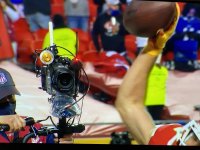
NFL - Large Sensor End Zone Cam... Your Thoughts?

NFL Films is still mostly Arri, but FOX’s “art”/feature guys are largely VENICE. One of my friends is one of their main guys(across multiple sports) and he had one of the first ones in the country. I was just on a big FOX shoot last week(not NFL) and between three of the four main sets, there were at least three to four VENICE’s and three to four F5/55’s on the fourth set.

Not sure what the CBS art/feature guys are using.
 
NFL films went big with Amira when it came out in 2014. Venice, at least, gives them 6K/4K.
 
I feel like cable and satellite TV are coasting on the loyalties of long-standing subscribers...
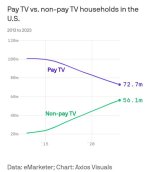
There's an article in Axios today putting numbers to the bleak outlook of pay TV:

Screenshot_20210126-185133_Chrome.jpg

The big picture: The pandemic will drive cable and satellite TV providers to lose the most subscribers ever, according to the most recent data from eMarketer.

Early estimates suggest roughly 5 million people cancelled their cable subscriptions last year.
Last year's lockdowns slowed cord-cutting by forcing people to stay inside, but it will accelerate again as the country opens back up.
Streaming has also taken off during the pandemic, which will push more consumers to cut the cord in coming years.
One forecast expects that pay-TV subscriptions will shrink by 36% in the next 5 years, compared to 9.5% from 2015-2019.
Be smart: Sports networks are often the most costly channels within a cable bundle. Telecom operators have been under pressure to rebate consumers for the expensive cable packages that lacked live sports during the pandemic.

While some networks, like news and variety programming, are struggling to demonstrate value in the cable bundle, sports networks are by far under the most pressure, given much cable operators are required to pay them for live sports rights.

What's next: With many major sports contracts set to expire in the next few years, analysts predict that the ultimate collapse of the cable TV model will happen when a tech or streaming company finally is granted rights to stream a major sports franchise.

AT&T's top executive John Stankey has said the telecom giant would consider dropping its exclusive rights to the NFL's Sunday Ticket package from its DirecTV satellite service.
The bottom line: In the interim, expect a flood of cable programming to start migrating over to streaming in anticipation for the day when cable is no longer a viable platform for networks to reach audiences.
https://www.axios.com/pay-tv-cord-c...ers-c90e400d-81c2-493b-a44a-0a1e65f3af96.html

Of course, all the shows on pay TV keep getting produced, they just end up online instead. What that means for the broader health of "TV" I'm not sure.
 
There's an article in Axios today putting numbers to the bleak outlook of pay TV


I suppose a service like "FUBO" would be considered "pay tv", no?

"Paid ( FUBO ) subscribers at year-end are expected to exceed 545,000, an increase of more than 72% year-over-year."
 
I am confused on what separates Pay TV from something like Netflix or YouTube TV? 300 channel bundles from cable providers is definitely on the way out but folks usually need to pay for everything unless they are pirating it... From my perspective, YouTube TV is gradually turning into what it was supposed to be a better alternative to. The channels are piling up along with price increases. It is just a natural business model to amass things in easy to use bundles. So we will ditch the big expensive cable packages to only wind up with big expensive on-demand packages. Only the delivery tech will change with a lot more personal tracking to boot!
 
Bottom line: unless you're flat out stealing it or just watching over-the-air, YOU ARE GOING TO PAY SOMEONE to watch "TV". Streaming services are pay tv. YouTube TV is pay tv. Even if you are just watching stuff on YouTube, you're paying for your internet service, so you are still paying someone to be able to watch content. People are just arguing semantics.
 
It depends on what you replace cable/satellite with. I don't know if many people will end up paying $225/month for their TV service. Even when you deduct the cost of the direcTV equipment/infrastructure/service, you're probably still paying more for "content" than many streaming subscribers will.

The thing about cable/satellite is that they make you pay for a whole bunch of stuff you may not want along with what you do want. And they lock you in for long contracts. Both those strategies push up their revenue.

My wife and I currently subscribe to Amazon prime video (plus the prime "fandor" french channel) and cbs all access. I think we also subscribe to hulu...I seem to remember signing up for their new year's discounted price but I haven't used it since.

And I don't have time to watch everything I want to watch on just those services! I want to churn back to Netflix for the new altered Carbon season, disney+ for the mandalorian, hbo max for raised by wolves...when I have time...

It doesn't matter to the cameraman how the work is being delivered. Sports will always be in demand (even golf...) The only question is if the economics changes - if the rates change, if shows get added or subtracted. And I wouldn't hazard a guess at the outcome. Netflix, for example, has been paying a lot of people more than they would have made making the show for someone else. Streaming could be a boon for shooters.
 
An odd thing is that, from the technology angle, the 4K OTA is great ... but soon, there'll be nothing left to watch OTA. Except the NFL, because if they went completely PPV, people would riot.

PS. Pay TV is euphemism for cable/satellite but it has several reasons for diminishing viewership. Slowly but surely, everything is going to the streamers. You like the "Office"? Well, it's on Peacock now. You like "Seinfeld"? It's on Hulu. Granted, many a program went into their current syndication cycles before the onslaught of the streaming services and they're still available on basic cable. Some major hits are making too much money in syndication to go completely to the streamers but the relocation off cable/satellite is going to happen soon enough.

And then you begin to realize that Comcast was correct to shut down NBC SN. The audience just won't be there anymore.

PPS. The problem with NBC SN was lack of prime time content. The EPL draws great numbers (in relative terms) but it's an early morning Sat/Sun show. The schedulers put the top games on early for the Asian markets but those 7:30 AM matches don't draw well in the US. And they're usually done by 2:30 PM. And a cable network needs something for the 7-11 PM. The NHL might work but that will require a new contract. The NBA is on ESPN and MLB is on Fox Sports/Regionals. And the top college basketball conferences are all spoken for. On the USA network, Comcast can mix and match.

On the other hand, TNT tried its hand at UEFA Champions League - outbidding Fox Sports - and very few people followed it there (Univision/Unimas has the Spanish language rights). That is something Comcast shouldn't be ignoring.

The EPL management is likewise rightly upset that many of its matches ended up on Peacock. That screws up the league's exposure and, with the contract up for bidding, Comcast would really have to sweeten the pot to make this worth it.
 
From my view, it all comes out in the wash. As Al stated, you still need to produce the content, either live or scripted. How you distribute it is really a marketing description. NBC sends out a crew to film a sports event, weather that shows up on NBCSN, NBC, NBC Sports Gold (streaming service) or is farmed out to some other outlet, they still need a business model that supports the cost of production. There is not much barrier of entry to any old school TV channel to have a streaming platform. In fact, it would seem having both is still alive. Seems like the option keep NBCSN as a brand and a streaming channel would be worth it and drop the equipment costs of having a 'TV station' so to speak. Is NBC going to stop filming sports? Probably not. It is very complicated.

I think we are still in the Goldilocks pricing period where the consumer pricing is unnaturally low for streaming services. The cable folks learned the hard way that you can not offer everything and not pay the fiddler. But there was strength in numbers. Players like Google come along and just ride the wave and do not produce any content while the creators and producers are left with the tough choices.
 
From my view, it all comes out in the wash. As Al stated, you still need to produce the content, either live or scripted. How you distribute it is really a marketing description...
Yes and no.

Let's deliberate on "no".

The classic radio/TV business works like this - you make a program, sell it to the distributor (sometimes it's one and the same), the distributor then finds commercial sponsors, who then measure the ratings and decide whether to keep sponsoring. Cable TV introduced another layer - a pay system with the infrastructure owners responsible for the delivery of content and taking a slice of profits with it.

The classic movie business worked like this - a studio makes a film, shows it in own theaters, gets to keep all the profits after deducting the cost of running the actual theaters. In the 1950's, the government broke up the movie system to turn it more into a radio/TV business with an intermediary once again eating up chunks of the profits.

The streaming system takes it back to the original movie system, where the servers take on the role of the old movie theaters. They ain't cheap but with the predictable expenditure pattern (which is also improving with the higher internet speeds). And, here again, the consumer decides what he wants, if not entirely piecemeal, then in a discernible bulk. Unlike the government imposed cable system, you don't need to pay for the streaming services you don't watch. All the money goes to the content producer and the consumer/content is king. No middle men.
 
I think we are still in the Goldilocks pricing period where the consumer pricing is unnaturally low for streaming services. The cable folks learned the hard way that you can not offer everything and not pay the fiddler. But there was strength in numbers. Players like Google come along and just ride the wave and do not produce any content while the creators and producers are left with the tough choices.

Maybe. Probably. But think about how much more (s*%t) you get when paying for cable/satellite. I can't find statistics on hours of original programming on cable vs Netflix... an article from 2016 said Netflix surpassed hbo that year.

So, let's say that your average cable tv bill (which google tells me is between 51 and 100) delivers a 10x multiple of original content more than Netflix does. Then the pricing for streamers may not be artificially low. If you subscribe to all the streamers, you may get back to a $100 monthly bill.

As I see it, the fulcrum point of cable/satellite tv is that you pay for the content at the same time as the delivery service. (The other important characteristic is that there are usually very few providers to choose from in any area aka monopoly.) So, you have no negotiating power and the provider sets the terms favorably for themselves.

Whereas with "internet TV," you pay for data delivery service and then separately order content. And there's a lower cost of entry for a streamer to start up since they may only need to rent server space and pay for what they use, which will scale with their customer base. Hence - competition.
 
I am not against the move, it just appears to me to resemble the internet model of giving the impression things do not cost very much or are free. When in reality, they always cost a lot. Netflix is throwing money around like it grows on trees yet their subscription costs less than $20 per month. Is that sustainable? I would say no. When they miss on some expensive productions/directors and the magic fades, they are back to reality.

The streamers and Google are playing the long game of putting the old guard out of business. They will then gradually work back up to the costs of the old guard because the costs are a reality. Athletes and sports organizations are very expensive. We will see if the 'watch what you want' model generates enough money to support the production values. For the most part, cable TV channel lineups are filled with content they did not pay to produce. In fact, people pay them just to be on the channels via ad revenue splits. I do not see this changing as demonstrated by YouTubeTV starting to bloat up. They do give you option of turning off the channels but the fact that they added them tells me they need the revenue.

Pure play drama services like Netflix are unique as nothing they do has a time frame associated with it. Nothing live. It is the live stuff that is more complicated. It will find its level over time.
 
I am not against the move, it just appears to me to resemble the internet model of giving the impression things do not cost very much or are free. When in reality, they always cost a lot. Netflix is throwing money around like it grows on trees yet their subscription costs less than $20 per month. Is that sustainable? I would say no...
Netflix just went over 200,000,000 subscribers. Let's say their average plan is $15/mo, making it $3B in monthly revenues and $36B in annual. It may not be sustainable per se, if/when their competitors begin to gain market share, but it's helluva lot of money.

PS. Whether Netflix spends its $16B per year on programming smartly is another story. And the next year, they can spend $25B to even less effect. And gain another 20,000,000 subscribers.
 
youtubetv actually looks like a pretty good deal. but do you get commercials? I assume you do. at any rate, it's probably 1/3 cheaper than the cable equivalent.

Netflix is sort of an hbo equivalent.

Looking at what's playing on youtubetv, it looks like the new scripted shows and sports are what you pay for. The unscripted stuff (game shows, news) will all be on YouTube proper within a day most likely.
 
Yes, the Netflix numbers are impressive. But I know quite a few folks that kind of 'burned through' what they cared to see on Netflix. As they raise the price, the numbers will fall. But more power to them as they give a nice option to the market.

YBTV is a good deal but it is only live TV. So it is still an ad supported business model. What I want (and probably many do as well) is a non-advertising supported model. This requires critical mass to generate enough revenue for it to be sustainable. So the Friday night chess showdown might have a tougher time existing compared to the Saturday night MMA match etc...
 
Netflix just went over 200,000,000 subscribers. Let's say their average plan is $15/mo, making it $3B in monthly revenues and $36B in annual. It may not be sustainable per se, if/when their competitors begin to gain market share, but it's helluva lot of money.

PS. Whether Netflix spends its $16B per year on programming smartly is another story. And the next year, they can spend $25B to even less effect. And gain another 20,000,000 subscribers.

Netflix is currently profitable, ergo their current model is sustainable I guess? And if they develop a troves of proprietary hits (like the next Friends and The Office) then there may be less pressure to create new content in the future. Right now they're feverishly trying to make up for the recent and upcoming losses of everyone else's stuff.

In short, I think their current price is probably sustainable. Although it's always an open question if they will retain all their subscribers.
 
People like Abe(not picking on you, just using you as an example) that "churn" are going to help eventually drive the monthly subscription prices up or bring minimum time period contracts to the streaming services. I can see people waiting until after the new seasons of all of they favorite shows drop and then "subscribe" for a month and binge everything, then drop it for 11 months. How do you counteract that? You jack up the monthly rate to help offset it or you lock people in and make sure they're paying you each and every month, like you originally planned for. Maybe you offer a "discount" to those that have an annual contract and people that choose to do month-to-month pay a much higher rate.

I agree that most streaming services are cheap. And you can't just go by their original content. You have to look at the entire catalogue that is available. Netflix and Amazon are both incredible store houses of docs and old TV shows that a lot of people would have never watched or even known about otherwise. That makes them even better values, but also shows how "cheap" they really are. I don't think the current model is sustainable, long-term. Prices will go up, or quality and quantity will go down. Maybe both...
 
Yeah, different pricing strategies are already being tested. Certainly there are annual discounts. Hbo max i think was offering a discount rate if you signed up for 6 months. Makes sense to me.

In point of fact, if we subscribe to a service, we're usually with it for at least 3 months if only because we can't binge that fast. Amazon we'll have forever. Same with youtube prime or whatever it's called (ad-free youtube). Cbs i've had for almost a year now.

But i want to watch what everyone has to offer. I don't need to see it right away and there's no reason for me to subscribe to them all simultaneously.

I think the smart move is they start billing for 3 months at a time. Good compromise.
 
Back
Top