
From today's Kansas City/Buffalo game.



Follow along with the video below to see how to install our site as a web app on your home screen.
Note: This feature may not be available in some browsers.




I feel like cable and satellite TV are coasting on the loyalties of long-standing subscribers...
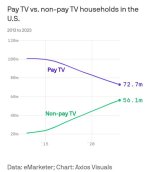
https://www.axios.com/pay-tv-cord-c...ers-c90e400d-81c2-493b-a44a-0a1e65f3af96.htmlThe big picture: The pandemic will drive cable and satellite TV providers to lose the most subscribers ever, according to the most recent data from eMarketer.
Early estimates suggest roughly 5 million people cancelled their cable subscriptions last year.
Last year's lockdowns slowed cord-cutting by forcing people to stay inside, but it will accelerate again as the country opens back up.
Streaming has also taken off during the pandemic, which will push more consumers to cut the cord in coming years.
One forecast expects that pay-TV subscriptions will shrink by 36% in the next 5 years, compared to 9.5% from 2015-2019.
Be smart: Sports networks are often the most costly channels within a cable bundle. Telecom operators have been under pressure to rebate consumers for the expensive cable packages that lacked live sports during the pandemic.
While some networks, like news and variety programming, are struggling to demonstrate value in the cable bundle, sports networks are by far under the most pressure, given much cable operators are required to pay them for live sports rights.
What's next: With many major sports contracts set to expire in the next few years, analysts predict that the ultimate collapse of the cable TV model will happen when a tech or streaming company finally is granted rights to stream a major sports franchise.
AT&T's top executive John Stankey has said the telecom giant would consider dropping its exclusive rights to the NFL's Sunday Ticket package from its DirecTV satellite service.
The bottom line: In the interim, expect a flood of cable programming to start migrating over to streaming in anticipation for the day when cable is no longer a viable platform for networks to reach audiences.

There's an article in Axios today putting numbers to the bleak outlook of pay TV
Yes and no.From my view, it all comes out in the wash. As Al stated, you still need to produce the content, either live or scripted. How you distribute it is really a marketing description...
I think we are still in the Goldilocks pricing period where the consumer pricing is unnaturally low for streaming services. The cable folks learned the hard way that you can not offer everything and not pay the fiddler. But there was strength in numbers. Players like Google come along and just ride the wave and do not produce any content while the creators and producers are left with the tough choices.
Netflix just went over 200,000,000 subscribers. Let's say their average plan is $15/mo, making it $3B in monthly revenues and $36B in annual. It may not be sustainable per se, if/when their competitors begin to gain market share, but it's helluva lot of money.I am not against the move, it just appears to me to resemble the internet model of giving the impression things do not cost very much or are free. When in reality, they always cost a lot. Netflix is throwing money around like it grows on trees yet their subscription costs less than $20 per month. Is that sustainable? I would say no...
Netflix just went over 200,000,000 subscribers. Let's say their average plan is $15/mo, making it $3B in monthly revenues and $36B in annual. It may not be sustainable per se, if/when their competitors begin to gain market share, but it's helluva lot of money.
PS. Whether Netflix spends its $16B per year on programming smartly is another story. And the next year, they can spend $25B to even less effect. And gain another 20,000,000 subscribers.