
ahalpert
Major Contributor
1000% not that sensor. It's not based on anything. It's built from the ground up.
No I get that but could the CFA be similar...
Tell us John! Screw your NDA!


Follow along with the video below to see how to install our site as a web app on your home screen.
Note: This feature may not be available in some browsers.
1000% not that sensor. It's not based on anything. It's built from the ground up.
1000% not that sensor. It's not based on anything. It's built from the ground up.
JB

I actually only see BRAW codecs listed in the supported codecs on the UMP 12K. No ProRes?
Here's what BM says about the sensor:
"The new 12K sensor has equal amounts of red, green and blue pixels"
That explains how they get greater color fidelity - more Rs and Bs
That also explains how you scale down to 4K RAW from 12K. Probably 3x3 pixel bin
And I guess somehow a 2x2 pixel bin works out for scaling to 8K RAW? Seems like your color pixels wouldn't be evenly distributed then...
...RED, Sony and Canon are on notice and perhaps when a camera shoots 16k with 20 stops of dynamic range and at 1000 fps we will stop complaining.
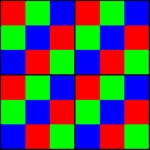
I was fascinated by Grant Petty’s mention that the new sensor has equal amounts of red, green and blue photosites. How is this possible? Well, if you arrange the colors in a 3 x 3 square you can achieve just that. Here’s what it looks like.
View attachment 139740
Each 3 x 3 square contains 9 photosites with equal amounts of red, green and blue.
Now the question is, how do we make a picture from this arrangement? And here it gets interesting. There are multiple ways to do it, but the most obvious is to take a 3 x 3 square and create one image pixel from it. In other words, 9 photosites would make one finished pixel with equal amounts of red, green and blue in it. In a sense, this is the holy grail of color imaging – full color resolution in every pixel.
So, if it takes 9 photosites to make one pixel, the next question is how many total pixels are we left with? Obviously, it will be 1/9 th the amount of total photosites.
Total photosites = 79,626,240 (12,288 x 6480)
79,626,240 divided by 9 = 8,847,360 final pixels
And guess what size image has 8,847,360 pixels in it? 4K at 4096 x 2160 !
These numbers are right off the specs sheet for the Ursa Mini Pro 12K.
Now we can see why Blackmagic went to a 12K sensor. It was to produce the ultimate 4K image with full RGB information in every pixel!

You haven't been here very long, have you?
Finally some sensor details:
"This is how Phil Holland explains it, ‘With Blackmagic’s new sensor instead of having the Bayer 2×2 grid (GRBG) it has a 6×6 grid. There are 6G, 6B, and 6R, plus 18W pixels. The W are clear or “white” pixels. This overcomes the reduced sensitivity issue of having a very small 2.2 micron pitch.’
The problem with having a very small 2.2 micron pitch sensor is that low light performance could very well be compromised, however, the high resolution may help to ease some of those worries. The white pixels are just clear and are there to deal with the light loss of using such small photosites with tiny microlenses. As a comparison the RED Monstro is 5 micron pixel, the RED Komodo is a 4.4 micron pixel."
That is fascinating. Rods and cones
Dumb question - can I download the 12K to play with in free Resolve? I think not...
You're kind of on the right path. You're missing one part though.
There's a grid, but it's 6x6 pixels.
It's an equal number of red, green and blue pixels, 6G, 6B and 6R. So that leaves 18 unaccounted pixels. Those pixels are there but there's no CFA on them. They're clear, or monochrome, or white pixels.
So it's RGBW in a 6x6 grid.
JB
Many years ago Kodak experimented with an RGBW sensor. It was a simple 2x2 array with one photosite for each color + monochrome. They ultimately abandoned it because they couldn't get the colors saturated enough. I wonder what's different now?

Hey Joshua, long time - hope you're well!The 6K Super 16 crop is a 15.28mm diameter, which is 0.73mm larger than S16.
However, that's a 17:9 ratio, so if you crop down to 16:9, it's 14.54mm, which is just a hair under full Super 16mm. So, all S16 lenses are going to cover in 6K if you do a further 16:9 crop.
The 4K Super 16 crop is a 10.19mm diameter, which is 4.36mm smaller than S16, actually 2.51mm smaller than Regular 16mm, and .81mm smaller than B4 11mm.
That's not Super 16mm at all. And, again, that's 17:9, so if you did 16:9, it's 9.69mm. That's tiny. That's a 4.26 crop factor from full frame.
Open them up and put them side by side.Zeiss supremes look very nice.
Someday I’ll post a resolution chart I have. A lot of lenses that are popular right now don’t have the same kind of high performance. If resolution is what you want. I wouldn’t get too hung up though because everyone want’s the vintage low-fi vibe these days anyway....
Also Zeiss make the Milvus, which I have to say...look to be nearly the same as these supremes.....
JB

That’s like asking the price of a Bugatti. If you have to ask it’s too much.You 'canna do ProRes if you wants the 12K.....and the scaling only works on this sensor because it's recording as BRAW so.....
JB
(EDIT, and this by the way is the true reason cDNG no longer is being used. Same issues but like 10 times worse. Someone calculate uncompressed 12K DNG files for me ??)
Open them up and put them side by side.
I was fascinated by Grant Petty’s mention that the new sensor has equal amounts of red, green and blue photosites. How is this possible? Well, if you arrange the colors in a 3 x 3 square you can achieve just that. Here’s what it looks like.
View attachment 139740
Each 3 x 3 square contains 9 photosites with equal amounts of red, green and blue.
Now the question is, how do we make a picture from this arrangement? And here it gets interesting. There are multiple ways to do it, but the most obvious is to take a 3 x 3 square and create one image pixel from it. In other words, 9 photosites would make one finished pixel with equal amounts of red, green and blue in it. In a sense, this is the holy grail of color imaging – full color resolution in every pixel.
So, if it takes 9 photosites to make one pixel, the next question is how many total pixels are we left with? Obviously, it will be 1/9 th the amount of total photosites.
Total photosites = 79,626,240 (12,288 x 6480)
79,626,240 divided by 9 = 8,847,360 final pixels
And guess what size image has 8,847,360 pixels in it? 4K at 4096 x 2160 !
These numbers are right off the specs sheet for the Ursa Mini Pro 12K.
Now we can see why Blackmagic went to a 12K sensor. It was to produce the ultimate 4K image with full RGB information in every pixel!