More AF100 footage...

Nearly every video seems to have been shot within hours (or a day) of taking it out of the box:
1. Get the camera
2. Turn it on
3. Play around with the settings for a few minutes, maybe an hour or two?
4. Go to an uncontrolled setting- Alfa Romeo track, Japanese park, Theater warehouse, Spanish market (or a very rushed model shoot, with little time for pre tests).
5. Start shooting
6. Edit/upload video for the world to see, return camera.
Correct. That is how it has happened so far.

Yes Laforet shot Reverie with little to zero pre-existing knowledge of the 5DII.
But, how likely is it that he:
• Rented a helicopter, mounted the camera on it.
• Set up a car mount.
• Lit a scene under the Brooklyn Bridge, etc, etc...
... without doing tests? Without going through the Picture Profiles extensively?
No shoot/screen/assess, shoot/screen/assess, shoot/screen/assess?
I believe it would be quite unlikely for someone to do those types of shots without having properly profiled the camera first.

I'm not an apologist for all that is Panasonic, and I'm not saying the AF100 has the buttery look the 5D does.
All I'm saying is look at the conditions of the AF100 tests.
And look forward to extensive testing (from amateurs to experts) upon its release.
All I'm saying is -- let's see what it can do when it's properly profiled, by people who know exactly what they're doing, and put through its paces in a proper cinema environment. To me, everything prior to that is wasted breath.

And that is coming, I guarantee you.

A little patience is all that's necessary.
 
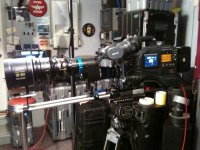
Please hurry up with the AF100, this thing is killing my back!View attachment 25983

LOOOOOOOOOOOOOOOOONG RIG!!!!!!!

The LOONG rig aside, this German footage is very nice!

I don't see any heinous sharpening artifacts, the blowouts are tart but still pleasant, the skin tones seem to have a decent amount of color detail....

What did these Germans do that our American and British boys couldn't???
 
i'm not saying that we should not use the highest quality lens we can or benefit from the superior mechanics of cine lenses, i'm just sick of the refrain that a given scene looks superior because of the glass; it's 98% lighting; 2% lens. If your lighting is bad, no lens on earth can make it good; conversely, if your lighting is good, almost any decent quality lens will not hurt it.
Thank you!!!!!!! :)

In all honesty, I think this camera is priced about a grand too cheap.

*ducks*
You be quiet!!!!!!! :)
 
Barry is fired up! I can feel it! I know you guys are going to re-write the book* on the AF100! Vive!!!
I am indeed fired up. I intend to do what I can to make this thing look as amazing as it possibly can, so we can get to the bottom of it. I'm planning on sinking a whole lot of money (well, a lot for one person, that is) in jack's feature film, and I want to push this AF100 to the limits to know that it's up to the task.

It takes time to put that together. It will be worth it. And I have some friends working on it. :thumbsup:
 
badass. yeah i remember the book i got when i purchased the dvx100b. That was an exciting and great read.

I remember i also purchased someone's short film that was shot on the dvx100. it's in my house somewhere... Great little short.

ps, pm'ed you barry.
 
I believe it would be quite unlikely for someone to do those types of shots without having properly profiled the camera first.

But guess what? He is a highly regarded photographer with an extensive expertise in Canon cameras. Color profiles et all are usually consistent in any camera brand. And I am sure the 5D wasn't in many respects much different than any pro still Canon out there, just that the images were moving at 30 FPS. Knowledge is king and I am sure he had a lot of that from his experience with everything Canon. And that is why he is making top dollar with his craft.
 
Of course it's important that, at some stage, there's a technical breakdown of how and what the final product - versions 1.0 and beyond - can and can't do.

The last-minute Mission Impossible feel of this whole pre-launch has been excellent theater. Imagine getting the call: 'Want to try out the new Pana 101? You have five hours. Starting now.'

What would you say?


Cheers,
George
 
Here's an enlarged area of a frame grab from this clip. In trying to figure out what it was in this video I found displeasing, harsh, video like, I think I found where some of it is coming from. There is intense edge noise in every high contrast area. Could be over enhancement adjustable in settings, pre-production camera roughness, what have you. But it's in every bit of this video, wherever there's high contrast, there's shadowing going on. May seem minor looking at it up close, but the overall effect in the "feel" as it's being called, "video" looking, harsh, whatever - it's there. Also, seems like lots of this footage is under saturated, making the skin tones feel pretty cold. That, and those harsh lines, are coming in to play here. Yes, "it's pre-production", but let's look for things like this in the production cameras, and see if they're gone, or can adjusted out.
 

Attachments

  • Edge Noise.jpg
    Edge Noise.jpg
    66.6 KB · Views: 0
Last edited:
It looks like detail circuit overshoot to me. The great thing about a full raster HD camera is that detail can be turned off(or down all the way). When I saw the AF100's in Burbank I thought they looked too sharp. First thing I would do is turn down detail as much as possible, if that isn't enough, add Soft FX or Diffusion FX filters. This is something that wouldn't work too well with an HVX200/200A/HPX170 or even 500, but a 1080X1920 camera like a 3700, 370, and hopefully AF100, should benefit from little or no detail added, assuming good glass.
 
That's already been answered a hundred times already, but I'll go through it again -- yes, the edge enhancement circuitry seems more noticeable on the AF100. Whereas with the HPX170 and HVX200 we would frequently run as high as +2, on the AF100 I'm recommending to keep it down around -4 if you want to avoid haloing.

And yes, this is something that would have been easily discovered by spending a little time with the camera and a monitor and getting a chance to learn how it performs.

So it's a complete non-issue, and soon there will be footage that demonstrates just how non of an issue it really is.

It's not a "non issue", because it's there. We may speculate as why, but that's pointless now. The point is that it's where to look. I have taken the time to illustrate the CAUSE of what many of these people seem concerned about and are defining as unpleasant or video-ish images. If it weren't there, it would be a non issue. You should consider exercising some tact in your terse responses. While it may be a safe assumption that this will be eliminated by adjusting the detail way down, doing so may have less desirable effects on the rest of the image. I am not slamming the camera. I posted this to illustrate a point instead of meandering through ambiguous subjective descriptions. Now I know exactly what to look for in production tests, and I chose to share that.
 
Last edited:
Yes, agreed, and my response did come off as terse. I'm saying it's a non-issue as far as folks using this camera goes, because it's totally controllable. It is, as someone said (Duke? Ticheli?) an "education" issue, not a "camera" issue.
 
My overall impressions from the test results are that best practices will be to turn the sharpening way down (or off and sharpen in post), reduce the saturation a bit and use an appropriate gamma.

Those are all education issues.
 
You should consider exercising some tact in your terse responses.

Do you have any idea how many times Barry repeats himself in here? Not only does he continue to answer all questions instead of telling them to do a forum search, like most people would do if the particular subject has been talked about already, but he goes into good detail with each explanation. I'd like to see how your responses would be, if you have answered the same question about 5 times already. I seem to think Barry's response is to the point, but anything but terse (abrupt).
 
There were no questions being asked, just observations and a bit of an illustration. I had already read Barry's opinion of a way to remedy. What I was attempting was to analyze and illustrate just what was happening to make the images seem less pleasing or less filmic (to me). He ackowledged in a stand-up way that his reply came off terse, and that's respectable. I still believe that much edge hallowing is something I hope got dealt with in the engineering process. Adjusting the user settings way down as a means to fix it could adversly effect other aspects of the image. We don't know yet. The purpose of my post was to simply examine an aspect of the image which has been causing concern, so we may watch for it's eventual remedy. And by extension, a less video-like feel.
 
For me, what is the last element missing from the film look in those videos is the dynamic range. You can see the windows clipping behind the guy in many place. The thing I notice until now in the Af100 images is the blue clipping. It is as if the blue channel clips more rapidly giving very yellow highlights that we saw a lot in the Japan shoot on people skin. These are preliminary observation looking at what has been shown until now and could be very different in the final camera or when people understand how to better use it.
 
Back
Top