Lowlight Shooting: Please Define what you consider lowlight?

Kholi

Section Moderator
Street Lamps? A 5K Light Kit? New York Street Side? A basement with only an 80watt light bulb?

Please, define what you feel lowlight qualifies as.

For instance, I consider lowlight about 5K worth of lights to play with.

150w HMI's, 2K Open Face lights, etc.

I don't consider street lamp shooting lowlight, I consider it no light or better get a RED MX/more money.

What's lowlight?
 
THAT is a great question.

Low light is a very ambiguous term. I have kind of always approached the idea that your asking about from the terms "Available light", or "Existing Light" (XL in old Super 8mm marketing parlance). Of course this is "Available light", or "Existing Light" other than bright outdoor daylight. I consider available light photography as being able to capture images in settings that are lit for normal human activities, such as a living room or kitchen normally lit for a conversation or meal. Anything lit lower than that would be "Low light".
 
Last edited:
My 6 battery powered Falcon Eye LED-60s and available light in background. Here's two of them for fill and one for back kick.
 

Attachments

  • LKstill01s.jpg
    LKstill01s.jpg
    68 KB · Views: 0
Crowds at concerts, clubs, indoor wedding receptions, in one case outdoors with a couple of overheads and ambient from the nearby building (which worked a lot better than anticipated), things like that. These are situations that come up on a very regular basis for me.
 
Crowds at concerts, clubs, indoor wedding receptions, in one case outdoors with a couple of overheads and ambient from the nearby building (which worked a lot better than anticipated), things like that. These are situations that come up on a very regular basis for me.

I had a Civil War re-enactor band Insist that we shot their night time performance video only with the light from a campfire, for "Authenticity" and to not look "Lit". Now that was low light.

They were convinced that was a bad idea once we shot a test around a real campfire and we were then able to light the video correctly.
 
anything darker than 640 ISO F4 ?

The point at which noise, focus lens choice start becoming issues

If im shooting wider than F4 or above 640 I start to sweat :)

S
 
I would consider low light to be whenever there is nothing lit in the frame. In a room with low ambient light then it's low light but a dark room with one light bulb to lit the scene and it's not low light.
 
low light for me is anything above 1600 iso. shooting at 1/60th / f 2.8 @ 3200 is low light in my book. i might combat that by going to f2.0 or f1.4 and lowering the ISO but then i have a really shallow DOF. i also look at it in regards to how much noise i will suffer if i need to go to 3200-6400 iso.

sure there is noise @ 1600 also but degradation @ 3200 and above is more alarming to me especially if what im doing is supposed to look polished and clean then even 1600 isnt a good choice. i think im more tolerant than most people to shooting upper iso's. i see many saying that anything above 640 iso is too much.

the kind/quality of lighting is a factor too.

david
www.davidprobst.com
 
I consider a scene that couldn't reasonably be shot on film, to be too low in light. And film pretty much maxxes out at 800 ISO. And while I haven't shot any Vision3, 800 ISO in Vision2 was more grain than I cared for.

So if you have to go above 800 ISO to get a well-exposed shot with a full rich waveform monitor and your highlights actually bright in the frame... then there isn't enough light, period.
 
I consider any situation where I am not in control of the light, lowlight. Visual integrity is determined by light quality, not quantity. 12pm sunlight is useless without augmentation, whether its a 5k HMi, a bounce card or mirror board. Sensitivity is one thing, control is another.
 
I consider any situation where I am not in control of the light, lowlight. Visual integrity is determined by light quality, not quantity. 12pm sunlight is useless without augmentation, whether its a 5k HMi, a bounce card or mirror board. Sensitivity is one thing, control is another.


This man sounds like a DP.

Ain't how much like you got, it's how you control it!
 
low light for me would be any time i have the bare minimum of light to expose my subject properly...usually with some noise. eg, on an hmc150, aperture wide open AND gain turned on at a wedding reception just to get an image. low light is whenever i'm forced to shoot with gain or high isos in order to see my subject, ie, the point where image quality starts to suffer because i don't have enough light.
 
He also shoots like one -- dig up "Cold Calls", Timur made some incredible images for us. Major skills.

This man sounds like a DP.

Ain't how much like you got, it's how you control it!

Aww shucks... :)

Some of Cold calls is on my narritive Reel... :)

www.timurcivan.com

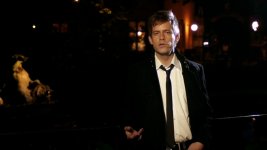
its the dark blue scene with the blonde woman. That was "Lowlight" but shot dark. You see i had control, so the image while low in luminance is exposed perfectly for the context of the scene.

I mean, heck barry, i shot 75% of that film with 1 light and a flag.
 
that shot is a good example of a lowlight image/end result that is lit properly even though with minimal lighting vs a situation where you can't control the light or can't get enough light to pull off the shot.
 
I often shoot lowlight and consider anything needing to be shot at f1.4 or f2.0 at 1/30-1/50th sec. at higher than 640 ASA to be lowlight. The majority of my work over the last 25 years is shot at night. I shoot under streetlights all the time and this is one of the major reasons I use a 5D vs a 7D. It clearly holds up better in lowlight. If I can, I fill the shadows, bringing them up by a stop, more for contour than density.

Here are a couple of shorts shot on film (35mm and Super 16), we used Ultra primes wide open for the Orpheus piece (click on the film in the margin to view):
http://www.claytonburkhart.com/film.html

I can say without hesitation that the 5D provides more apparent detail than even 35mm film at 500 ASA, which tends to become grainy very quickly in the shadows. The 5D already surpasses the REDone with regards to lowlight. Where it falls apart is in the lack of color depth and thus the way it renders the transitions of halos around a bright source. I tend to look at these camera's like old reversal film. At the end of the shoot, if you got the color and proper exposure in the baked in image, there is almost nothing better. If you try to pull it up in post - almost no latitude (maybe a stop). Something that clearly is an important next step if DSLR's are to take the lead going forward. So for night work: expose properly, stay away from putting the light source directly in the frame (unless you are going for flare) and look for situations where you have multiple colored light sources to give dimensionality and depth to the scene.
 
Last edited:
I never heard of the term until I started reading this board. When I see the term used, I understand it to be the practical light(s) in a given room or area. I figured this term was more applicable to documentary shooters. I consider myself a narrative filmmaker. As such, I will always try to have my image properly exposed using lights, silks, bounce boards, etc. Maybe I shouldn't say properly exposed. I should say that I want to control my exposure. If I want to shoot at a 2.8 or a 5.6, I should be able to light for it.
 
Last edited:
Back
Top