Keto diet

Wow this thread has people more riled up than 8k. I don't care for these fad diets, but people seem to need the latest extreme diet to motivate themselves. The more extreme and exotic the better. I guess eating your veggies like your parents told you to do as a kid is so boring and uncool.
 
5.
Cut out anything but natural ingredients. If it has MSG, corn syrup, or just lots of ingredients that the average child does not recognize, don't eat it.

MSG got a bad rap in the U.S. from an anti-china smear campaign. While I doubt there are huge health benefits, just like salt it's completely safe in moderation.

That's no hall pass for chinese takeout either. It's not any one ingredient but the volume and ratios - too much oil, salt, MSG, sugar that goes with ridiculous amounts of noodles/rice. Their goal isn't to make sure you don't get diabetes but to satisfy the customer the same way mcdonalds or taco bell does.

Your point number 6 is important - take back control where possible.
 
I don't think there is anything better than the tried-and-true combination of exercise and a caloric deficit.

Adding to that I think understanding that not all calories are created equal is what cracks the code for a lot of people. 2000 calories of lean chicken breast vs 2000 calories of white bread is not the same. From there, realizing one big reason Keto is effective is because it cuts out all the crappy sugars and fast carbs.

In some ways, Keto/Atkins/Paleo are all riffs on this.

Filmguy's starter 2 cents... Go to Costco. Fill the cart with:

24 pack crate of eggs
Crate of liquid egg whites, the one in individual packages
Frozen Vegetables of all types
Cases of black beans
Cases of brown rice & quinoa
Frozen Wild Alaskan Salmom
Chicken breast
Organic Sliced Turkey
Bison
Dave's Killer Good Seed (red) bread with only 1g sugar per slice
Nutzo butter
Lemons
Kirkland Greek Yogurt with super low fat/sugar
Low sugar whole grain granola
Favorite fruit to eat sparingly for dessert
Sweet Potatoes
Avocado
Olive Oil

Start breakfast high protein high fat. Make a couple eggs scrambled, but up the protein by adding egg whites from the carton. Have the Daves Killer whole grain bread with Nutzo part. Have some greek yogurt with low sugar whole grain granola.

Buy a sous vide and vacuum sealer, package your chicken breasts into the vac packs and Sous Vide @ 145 F. Eat with olive oil, lemon, S&P. Have with black beans and/or brown rice, quinoa. Try sliced turkey as mid day snacks. Bison is similar in makeup to turkey but tastes very similar to ground beef.

Don't get cream and sugar in your coffee, drink it black. When you go for a milk based espresso, stick to Cortado, Cappucinno, or an 8oz latte in moderation - preferrably unsweetened (admittedly hard to do if you order from places like starbucks).

Lemon, herbs, spices go a LONG way to adding flavor.

I love Late July Multigrain chips + guac for a healthier snack that still feels like a snack.

Etc. etc.


Do 7-minute workout every day except a rest day. Do weight training 2-3x a week on a proper whole body rotation, don't skip leg day, those muscles will burn fat for you. Like a passive income stream of stock footage. Don't waste any muscle groups.

For a healthier alternative of Norbros craving you could always sub mashed potatoes for sweet potatoes (complex carbs) with your steak, and choose New York cut over Ribeye for less saturated fat.

But also, have a cheat day every week and do what you want. No need to go crazy, just chill and eat what you crave and have been missing within moderation. Always best to avoid fast food junk food and processed food.
 
The mashed potatoes was just a random example with that particular meal (steak), lol.

I definitely like sweets and I have eaten an entire Carvel ice cream cake after barbell squats, which is my most hated exercise.

But leading up to the squats and after the cake would consist of practically no food which is why the 2000 calorie cake was still a deficit.

___

P.S. Definitely not normal and unhealthy and not recommended, but those are the kind of balances that are mentally necessary for me to be able to train continuously.
 
Last edited:
Potatoes are my kryptonite. Nothing puts the pounds on faster for me. And I love me some potatoes and french fries. The magic of keto for me is that after a week or so I do stop craving sweets and starches. The steak and veggies totally satisfies and I barely get hunger pangs between meals. When I eat carb heavy meals, I usually end up snacking a couple hours later. No, it's not for everyone. People's bodies are different. My body really responds to it.
 
Daves Killer whole grain bread

I love Dave's Bread. It was only a few months ago that I found it. I had tried many other kinds:

  • Ezekiel bread is good for you but you have to keep it frozen, which means every time you want it, you have to put it in the toaster. And it doesn't taste as good as Dave's.
  • Bakery bread tastes best but doesn't keep more than a few days.

With Dave's, it tastes better than everything but bakery bread and lasts as long other mainstream breads.
 
Well, what are you trying to accomplish by going on a keto diet? Lose weight? Control epilepsy? Have a life-long sustainable diet? Interventional diet for a specific goal?

Nutrition science has been moving slowly toward personalized interventions (as has been all of medicine). One of the many reasons nutrition science has been such a mess with contradictory studies and recommendations all over the place, because only now do we finally appreciate that what might be optimal for Bob might be suboptimal for Richard and disastrous for Mary.

And there you have it. Making broad generalizations assumes that you’re somewhere in the average cohort, because when a study finds X - it finds it for a given population, and the outliers are always ignored by the pop press. Odds are that you might fall into the average for some factors but not for ALL factors. Nobody - nobody! - is average along all axis. So necessarily, many study findings are going to be irrelevant or contraindicated for a particular individual.

And that’s true for nutrition, exercise, medication, supplements and various lifestyle elements. Heck, there are centenarians who smoke, never exercised and had pretty poor diets - cause, see, it’s about the individual. Sure, superbroad generalizations are probably applicable to most (plant based diets, avoiding tobacco, exercising etc.), but again, not each and every recommendation.

So giving advice to the general public - or the readers of dvxuser - is really shooting in the dark. The recommendations might work for some, but most certainly will not for many others.

It all depends on your individual makeup, genetic, epigenetic, gut microbiome etc, etc., etc. So unless you know your profile pretty well, it’s all just a wild gamble. And medicine today is still too primitive to give us advice that’s well tailored to an individual. It truly is a crapshoot. For example, there’s the glycemic index, but it turns out that no two people respond the same way to the same food - Israeli scientits showed definitively that there are wildly different BG responses to various foods, rendering the glycemic index next to useless. And so on.

Do you know your makeup that intimately? If you don’t, you’re just randomly gambling on any given diet. Keto might be useful f.ex. if you have ApoE4 - but the fat should be mono and not saturated. But what if you’re. ApoE2? What if you won’t benefit from burning ketones. Do you have cancer, or are you vulnerable to cancer - you may need a dramtically different diet.

So, throwing out recommendations here is pointless. You can give testimony as to how this or that diet worked for you for this or that reason (keto and weight loss f.ex.), but that’s you, and it says nothing about what the effect would be on someone else.

I like the doctor’s perspective. A few broad strokes is probably the best we can do in the way of general recommendations, but keto is such a specific diet that it’s pointless to speculate about whether it would be “good” for a specific you.

But of course, that’s not what anyone wants to hear, everyone loves to recommend diets and relay their experiences and there’s always a shiny new diet on the horizon. This has entertainment value but no medical value. But then again, entertainment is valuable too for QOL - so have at it!
 
Keto pantry staples that might be helpful. Black soybeans (one net carb ), radishes not pantry staple ( faux fries, hash, ah gratin, mashed), ground Lupin ( faux daal, cheesy grits, stir fry), 1 net carb bread 35 calories ( many are coming out all over country). Australia is really making great Lupin products which are just becoming available in the states.
 
I think it pays to take a more holistic look at your diet and lifestyle.

For example, I think that intermittent fasting can be beneficial and done casually.

Finding forms of exercise that you enjoy is important.

I've done variations of paleo/low-carb dieting. Now I eat pretty casually but incorporate the lessons I've learned. I don't think it pays to be too extremist or limited.

I think it's bollocks that saturated fat is bad for you or especially fattening.

I've seen studies with mice (probably mentioned in the book I read, Perfect Health Diet) that showed that mice consumed the fewest calories when balancing their fat/protein/carb intake at ideal ratios (which they decided themselves). Limiting any of the 3 led to a disproportionate increase in the others.

I think refined sugar and grains are generally bad. I think that freshness and quality are important (good quality bread better than bad). I generally avoid grains except white rice because they're digestively problematic and not very nutritious. But I still eat pizza and bread and whatever if it's around.

I think it's really important to listen to your body's cravings and eat that or the healthier version of that (like if you want something sweet, you probably need potassium and vitamin c, so fruit will be good but if you drink soda you're really screwing yourself).

Today I went shopping and felt like an omelette so I just loaded everything into my cart that I felt like eating. (Mushrooms, broccoli, orange pepper, carrots, grape tomatoes, salsa and guacamole...I make messy omelettes). And I didn't skimp on the eggs, I probably had 6 in my portion. I feel great right now.

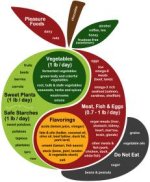
I more or less subscribe to this paradigm:

PHD_Apple_plate-cropped.jpg
http://perfecthealthdiet.com/the-diet/
 
Ideally you first look to your garden and then go to market most days and base menus on what is the freshest, in season. Almost impossible for almost all of us.
 
Adding to that I think understanding that not all calories are created equal is what cracks the code for a lot of people. 2000 calories of lean chicken breast vs 2000 calories of white bread is not the same.

While I agree that not all calories are created equal, I think it's helpful to understand, especially when dieting, that all calories ARE basically created equal when it comes to losing and gaining weight. Our bodies will convert anything we throw at it into extra weight if we eat more calories than we burn every day.

About 18 years ago, I lost about 50 pounds by eating Hot Pockets and other microwavable garbage almost every single day (with some healthy food on top of that.) I had gotten a gym membership to lose weight, but I quickly realized how long it took on a treadmill to just burn a few hundred calories. I realized that my time was better spent cutting back on calories. So, I limited myself to about 1200-1500 calories a day and the weight quickly came off.

Like intermittent fasting, you have to get used to being a little hungry at times, but it's not that hard once you do it for a bit.

On the flip side, if you do exercise a lot, you can get away with eating more calories. Weight loss is just going to happen if you eat less calories than your body uses. (We are not perpetual motion machines - our bodies follow thermodynamics.)

Good calories are definitely better for your overall health and may keep you feeling fuller, longer, but in terms of overall weight gain and loss, it's simply a numbers game.
 
Last edited:
I think it's really important to listen to your body's cravings and eat that or the healthier version of that

Yes, this is what I do too.

It's tedious and error-prone to calculate which micronutritent I need at the moment. (Do I need more Vitamin C or potassium? And to get that, should I eat a banana or an avocado?) On the other hand, I was quick to pick up which macronutrient I craved, since there are only 3: protein, fat, or carb.

For example, if I'm hungry, the idea of a chicken breast (high protein, low fat, no carbs) might still seem repulsive, but a glass of orange juice (no protein, no fat, high carbs) might sound just what the doctor ordered. Other times, the opposite.

If a ribeye sounds good, then I'm craving both protein and fat. Maybe I'll eat a steak, or maybe I will seek healthier alternatives of each.

If only fat sounds good, then I might try to get it from something healthier than a stick of butter, like nuts (which is so counterintuitive to me that they are high in fat) or an avocado (also mindblowing that a vegetable could have fat, but these are the things you learn when you read those food-swap websites).

So yeah, you kind of half-listen to your cravings. There is a kernel of truth to them. So if I feel like candy, it would be dumb to eat candy, but it would also be dumb to try to force myself to eat lean chicken breast. I would still have the same cravings afterward. So I would try to go for some healthier carb, like fruit, oatmeal, etc.

---

I am not perfect, and I still have junk food sometimes. Then again, I am not losing weight, just kind of holding steady (usually).
 
Last edited:
Anyone tried keto? Thoughts on it?

I'm a big fan. You get to eat filling, tasty meals, and the weight just falls off. Granted I'm a fat tooth, rather than a sweet tooth - so I'm maybe a little more pre-disposed to it. But it's one of the few diets that I've tried that I've not ended up breaking from and gorging myself for relief.

That said, once you've used keto to bring your weight down to wherever you want it, I'd suggest transitioning to a Low GI diet instead. Which is more manageable, and offers most of the same benefits that keto does (reduced inflammation, less afternoon carb-enduced brain fog etc.).
 
In terms of new diets vs. old diets - a maximum caloric intake was nigh necessary during the majority of a human existence. We ate when we had a chance because malnutrition was a greater concern than any weight related complications. That same goes for the "banned items" such as salt and sugar.

Side story - a few years ago, I was watching a Russian neorealist TV series set in a modern Moscow high school. The cameras were hand held and much of the dialog was improvised by the actors off the scripted outlines. There was a scene where the high schoolers are standing in line outside a food kiosk. A female purchases a chocolate bar and explains to her friends, "My doctor says I need to up my caloric intake".

Now, that might sound insane to an American ... but ... during WWII, my mother's family escaped from Minsk in June, 1941 and ended up in the near Urals, not far from Perm. Food was scarce and everyone suffered from malnutrition. In 1943, the Soviets began to receive food shipments from the USA via the Land Lease. Mom said that the American chocolate bars may have saved her life. Later in life, she became rather overweight. When we talked about her years in the near Urals, she'd say, "We had no food. We were starving every day. On the positive side, no one was suffering from diabetes".
 
While I agree that not all calories are created equal, I think it's helpful to understand, especially when dieting, that all calories ARE basically created equal when it comes to losing and gaining weight. Our bodies will convert anything we throw at it into extra weight if we eat more calories than we burn every day... Good calories are definitely better for your overall health and may keep you feeling fuller, longer, but in terms of overall weight gain and loss, it's simply a numbers game.

The idea with macronutrient breakdowns of say 40/40/20 (or whatever you select) is based on your target calories (i.e. 2000 - assuming that is a deficit from total calories burned per day). That would be if your goal is fat loss only.

But the idea that calories are only a numbers game has been contested, there was a study by Kekwick and Pawan that compared three different focus groups with identical calorie intake and controls for physical activity. I doubt it's perfect but it showed very clear differences.

Group @ 90% fat calories = .9lbs/day weight loss
Group @ 90% protein calories = .6lbs/day weight loss
Group @ 90% carbs = 0.24lbs/day weight GAIN

The body's hormonal responses to carbs, fat, and protein are different.

Ketosis is based around some of this, but as others pointed it out, it can be difficult to sustain and it is not free of downsides.

What has worked well for my personal lifestyle/goals/body's response has been focusing on muscle growth as a source of weight loss.

This is favorable because increasing protein intake paired with resistance training (weight lifting) spurs muscle growth, which then increases resting metabolic rate (remember seeing the calorie count climb slowly by running at the gym? Forget that! Make your body burn a few more hundred calories everyday by having more muscle mass and sitting at the computer editing).

The other big metabolic boost is HIIT which is why 7 minute workout can be so effective. It's not going to help you so much if you are training for a marathon as it doesn't focus on endurance, rather on boosting metabolism, but HIIT + resistance training + protein to support muscle growth *changes body composition*.

For me, in the past I had tried to lose weight by just focusing on dropping pounds. After some researched I learned converting fat into muscle so that it burns body fat was highly recommended. The side benefits to this of course is better posture, stronger muscles, etc. etc. A changed body composition. Another benefit to this approach is that once you reach your fat loss goal (cutting), you can eat more calories per day as long as they consistent of a lot of protein and as long as you are lifting heavy weights (bulking). The protein will convert to muscle growth instead of fat growth. So for me, once I drop pounds, I lift heavy weights - and am much more free to eat what I like (I like high protein foods like meats so this works great for me). But it's not just protein I can eat more, it's everything, because more muscle mass = more resting calories burned per day.

Coming full circle....

Keto is great as you can see from the study above. But it's also great not just by focusing on fat, but because it cuts out processed foods and cuts out sugars and fast/white carbs. But so do other things! Overall I think it can be very limiting and less sustainable, unless of course you prefer this dietary choice as a lifestyle. One pitfall of it that I see is it doesn't support muscle growth nearly as well as a higher protein diet (assuming you are willing to weight lift) which kills your "passive income stream" of free caloric burning. I think long-term, overall, you can see more dietary freedom with a 40/40/20 (complex carbs/lean protein/monounsaturated fat) macronutrient blend. Some people go even higher on protein, dropping carbs down to 30 or even 20.

Anecdote - family member called me frustrated on her weight loss goals a few years ago. She was following weight watchers, walking 5 miles a day, and hit a plateau. She just couldn't lose weight! It had been months. I asked her what she was eating, and she was eating a lot of fruit and not much protein. She said "But fruit is free!" (or only 1 point or something - she was referring to the weight watchers guide). I said "sure but humor me - cut the fruit out despite what they say, and have it very sparingly for dessert. Eat way more protein. Do a light weight 10lbs lifting routine. Leave everything else the same". Two weeks later she was losing weight again.

In short, it's always about your personal goals... but calories are definitely more than just a numbers game! That was the official line for a long time, but once I realized this it changed the game for me.

Again, YMMV!
 
Really depends on the fruit and how much...too vague of an example to pinpoint what and if anything else changed in her life (including the benefits of the new 10lb workout which could have been the plateau-breaking variable).

Because unless you're eating bananas and cups of raisins all day every day, rarely does any human ever eat enough fruit for it to majorly have an impact on weight gain. IMO, you'd really have to be standing still most of the week, lol.

Personally, I also think it's a numbers game for most people, especially if they are exerting themselves.

The mentality and understanding of physical activity is also worth noting. Some have very low-standard, low-quality workouts because it's not something they are used to doing, which affect their personal journeys.

So when someone complains about not losing weight, it's like...well because the 10lb curls you do for 20 minutes isn't exercise, ha.
 
Another issue that may have not been mentioned is the interplay between stress and diet.

Before I had kids, I naturally did intermittent fasting. I wouldn't eat in the morning until I got hungry, and usually not until well after that since I'm lazy. Boom intermittent fasting.

But now I often need to make them food which means the food is already around and there's no obstacle to eating it. And when I'm under stress, which the kids are good at causing, food can become a response to that.

When you're eating and you're not even hungry, you're really screwing yourself over.

Theoretically, you shouldn't even need to intentionally exercise. You'll just lower your caloric intake in parallel with diminished exertion. (Although some diet people say that boosting dietary vitamin and micronutrient levels is positive, and eating more due to increased exercise can boost those levels).

Not sure if these have been mentioned yet either - dietary aids (vinegar, lemon juice), fermented foods (kimchi, yogurt), organ meats (liver), bone broth
 
I have an opposite opinion on fruits (and it doesn't just come from spending summers at a micro farm in my youth). A fruit displaces a non-fruit as body craves for volume. Additionally, fruits provide the necessary vitamins. So, I believe that eating an apple, a banana and an orange a day is greatly beneficial to one's health.

Additionally, fruits contains juices/acids that react with our intestines. Finish your pizza and then bite on a couple of plums and your body will process the combined intake far differently than if you had the same pizza with a six pack.
 
Back
Top