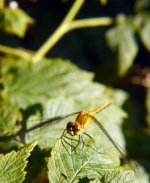
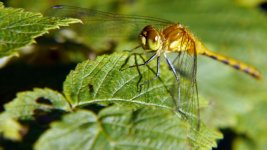
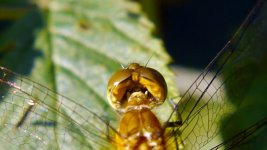
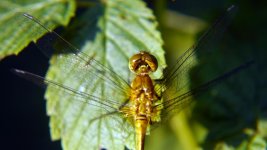
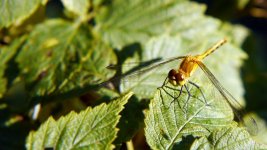
GH2 Insect Lens Recommendation?

This is the lens on eBay that I had in mind. I'm not worried if someone snaps it up here before I do. They'll be more like it. But, is this a 1:1 that might be sharp for my insects? Looks like it at least the way the guy describes it.
http://cgi.ebay.com/ws/eBayISAPI.dll?ViewItem&item=260820885330&ssPageName=STRK:MEWAX:IT

I asked the seller if I could adapt it the the GH2 but haven't heard back yet on that.
Ragnar

Yes. you can adapt any Nikon/Nikkor 35mm lens to the GH2. You have options of adapters from Novoflex, Adaptimax.. etc.

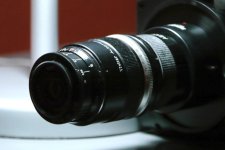
Here's my setup using a 2x tele converter, and 1 extension tube with an Industar 50mm f3.5 (M42 Screw Mount). It's a slow lens. But I really like this lens because of its P1010506.jpgP1010507.jpgP1010508.jpg size and super light-weight.
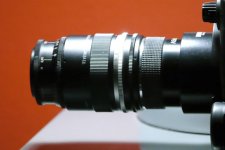
Lighter-Macro.jpgWick.jpg
 
No one has mentioned the Panasonic 45mm 2.8? It's the only proper macro lens in the Panasonic m4/3 lineup. Apparently it is very sharp, and the OIS will help a lot doing handheld macro work.

That lens seems like a winner for macro (1:1) AND portrait work. Damn! yet another lens to check out. I wonder how that would couple with the Raynox?
 
If you really want the best of the best get a Nikkor AF-D 200mm f4.0...top shelf glass.

The Tamron SP 90mm f2.8 and Tokina 100mm f2.8 are also awesome.

A golden oldie if you can find one is the Kiron Macro 105mm f2.8 (Lester Dine AIS lens)

I have a Sigma 150mm f2.8 macro and it is one of the best lenses I have ever used. 5 Star in every way but it has no aperture ring so useless on micro four thirds without a specialised adapter.

All of these are 1:1 macro and come in Nikon mount but the Sigma Tamron and Tokina also have Canon mount versions.
The above are excellent choices. I have also the Vivitar 90mm 2.5 macro and the Vivitar 55mm macro. The 55 can be had often for ~$35 on eBay, it is very light and very sharp. You can also get very good results with a ten dollar tube extension from eBay.
 
Last edited:
So the DCR-250 will give very high magnification on a 200mm lens, but only more moderate magnification on a 45mm lens.

Ok, that's an important point as I hadn't realized that.


Generally a macro lens is the best lens to use for field insect photography, because it focuses all the way from infinity to close-up. Being able to adjust the magnification quickly is often important.


Yes, and that's something I should have pointed out earlier. My main setup is a light run/gun insect shooter, so just the GH2, camera strap, and smallish lens, the kit 14-42 or one of my older 55mm primes at f1.4, or f1.8. It allows me to get close without breaking my back and usually withut spooking the insect, it seems.

For higher magnification, an old manual focus lens in the range 24-50mm reversed is very good.

Not sure if you read above but I mentioned I have used the reversal method, and it worked well indoors on static objects but I found it quite hard to use in the state park as the depth of field is so very shallow, but I need to try it some more.

http://www.flickr.com/photos/9578475@N02/

Those are awesome shots, SteB. What camera setup did you use for some of those nice butterflies...very, very sharp indeed. Also, thanks for your detailed reply.

Update: Ok, I see you used a Canon EOS 40D. How 'bout the lens?

Ragnar


I use a few macro lenses for my Canon system. A Canon MP-E 65mm 2.8, which goes from life-size to 5x life-size without attachments, along with Sigma 150mm f2.8 and Sigma 70mm 2.8 macro lenses. I often use a 1.4x converter with the Sigma 150mm. If you check the shooting information on the Flickr photos it gives the lens on most, except where I've used some of the old manual focus macro lenses I used to use. I also have a few macro lenses for an Olympus 4/3 system which I am going to convert to m4/3, hence my interest in the GH2. Sorry my bad, I see you did see mentioning reversing in your comment. I thought from the photograph you meant reversed stacking, where you reverse the lens onto another lens, so it acts as a close-up lens.

I think the problem you have with the shallow depth of field on the reversed Canon 50mm f1.8 is twofold. Firstly, as the magnification rises the depth of field shrinks to nothing even at small apertures. However, in the reversed position Canon FD lenses won't stop down unless a pin is pressed down. You can make your own by cutting out the centre of an rear lens cap, although apparently it needs to be a Canon one as the independent ones don't have the necessary bit to push the pin down. Canon also did use to make a special attachment, but I think you'd struggle to find one now as the FD system has been out of production for so long. Most of the other fits of old manual focus lens don't have that problem in reverse.
http://photo.net/nature-photography-forum/00BLfV

Also if you want some more info on using old manual lenses, including microsope lenses, and enlarger lenses check out the photostream on the link below. John's photographs are some of the most incredible macro shots you've ever seen, or will see. Surprisingly John sometimes uses quite cheap old lenses for some of these shots. He has a few videos up on YouTube and I think you'll find some links on his Flickr photostream.
http://www.flickr.com/photos/johnhallmen/

This thread is very useful for both info and inspirational macro photos taken with reversed 50mms, and shorter lenses.
http://www.fredmiranda.com/forum/topic/663112
pixel.gif
pixel.gif
pixel.gif
 
However, in the reversed position Canon FD lenses won't stop down unless a pin is pressed down.

What I did on my GH2, to get around this issue, was to attach another micro 4/3 adapter to the reversed lens, that way the aperture than works. So to be clear, I reverse the 50mm f1.8 lens and attach that to my GH2 using a reversing ring and a micro 4/3 adapter, one of those cheap ones from eBay. Then, on the reversed end of the lens, I attach another micro 4/3 adapter, which does it's thing and allows me to then use the aperture ring like normal. I don't recall any vignetting issues come to think of it doing it this way.

Thanks again for those links. What with the other comments and those sites, I think I'm on the right track to sharper and larger macro insect pics and maybe videos.

I did read all of the Lumix 45mm f2.8 Macro 1:1 lens reviews on Amazon; it seems like quite the lens. However, at some $700 it's outa my pocket book for the time being.

Ragnar

$700??? Well, if you've got it, go for it :) You can't really use autofocus for macro, so a legacy prime is the way to go. There's lots to choose from, this is a great "first macro"
http://www.flickr.com/groups/365610@N21/discuss/72157604860578430/
Smooth, broad focusing throw, integral hood (the lens is countersunk) and dirt cheap. Sharpness, color, bokeh and contrast very good.
Also consider a lens stacking program. Reversing the lens is fun, I have actually had very good luck with these micro 4/3 adapters that have two mounts and four extension sections. Turns any lens into an adjustable macro, no reversal needed.
 
Here are some quick clips I threw together to illustrate some of the ins and out of the Panny 45mm/2.8 macro lens that has been mentioned here. Consider it a demo of what a brand spankin' new videographer (granted with just shy of a couple decades of still photo experience) can do out of the box.

http://www.youtube.com/watch?v=-hF0ACk4ask

I realize the aspect ratio is wrong on the upload but it should still give an idea of what a very amateur videographer can do with the lens. It seems to have pretty decent optics but certainly you can get that with legacy glass for a fraction of the price. I actually put my old (30ish years old) 85-200 on the camera and got decent but not great results. The 45/2.8 is definitely clearer but I'm not sure how it would compare to other modern lenses.

The big deal with the lens, of course, is the focus capabilities. So far I have had mixed results. It is actually pretty good at hitting focus on a relatively small portion of the frame which you can move around with the stylus on the touch screen or with the thumb pad. For stationary subjects this works wonders and I have used it to rack from foreground to background with decently good results. It usually hits its mark but will sometimes overshoot ever so slightly and then pull back. With moving targets it does have a tendency to hunt for focus and more often I find myself using it to hit the general focus area and then adjusting by hand or swapping to MF to stop it from hunting. I did leave in portions of the Ichneumonidae with the auto focus enabled to show how it does/doesn't deal well with a moving target. Between the wasp moving about and the sunflower blowing in the breeze you can see that it was constantly hunting for clear focus and sometimes missed. I do wonder how it would react if I adjusted the size of the focus target to a larger size and tried something like that. I tend to keep it set to the smallest size so that I can hit a particular part of the bug. That being said, without a focus aid (which is next for me to work on) it can sometimes be hard to see exactly where your focal plane is. You can see that I just missed it on the leaf hopper and the shot of the grass spider from above .. though I got it right for the last shot of the grass spider eating.

So yeah. I know the video is not well lit or shot or cut but hopefully it gives you some idea of the capabilities of the lens and the limitations that must be overcome. Hopefully this was of use to someone.

Cheers,
Dave
 
Last edited:
Back
Top