I'm waiting for 4K fad to fade in favor of 8K

... But that's not sexy, you can't market that outside a small niche audience. So I expect the resolution race to continue for now.
Considering that most 1080p cameras are really in between 720p and 850p due to the Debayering, I happen to really enjoy higher res, which is easier to pick up on the lower dynamic range monitor. That said, neither the res, the sensor size nor the DR race will end for a while longer. 8K will be used en masse, at the latest, for the 2018 Olympics on South Korea (because they really want to nip the Japanese manufacturers for the prestige reasons, if no other).

Indeed. I'm waiting for 16k myself.
There are already 133 MPX military/surveillance sensors and the 128 MPX Canon prototype cameras. In the stills market, there are rumors that the new Pentax full frame camera - its prototype was shown at the Photo Plus in NYC last September - will have the same Sony sensor as found in Nikon 810 but with the pixel shifting capability that Sony has made for Olympus and Hasselblad. In Olympus, this resulted in the 3x pixel count, in the Hasseblad, due to the greater processing power, in 4x. Assuming newer chips can match H-blad, this new full frame Pentax would have a 144 MPX photo res. Which is more than 16K (off a stable platform).
 
Considering that most 1080p cameras are really in between 720p and 850p due to the Debayering, ........
Not sure I agree with that. A lot of 1080 cameras are 3x1920x1080 chips - so true 1080p resolution. A lot of others use a single 3840x2160 sensor with simple read (eg Canon C300) - but again such will give "true" 1080 resolution. I don't think there are that many today which are a single 1920x1080 Bayer?

It's when you get to 4K, the real resolution is so often less than the system can manage. Typically still a 3840x2160 sensor, but now fully deBayered - but you're now talking typically around 1600 lpph luminance resolution, rather than the 2160 the system is theoretically capable of.
 
Not sure I agree with that. A lot of 1080 cameras are 3x1920x1080 chips - so true 1080p resolution...
true, true, true ..... I was thinking of the DSLR style single chip 1080p sensor that is commonly found on the Canon, Nikon, Sony, etc. types, not a pro 3-chipper.

But then a 3-chipper doesn't need to debayer either.

There are also a bunch of products still in use that will oversample into 2K off a single sensor. The best of them was arguably F35 that shot in 444. Alexa is a similar camera that many shoot 2880x1600 to get a "real" 2K.

And now, many models will oversample 4K, including the DVX200 and A7RII.
 
Certainly an interesting take on it, but it makes sense. It's funny how the companies releasing the cams throw out specs and we just assume they're factual. I like 4k, it's saved me a few times when I didn't have time to get as much coverage as I wanted, the ability to punch in is a great last option if your in the same boat.
 
There are already 133 MPX military/surveillance sensors and the 128 MPX Canon prototype cameras. In the stills market, there are rumors that the new Pentax full frame camera - its prototype was shown at the Photo Plus in NYC last September - will have the same Sony sensor as found in Nikon 810 but with the pixel shifting capability that Sony has made for Olympus and Hasselblad. In Olympus, this resulted in the 3x pixel count, in the Hasseblad, due to the greater processing power, in 4x. Assuming newer chips can match H-blad, this new full frame Pentax would have a 144 MPX photo res. Which is more than 16K (off a stable platform).

Ah, irony. You took my joke seriously. People do tell me that I don't know how to tell a joke. Maybe I should listen. Nah...

You really think there's a need for 16k cinema? The physics say otherwise. But that won't stop the resolution first crowd. I don't understand the drumbeat for more resolution when better tonality, more dynamic range, better highlight handling, etc. are all things we could actually take advantage of.

I suspect that the only place that could take advantage of 8k would be the true IMAX screens (not the faux-max at your local cineplex). But I haven't done the math for that myself. But Sony did the math and published a white paper on resolution at cinemas and showed that even with the closer stadium seating that only the first couple of rows could take advantage of 4k. The center of the theater maxed out at 2k, and the very back rows couldn't tell the different between 2k and 720p. There's no 8k in that paper, because you can't get close enough to a normal size screen to see the difference between 4k and 8k. Which is why I joke at the idea of 8k. Until you get to IMAX size screens and IMAX style extremely close seating, you can't physically see it.
 
Ah, irony. You took my joke seriously. People do tell me that I don't know how to tell a joke. Maybe I should listen. Nah... .
No, I got the joke but ... who might need 8K? It's hard to say before the 8K cameras are out. Obviously, big event video/photographers, as the one shooting the Olympics, the World Cup and so on. And, at some point, everyone. At the very least, this is just a reframing option taken a step (or two) higher. Let's say, you have your digital server plugged into your 4K/6K/8K TV and then someone asks to magnify a certain portion of the shot that they are interested in. In 2K, it'd be pixilated, as it can be seen during the NFL instant replays. In 8K, it'll be as sharp as the original.

BTW, Panasonic is now offering a "focus bracketing" firmware update/upgrade, where one can also choose focus in post. It's not quite Lytra but it also lowers the out-of-focus/error percentage for a casual shooter. And, when everything is in focus, the higher resolution is almost a must. Landscapes, interiors, art, sports, etc.
 
You really think there's a need for 16k cinema? The physics say otherwise. But that won't stop the resolution first crowd..........

I suspect that the only place that could take advantage of 8k would be the true IMAX screens (not the faux-max at your local cineplex). But I haven't done the math for that myself.
Regarding your first question, you have to ask "for what"?

You mention IMAX yourself (and I agree) but it's wrong to think the only reason for having cameras is for making films fundamentally for entertainment purposes...... what about uses such as scientific, medical or military? And as for surveillance........

When we talk about broadcast or even cinema I fully agree there seems little point in going beyond 4K, and even 1080 for a lot of things. But outside that sphere, I think it's very, very different and well worth a manufacturer developing even 16K cameras, maybe even beyond. Imagine a CCTV system with such a 16K camera. It could theoretically make do with no zoom lens at all, and operators could look at the full view, then select a small portion of the total image but still retain excellent resolution. Same in other (specialist) areas.

I'm not convinced of any need to move to 8K for broadcast, and doubt that even 4K is necessary in most cases, but 8K (even 16K in time) cameras for specialist use are a different matter, even if unlikely to appeal to filmmakers.
 
IMO 8K would be best used for video walls you stand close to and virtual reality. The latter of which wouldn't require cameras I would think.
But yes as we continue onward in the world of compression, 8K for 4K output would be nice.

I can imagine a future where we have touch sensitive video tiles that are edge to edge screens and seemlessly connect together. Preferrably waterproof.
I would retile my shower with these so I feel like I'm taking a shower out in woods, because that's not at all weird but I might be into it. ;)
 
I love this idea of snapping together tiles to build a screen of whatever size and resolution you need, can afford, and fits the available space.

In the digital age, I don't really understand why video formats need to be a fixed size anyway. The horizontal and vertical resolution of a frame can be metadata just like everything else. The resolution, size and aspect ratio could even change from shot to shot. In the still photography world, we've long had the freedom to crop and resize images to any shape we desire, along with cameras that offer a vast range of different sensor sizes and pixel densities. No reason this couldn't extend to moving images. Of course, broadcasters and movie theatres will still want to impose their own minimum pixel counts for quality control reasons (which could vary with the type of subject matter), but as long as that's met, who cares how much bigger the image or what shape it is? This would give us another set of important creative options and just might make the camera format less of a competitive factor (and a source of planned obsolescence) in the future.

- Greg
 
The see-through tiles/screens are already here (OLED and alike). It's just that they are a little pricey at the moment. A digital see-through 1x1 meter OLED screen runs something like $14,000 at the moment.

That, naturally, brings me back to 1998, where a 46" 480p Philips LED set was $14,000. It's a relic now.
 
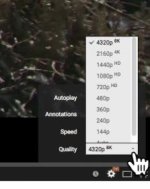
I remember back in the 90's some people said the internet was a fad like CB radio. It looks like 4K TVs are the top selling consumer electronic purchase this holiday season and all of the top selling smartphones now shoot 4K UHD video. BTW youtube now has 4320p 8K videos.
18451392569_bb46ac5c7e_o.jpg
 
Reminds me of the Quadraphonic Sound format battles during the 70's
It was about a decade ahead of its time. By 1986, Dolby Surround was vowing folks left and right. I remember the "Top Gun" (on VHS, naturally) blowing people away with its fighter action. Back then, it was three channels. Then Dolby Pro Logic came out a couple of years later, adding the center channel for the dialog. I was working at a SF Valley store around Christmas 1988 and had to pick up a phone call from a customer inquiring about a Pioneer A/V receiver with the built-in Pro Logic chip, a relative rarity at that time. That customer was George Kennedy on his speaker phone. He sounded like G-d.
 
Now that we're onto the audio nostalgia - there is an article today on ... (Verge?) about the comeback of reel-to-reel tape player/recorders. They're very pricey and custom made (sign of a future camera world, perhaps) but, if someone likes the analog sound, it's pretty much the state of the art.

As a side note : to combine the best features of the Philips derived consumer quality cassette and the high end sound of R2R, Sony came out with what they called Elcassette right about that time, in the mid-70's. It functioned like a standard Philips 4mm type but was much larger and dragged its tape much faster, giving it a R2R quality performance. Of course, Sony decided to price its tape decks at an ultra premium level and not license the rights to anyone else. Then Nakamichi came out with a high end tape deck of its own and the Elcassette faded away.
 
Last edited:
I sold my Studer A810 reel to reel on ebay last year for $1700, and a couple drove all the way from Toronta to pick it up. Crazy!
 
Back
Top