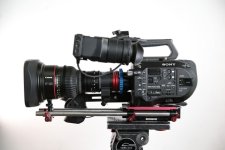
C100: I need a New Look for 2017. What's your fave interview lens besides the 70-200?

P.S.S. Did you study the Camera Porn around the Brady cluster f**k immediately after he won the Super Bowl? The Sony XDCam and Panasonic P2 full size ENG cameras are still going strong. Heavy as hell. I watch the Super Bowl for the commercials and eyeing the pro cameras.

I keep saying it over and over, my favorite camera ever is still my P2 VariCam.
 
P2 Varicam - 3000, 3100, Made some damn great HD images , was easy on the shoulder , and pretty great to shoot hand held. I was just looking at some scenes I shot on an expedition with a Panasonic Hpx 370 which had a similar form factor and 7 years later the pictures/ hand held work still look great.
 
I often use the 70-200 2.8 L version 2 as it's easy to make look nice. However sometimes the content just begs for a 24mm 1.4 up closer to the subject and showing more of what's behind the subject. Really it's all about learning what your lenses do and how that helps you better tell the story at hand, even in an interview setting. On a current project we have been shooting a combination lately of 24mm 1.4 and 70-200mm... it's been fun! Rent some lenses and see what you like...

Best Regards,

Chris
 
Business constantly changes. Can't say I like the new media swing- trying to figure it out. Change always creates opportunity too.
who.jpg
 
often use the 70-200 2.8 L version 2 as it's easy to make look nice. However sometimes the content just begs for a 24mm 1.4 up closer to the subject and showing more of what's behind the subject. Really it's all about learning what your lenses do and how that helps you better tell the story at hand, even in an interview setting. On a current project we have been shooting a combination lately of 24mm 1.4 and 70-200mm... i


Just used this same combo. 24 1.4 ( actually 1.8 as a shooting stop) and 70-200 off angle close up a while back. If you have. Enough shootable background and we did in this case the Main camera was the 24 @ 1.8 on a Dana dolly and the 70-200 was off angle usually 80-90 MM at 2.8 . THe client really liked that look when cut and so did I .
 
How close are you putting the camera to your subject when shooting at 24mm? You're talking about the 24 L right? I was curious if there was a significant image advantage to using CINE lenses over the 70-200 2.8 L II lens (which I agree is easy to make look nice)
 
I was curious if there was a significant image advantage to using CINE lenses over the 70-200 2.8 L II lens (which I agree is easy to make look nice)

A cine lens will

1. Look better, sharper and more refined. As to the issue of will your client be able to tell the difference, doubtful
2. Cine lens will have less breathing, fewer chromatic aberrations
3. Cine lens will be better operationally as the focus scale is more spaced out, repeatable focus and zoom marks, the smooth, declicked iris ring, using T-stops, etc.
4. Cine lenses, especially zooms are much more impressive looking to a client. Ther are larger, heavier, have a lot more "wow" factor.

OTOH,

1. Still lens has IS, Cine doesn't
2. Still lens works with DPAF
3. Much, much lower cost to buy or rent
4. The 70-200 2.8 IS II is a great value and looks pretty much in the neighborhood of a cine zoom, it's just a still lens though operationally.

Bottom line, single person, doc, event, one man band shooters should use the still lens, those shooting narrative, music video, commercials and or have a crew, particularly ACs, the cine lens will be a much better choice. I rarely shoot with ACs and I shoot lots of BTS/doc footage, run and gun, so I own the 70-200 2.8 IS II. You can shoot a feature with a still lens fine, you can shoot a wedding one man band with a cine zoom, but neither are the optimal tool for those respective situations. Horses for courses. The biggest differentiator is cost. The 70-200 2.8 IS II costs $2k. Most cine zooms cost $25k and up, way up. Go onto lensrentals.com and you'll see the difference in the rental rates too. $75.00 per day for the 70-200 versus $500.00 to $800.00 per day for a cine zoom plus you have to have all of the support, FF motors, zoom servo setups, etc. for the cine zooms. It's just a whole different league of production.
 
Last edited:
Puredrifting, thanks for the clarification. It may be my abilities but I find there is a significant difference between my 70-200 & my 24-70 in over all image quality. (both markII 2.8) I really struggle to get that 24-70 nice & sharp with some shallow DOF whereas the 70-200 just makes everything look great, but it's not wide. I bought the 17-55IS per your suggestion & definitely enjoy it for the IS & 17mm but it doesn't seem to have that same "something" the 70-200 has. Any thoughts on that?
 
A cine lens will

1. Look better, sharper and more refined. As to the issue of will your client be able to tell the difference, doubtful
2. Cine lens will have less breathing, fewer chromatic aberrations
3. Cine lens will be better operationally as the focus scale is more spaced out, repeatable focus and zoom marks, the smooth, declicked iris ring, using T-stops, etc.
4. Cine lenses, especially zooms are much more impressive looking to a client. Ther are larger, heavier, have a lot more "wow" factor.

I would dispute #1 & #2, and #4 is pretty subjective, and #3 can be a downside if you don't have a focuspuller (the long focus throw makes markings more accurate and turns more precise, but it can be quite difficult to pull focus from the barrel on some cine lenses).

Many of the new cine lenses are literally rehoused still lenses or are newer inexpensive designs that have benefitted from the great improvemtns in still lens designs in the past decade or so. Cine lenses may be more parfocal in some cases and might offer less breathing, but it's hardly true that they necessarily have less CA or more sharpness. They do however, offer certain designs and form factors, focal ranges, and speeds that are not available in still lenses.

In some cases, I would expect that a DP chooses a cine lens because it is less sharp and less refined, especially if we are talking about anamorphic lenses. I thought people used cine lenses because they can be swapped out quickly when using rails and a mattebox, the mounts are more robust, and better manual control when working with a follow focus and/or gears. Sometimes a cine lens set will tend to have the same color rendering, but rarely are they sharper or have less CA than contemporary top of the line still lenses.
 
I would dispute #1 & #2, and #4 is pretty subjective, and #3 can be a downside if you don't have a focuspuller (the long focus throw makes markings more accurate and turns more precise, but it can be quite difficult to pull focus from the barrel on some cine lenses).

Many of the new cine lenses are literally rehoused still lenses or are newer inexpensive designs that have benefitted from the great improvemtns in still lens designs in the past decade or so. Cine lenses may be more parfocal in some cases and might offer less breathing, but it's hardly true that they necessarily have less CA or more sharpness. They do however, offer certain designs and form factors, focal ranges, and speeds that are not available in still lenses.

Of course, 1 & 2 depend on the lenses involved, I was relating my experience in shooting, owning and renting the 70-200 2.8 IS II and my experiences renting larger, more expensive cine zooms like the Fujinon Cabrio 19-90 and the Canon 17-120. In both cases, at 90 and 120mm focal length, the cine zooms appeared to be sharper and both had less breathing. Does not apply to every cine lens, just the few I have shot with.

As far as CA, that was generalization on my part that most of the lenses I have used, generally, the lower cost lenses have more visible CA, usually due to lower cost, lower tech lens coatings. Also, the older lenses tend to have more CA, my set of Nikon AI and Ais primes from the 70s look great but outdoors, the flare, intense CA and generally low contrast make them pale in comparison to my modern Canon primes. I have not shot with any of the "new generation" Tokina, Sigma, etc. re-housed still cine lenses while you possibly have so I can't comment on them.
 
...but rarely are they sharper or have less CA than contemporary top of the line still lenses.

Canon 70-200 2.8 IS II is probably a poor example because it is so good. How about comparing the 18-135 STM IS or even the 17-55 2.8 IS? I see quite a larger difference. I have shot stills with my 18-135 STM IS and I was amazed at how soft in the corners it is but it looks great in 1080, sharp enough. And I definitely see significant CA on my copy of both of these lenses too that I have never seen on a fine cine zoom.
 
The other hybrid option is the Canon 18-80. I have to shoot with it more to get a real feel for it- from the field. Being a new lens from Canon I would hope it matches well with the CN-E Primes.
This lens seems a true hybrid or bastard to some. Covers the C300 Mkii as expected. Have to put IS and DPAF to the test- just been manual focusing it as that's what I'm familiar with. Manual focus is just like a still lens (short rotation, no hard stops), just a beefier housing and feels smoother.

Planned on using this for day in day out regular bread and butter shoots, when I don't have an AC. When I don't need the look of a T2-T2.8 split.

Camera body really wants the Pro Lock EF mount- this is a PITA to switch out with the included lens support, and personally won't use the lens w-o the lens support- it does rock on the mount.

T4.4 is uninspiring, but I decided on this specifically for the autofocus capability (have to fight for good, qualified ac's on small shoots these days) and the fact the C300 mkii is pretty good at high ISO. 18-80 covers much of the bread and butter shoots and greatly reduces lens swaps. When shooting 1080 I will use the crop factor as a tele extender so this lens is good for fast moving, low budget shoots that are poorly supported.

More to come.
 
Last edited:
The other hybrid option is the Canon 18-80. I have to shoot with it more to get a real feel for it- from the field. Being a new lens from Canon I would hope it matches well with the CN-E Primes.
This lens seems a true hybrid or bastard to some. Covers the C300 Mkii as expected. Have to put IS and DPAF to the test- just been manual focusing it as that's what I'm familiar with. Manual focus is just like a still lens (short rotation, no hard stops), just a beefier housing and feels smoother.

Planned on using this for day in day out regular bread and butter shoots, when I don't have an AC. When I don't need the look of a T2-T2.8 split.

Camera body really wants the Pro Lock EF mount- this is a PITA to switch out with the included lens support, and personally won't use the lens w-o the lens support- it does rock on the mount.

T4.4 is uninspiring, but I decided on this specifically for the autofocus capability (have to fight for good, qualified ac's on small shoots these days) and the fact the C300 mkii is pretty good at high ISO. 18-80 covers much of the bread and butter shoots and greatly reduces lens swaps. When shooting 1080 I will use the crop factor as a tele extender so this lens is good for fast moving, low budget shoots that are poorly supported.

More to come.

I'm hoping you can answer a question I have about the 18-80 t/4.4. When you stop down to anything below 4.4, is there a loss of light transmission while zooming. All of the Canon zooms in this range have transmission loss while not wide open and I'm hoping the 18-80 does not have the same problem.
 
It's constant aperture. T4.4, though just checked on the camera with the built in waveform, not on a larger production monitor nor have I brought it into Resolve to verify. But just a quick look I believe it's constant aperture. Maybe someone from Canon can confirm or deny.
Hell, at T4.4 it better be constant.
 
I'm hoping you can answer a question I have about the 18-80 t/4.4. When you stop down to anything below 4.4, is there a loss of light transmission while zooming. All of the Canon zooms in this range have transmission loss while not wide open and I'm hoping the 18-80 does not have the same problem.

I had the lens a few weeks ago for a review for an article I wrote for HD Video Pro. It does not ramp the aperture, it is constant aperture throught the range, I specifically tested for that.
 
Last edited:
A cine lens will

1. Look better, sharper and more refined. As to the issue of will your client be able to tell the difference, doubtful
2. Cine lens will have less breathing, fewer chromatic aberrations
3. Cine lens will be better operationally as the focus scale is more spaced out, repeatable focus and zoom marks, the smooth, declicked iris ring, using T-stops, etc.
4. Cine lenses, especially zooms are much more impressive looking to a client. Ther are larger, heavier, have a lot more "wow" factor.

OTOH,

1. Still lens has IS, Cine doesn't
2. Still lens works with DPAF
3. Much, much lower cost to buy or rent
4. The 70-200 2.8 IS II is a great value and looks pretty much in the neighborhood of a cine zoom, it's just a still lens though operationally.

Bottom line, single person, doc, event, one man band shooters should use the still lens, those shooting narrative, music video, commercials and or have a crew, particularly ACs, the cine lens will be a much better choice. I rarely shoot with ACs and I shoot lots of BTS/doc footage, run and gun, so I own the 70-200 2.8 IS II. You can shoot a feature with a still lens fine, you can shoot a wedding one man band with a cine zoom, but neither are the optimal tool for those respective situations. Horses for courses. The biggest differentiator is cost. The 70-200 2.8 IS II costs $2k. Most cine zooms cost $25k and up, way up. Go onto lensrentals.com and you'll see the difference in the rental rates too. $75.00 per day for the 70-200 versus $500.00 to $800.00 per day for a cine zoom plus you have to have all of the support, FF motors, zoom servo setups, etc. for the cine zooms. It's just a whole different league of production.

I have seen many shooters, lens rental agencies/lens modifying guys peddling cine lenses and going ga ga about certain "cine lenses" when they were introduced/group buys whereas they do have significant aberrations. Will refrain from naming. Some of those non-canon cine lenses are way bad than some of the L series Canon still lenses. It is important to do your own tests, draw own conclusions based on personal aesthetics, likes and dislikes.
 
I bought the 17-55IS per your suggestion & definitely enjoy it for the IS & 17mm but it doesn't seem to have that same "something" the 70-200 has. Any thoughts on that?

That lens is just special. I found that immediately upon first using one, but it was driven home for me when I had one on the set of a feature film and a highly seasoned feature film DP came over to rave about that lens. In his career he has used all manner of expensive cinema zooms and primes yet he couldn't say enough in compliment of the Canon 70-200mm.

Someone mentioned iris-travel- I was looking at a photo of the Canon CN-E primes and it appears that the iris travel is relatively short compared to the Zeiss CP2 primes. The travel, going by the markings, looks more like that of a still photo prime. While the iris travel of the CP2's seems more like that of true Cinema primes. Anyone using the Canon CN-E's find the iris travel to be wanting?

The lens I want badly is the Canon 17-120mm Cine servo. You can just about live on that one lens for nearly all types of shooting and sell all your other glass. I know a commercial DP who used to be a prime lens guy but he says he is now almost always on the Canon 17-120mm. It is that good. I used one last week for an ENG-style shoot and it is pure sweetness after being on EF zooms and the Sony zooms. It has all that we miss from the B4 ENG lenses. I was even able to use my old trick of doing perfect extreme focus racks using the macro ring. The 17mm wide end is just about all you could ever want for ENG shooting and the Canon will still have that over the recently announce Zeiss 20-100mm. Which isn't even a servo lens anyway. If I could swing the price of the Canon 17-120mm I might be done buying lenses for good.


The last lens you'll ever need??


CanonCineServo.jpg
 
Last edited:
Someone mentioned iris-travel- I was looking at a photo of the Canon CN-E primes and it appears that the iris travel is relatively short compared to the Zeiss CP2 primes. The travel, going by the markings, looks more like that of a still photo prime. While the iris travel of the CP2's seems more like that of true Cinema primes. Anyone using the Canon CN-E's find the iris travel to be wanting?

re: 17-120
The last lens you'll ever need??
View attachment 120897

On Canon CN-E prime iris travel- never once an issue. I don't ramp iris by hand. When using a wireless remote on iris you can map all the digital wireless systems to spread the travel if need be.

There is no "last lens you'll ever need." Every job is different, looks are different, constraints are different- and something new is always coming out.

As IndiaWilds says, everyone MUST TEST ON THEIR OWN to verify if a piece of equipment works or doesn't work for you.

One should not be allergic to renting. It's hard as an owner op to have gear make money these days. Bigger budget shoots will almost always rent. Low budget shoots- owner op gear is usually discounted- sometimes severely- just ask any Red Scarlet MX or Scarlet Dragon owner.

Now if you can afford to buy any lens- by all means do so. And enjoy and cherish ownership. For me it doesn't make a lot of business sense these days to buy, especially the "industry standard" products. I think you have to completely forget everything you've seen since 2007 about owner ops- guys who bought a Red One or better yet, the first owners of Alexa's. Those guys made out like bandits and some started careers that way. That was a unique time in history as far as owner/ops go. And completely over. Now manufacturers are overflowing with super35 cameras and glass. Cheap LED lights that look great abound. Resolve 12.5 is for FREE.

As far as Ned's original post goes: I still say test old glass- 75-135mm. Either cine glass or old still glass (manual focus) remounted to whatever mount you are using. You may be pleasantly surprised. You may not like it. You may find a $50 lens is fantastic and wonder why everyone else is struggling with modern, mid priced lenses that frankly look like crap in 4K. They make everything look like really sharp VIDEO. Clinical is the term. Good for scientific work, bad for photographing middle aged talent, clients, etc. On some shoots you need a sharp, modern "clinical" lens.

At the same time we all know about the Dog and Pony Show. I may abhor the idea, but it is real and it exists with some clients. The general trend to do away with focus pullers makes a working autofocus system, as a backup or alternative, very real to me. Minimizing lens swaps is a plus.

I'd much rather have the 17-120 but that cost $26K. The 18-80 is a total compromise but the cost can be absorbed and truthfully it's more than adequate for virtually all low budget shoots. I'm not bringing the 18-80 on bigger budget projects when I can rent Cooke S4s, or Optimos, or Canon Cine zooms.

The IT factor on the 70-200 has a lot to do with optics and focal lengths. Why did Yousuf Karsh shoot portraits with an 8x10 view camera? Several reasons but focal length plays a huge part. Ned, try a Canon FD 135/2 or Nikon 135/2 with appropriate lens mount. OR a Tair-11a 135/2.8 Or 85mm equiv. Tell clients it's your "beauty" lens. Because they are very complimentary to a middle aged woman's face.
 
Last edited:
Back
Top