C100: I need a New Look for 2017. What's your fave interview lens besides the 70-200?

nedcam

Well-known member
My Go-To interview lens, when I have the space, is my 70-200 and to tell the truth, I'm getting really bored with looking at my footage. When I sit down to edit, eeesh...I need a new look. Every sample video I send out starts to look the same.

I recall when the C100 & 300 came out folks liked a 50 or 85mm but I'm having trouble searching the threads for which one exactly because there were so many lens threads. So, what is your favorite talking head lens? I got to thinking because I did an estimate yesterday, an author on book tour who will talk straight to the lens, and she wants "a high production look" so I would like to have another tool, and please don't say the 24-105.

Thanks,

Ned
 
Sigma Art time?

Sigma Art time?

My Go-To interview lens, when I have the space, is my 70-200 and to tell the truth, I'm getting really bored with looking at my footage. When I sit down to edit, eeesh...I need a new look. Every sample video I send out starts to look the same.

I recall when the C100 & 300 came out folks liked a 50 or 85mm but I'm having trouble searching the threads for which one exactly because there were so many lens threads. So, what is your favorite talking head lens? I got to thinking because I did an estimate yesterday, an author on book tour who will talk straight to the lens, and she wants "a high production look" so I would like to have another tool, and please don't say the 24-105.

Thanks,

Ned

Consider the Sigma 18-35mm, wide open, wider framing than typical for interview but with a shallow DOF that throws the background out of focus. Camera placed closer to subject than you would with the 70-200mm...around 6ft from subject. Maybe position the camera lower than you might normally so as to have a bit of the ceiling in the frame if shooting indoors.

JP
 
Want to have fun? Get the 90mm tse. Want beauty? 85mm f/1.2. If you want a general problem solver, the Sigma 50-100 f/1.8 is a good choice when you need adaptability and the ability to throw the background OOF.
 
I second the Sigma 18-35, or a 24mm or 35mm prime, filming around f/1.4-f/2.8, typically around f/2. If you film all of your interviews with one camera on a long focal length, they tend to look generically the same because the background is small, compressed, and heavily out of focus (even at f/5.6). Film your interviews wide at 24mm and suddenly the location of the interview becomes a part of the interview, making each interview setup more unique. It also gives you a lot of choices with background lighting and set design.

Though, I may be hesitant to shoot too wide with framing if I'm shooting with just one camera; typically I do two or three cameras if I'm shooting like that.

nG2NzrP.jpg
 
From what I recall it was the 85mm that was basically the go to portrait lens for most Canon shooters. I usually shoot interviews with 2 cams and the 24-70 + 70-200 combo but my favorite lens is the 100mm macro, even as a tele. It really allows you to stop down enough to allow for some movement yet still have the OOF background. As mentioned before the TS-E series is unique and fun. Maybe check out some lensbaby options if you go that way. Would be a bold decision on a corporate shoot.
 
My usual setup has been Zeiss 50mm 1.4 on main camera and Zeiss 85mm 1.4 on side angle. Been pretty happy with that setup for the most part!
 
I can relate to interviews having a certain look since I guess most of us go by the normal rules as they work and give a nice looking result. But why not change your lighting? That'll give you another look. Go low key or high key or whatever you never do and experiment. Raise the camera go bananas with wider shots or super narrow.
 
Ned, in the past I stayed tight with interviews because of problems with the background (I also frequently used the same framing because I'd just clip/tape the lav on just out of shot).

I remember hearing something like "the bigger the budget the more background you get", which was referring to 6x6 vs. 20x20 overheads, but it still applies with interviews.

I wouldn't put so much weight in choosing particular lenses. I think Eric's very wide example is great - if the location is decent, you have an opportunity to show it off. Of course this might mean you need to fight for extra time to set up or remove light for the background. We all know the abysmal corporate "boardroom", so obviously it helps if the location moves away from this end of the spectrum. But it seems like you work for some pretty big/cool/interesting companies that would have some fantastic facilities. If you're not happy with one ultra wide angle then you could pick a point in the interview/reading etc. to change angles.

This comes to Osslund's point of lighting, which can (as I'm sure you're aware) transform a terrible location into something really nice.

Look at the set up Kassim Norris uses in one of his videos - https://vimeo.com/76647626 - at one point he's even 100% behind her, I'd thought about that but never seen it done!

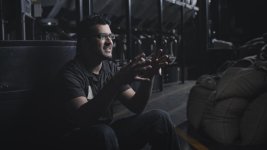
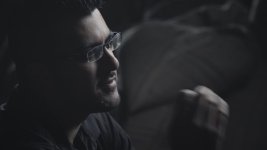
I didn't shoot these but directed this video for a coffee company and we interviewed the roaster in the roasting warehouse. I'm not crazy about the profile shot, but it worked and to me, was better than a completely vanilla side on B camera:

Rai4.jpgRai3.jpg
 
Last edited:
My go-to is the CN-E 135mm T2.2 or 85mm T1.3. 50mm T1.3 when I need wide(r). Of course I did use my 17-120 for an interview for the first time on a three cam shoot today ; )
 
Thanks all! I guess I should consider Sigma, always considered them more of an "off brand". Will it talk with the Canon though?

Also, as in Eric's shot, so many of the places I'm in, that would require a lot of cleaning up to allow a super wide shot. The gig I just bid is for a McMansion shoot, where I just keep pivoting for the 20 videos, maybe do 4 each background? I wish there was a place centrally located in the US where we could fly in and try all the lenses! Perhaps they would have a hot model and we could bring our favorite lights?

Don't steal my idea...
 
Preparing a location is just an expectation to set for the client. If they're supposedly down for the cause of helping to create a decent video, cleaning is a non-issue. Of course this depends - if it's a documentary in an old person's house, let it go, but if it's an interesting or nice location then it's definitely worth fighting for. On the other hand if a place is extremely messy you can show that off too...
 
My go-to is the CN-E 135mm T2.2 or 85mm T1.3. 50mm T1.3 when I need wide(r). Of course I did use my 17-120 for an interview for the first time on a three cam shoot today ; )

Wait, you have a 135mm CN-E, an 85mm CN-E, a 50mm CN-E, AND the 17-120mm Cine servo? Okay, I officially hate you now. :tongue:
 
Thanks all! I guess I should consider Sigma, always considered them more of an "off brand". Will it talk with the Canon though?

Also, as in Eric's shot, so many of the places I'm in, that would require a lot of cleaning up to allow a super wide shot. The gig I just bid is for a McMansion shoot, where I just keep pivoting for the 20 videos, maybe do 4 each background? I wish there was a place centrally located in the US where we could fly in and try all the lenses! Perhaps they would have a hot model and we could bring our favorite lights?

Don't steal my idea...

A Canon C300 owner shares his new found love of the Sigma 18-35mm:

http://www.pauljoy.com/2015/10/sigma-18-35-f1-8-art-lens-for-video/


"A Day With the Sigma 18-35mm" using Canon C100:


__________________

There is something magical about that lens. Something intangible above and beyond Canon L glass.

The 18-35mm's price tag of roughly $600-650 makes it even more appealing. I've spoken with seasoned DP's who get to use all manner of fancy, high-priced glass and they rave about the Sigma Art glass. I think maybe part of the magic is that f/1.8. Although, that said, it also has a certain magic to it at smaller stops as others can attest. It is both sharp and pretty at the same time. ( some have compared the Sigma Art glass to Zeiss super speeds but with more modern flare suppression. ) My Canon L glass seems a bit lifeless after being on the Sigma.

A Sigma Art 24-70mm has been rumored. If it materializes I am all over it and may well jettison the Canon L glass altogether. I would love to have a lens kit with nothing slower than f/2.0.
 
If you film all of your interviews with one camera on a long focal length, they tend to look generically the same [...]

+1

Although my vote is for a 35mm prime (on the C100 this is a normal lens, like a 50mm on a full-frame camera).

Get rid of the talking heads! That form originated when TVs were 4:3, 640x480 (roughly), and 13". Everything had to be a close-up. But rewind further back, to when the only moving picture was at the theaters, and look at the compositions then: medium and wide shots, with few close-ups.
 
+1

Although my vote is for a 35mm prime (on the C100 this is a normal lens, like a 50mm on a full-frame camera).

Get rid of the talking heads! That form originated when TVs were 4:3, 640x480 (roughly), and 13". Everything had to be a close-up. But rewind further back, to when the only moving picture was at the theaters, and look at the compositions then: medium and wide shots, with few close-ups.


There is an intimacy with the talking-head framing that you do not get with the wide framing. And the tighter framing with out of focus background limits the viewer to looking at the person doing the speaking. With super-wide interview framing the viewer can end up looking at things in the background and as a result pay less attention to what is being said.

At the risk of heresy, I'm not wild about the framing on that Sister Agnes example. I find the expanse of tile floor unappealing. I was more recommending a wide focal length but with the camera close to the subject and the lens wide open to produce a somewhat out of focus background. Framing that cuts the subject off at the waistline. It still feels "intimate" even though the focal length is relatively wide.

There are very good reasons that the camera is not typically positioned close to the interview subject. Some having to do with the distortion of the human face that can occur when the lens is close and wide, others being practical matters having to do with things such as the camera and operator casting a shadow on the subject. Or making the subject uncomfortable as a result of the camera and operator being so close to their person. But when done with care it can be an interesting look that makes a statement in defiance of the long-lens habit. At one time the camera was positioned a distance away from the subject so as to avoid the sound of the film camera being picked up by the microphone recording the subject.

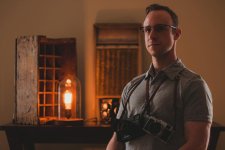
Below is an example that is the closest example I could find online to what I mean by wide and close(r). The lens in the example is positioned below the eyeline of the subject and also more lateral of the eyeline than is typical. ( maybe too lateral for my liking ):

featured_selfie.jpg
 
I'd have to agree with Osslund that if you want to change the style of your interviews, it's not singularly a lensing issue.

Try using gels, grids or cucoloris on your backgrounds, or using backdrops instead. Change up between high key/low key, try coloured rim lights, move outdoors, etc. You could also try doing dirty shots either with your producer or parts of the set/lighting appearing in the foreground.

One popular style I've noticed a lot more with corporate stuff in the past 1-2 years is handheld for interviews. Usually it is shoulder mounted with the DoP sitting quite low on something like a pelican case for the eyelines to match up. I guess it has developed as an attempt to add a more organic, genuine mood to otherwise very boring and artificial content.
 
Yes, just changing the angle of view will not fix everything. But it's a start, if most of your past work was head-and-shoulders shots.

And yes, I was actually thinking more a waist-up medium shot, than a full-body wide shot or anything like that. The first image in rob norton's post, and the image in JPNola's post, would be a welcome change from the claustrophobic tight shots I'm used to seeing.
 
I actually really like my Sigma 18-35 as well. That lens is absolutely fantastic.
When you throw in the fact that it's like $800.....seriously everyone should have
it, it's kind of amazing.
 
Fully with JP. That ultra wide is TOO wide, to my taste. I simply see shot of someone sitting in the middle of a room in a chair; it reveals, too much, the artifice of what we do/how the shot is set up. Almost a BTS shot except no gear/interviewer in the frame (I realize Eric said that was generally on multi-angle shoots that he did that and as a cutaway I could see it working). If you're going to go wider than typical I think there's a limit to how far you can take it before it just looks "wrong," and he cutoff point is somewhere around the waist. Someone else had a thread where high end DP was mentioned (Deakins?) who talked about doing interviews wide and close and at a lower than typical angle. The example video had a kind of cool shot. Maybe not always appropriate but could work sometimes. Saw some British crime show/doc where the interviews were typical focal length/closeness but were dutch tillted, on a slider, and had blurry foreground elements they were sliding past! now THAT'S different!
 
Back
Top