F35: Holy smokes, I bought a F35 too

View attachment 138233

Hey guys my Sony AC-DN2B Power Supply arrived today. I connected it straight to the Interface Box via XLR cable, and Nothing. Camera does not power up. The Power supply is turned on and it does charge the Vmount Batttery, I hear the fan going as well. Did I make a wrong connection, or is it not supposed to be used like this?

Thanks. Camera does power fine from Gold Mount battery To Limo on the body. Am I doing this wrong?

I may have a anton bauer Battery plate for sale.
 
Ok so I asked Mr. Manuel, and it says on page 27 that my connection is fine. I guess the Power supply came defective or my cable is defective or worse: my Interface box. Nobody had this issue? I did try to reconnect the interface may times in the dock. I guess I'm on battery power only for now.
 
SRR4 is not 4k only, F65 can record HD also. The F65 dock is NOT the same as the F35/F23 either.

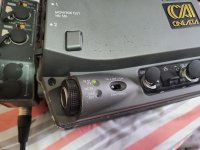
Thanks Yachacha. I really had not noticed that switch had three positions. Actually on mine I see all three labels CA,OFf,ON but my switch really only does 2 positions. It won't stay on CA, I kinda springy on that direction but it wont switch to it. Broken switch??!! Is your switch like that as well?
 
Thanks Yachacha. I really had not noticed that switch had three positions. Actually on mine I see all three labels CA,OFf,ON but my switch really only does 2 positions. It won't stay on CA, I kinda springy on that direction but it wont switch to it. Broken switch??!! Is your switch like that as well?

CA is the position to turn the camera on (if using IF box). Switch should not spring back from CA position. It should stay there. Something might be wrong with your switch. Perhaps others know more.
 
Ok it's very clear now. My switch kind of does not have the on Position. CA : turn Off, Off: Camera On, ON : It does not go that far. I think my switch is slipped to the left towards CA. So now the body of the camera stops it from going further left (towards CA). Escuse me I need a Kleenex...*sniffs. Anyone know how difficult it is to remove that face I'm going fix that switch. Or Does any one know if I can power the camera straight to its body from the AC-DN2B? Like is it possible to use XLR to lemo 8 pin without frying the camera? The voltage from the AC-DN2B is 14.something Volts DC.
 
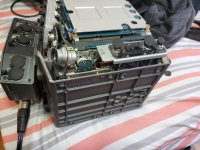
It’s really easy to remove the plate. Just unscrew the 4 Phillips head screws and unscrew the lemo power ring nut (black) and it comes right off. You should be able to test the switch without the camera panel interfering.
 
There seems to be some naming confusion going on here.

SRW1 is the original tape based, developed for the F23 and later also used with the F35. This does not support 12-bit. Only up to 10-bit. HDCAM tape was never 12-bit. The 12-bit upgrade was done late in the F35's life. The Genesis also does not support 12-bit.
Advantages of a SWR1 at this point is only the speed ramping features plus the variable frame rates. The variable frame rates can be useful, depending on what you are shooting. But the speed ramping is a gimmick at best. Because the F35 tops at 50fps. The ramping from 50fps to 25 or 24fps is not very noticeable in most applications. Given the size, weight, power consumption, tape workflow and capture awkwardness for most modern systems, a SWR1 is hardly worth it as a main unit today. If found cheap, it could be used as a second recorder or sort of effects recorder for those single shots.

SR-R1 is a digital recorder and absolutely supports 12-bit. Looks basically exactly like the F65 recorder, which is called SR-R4. Main difference is the SR-R1 is HD only and the SR-R4 is 4K only. Totally different animal to a SRW1.

The SR-R1 is in my opinion the best recorder for the F35, since Sony never delivered the version which would dock with the F35, called SR-R3. So the SR-R1 is the best compromise in my opinion. It's only disadvantage is if you are worried about size. But in a camera such as the F35 worrying about size is like worrying about calories, if you are already eating a hamburger. It is a full fledged production camera and works best that way. If the project calls for a light weight camera I will just use that. But trying to use the F35 as a DSLR handicaps the camera and makes it harder to work with.

I remember complains of the camera being unbalanced for shoulder work, right here on the forums. But the camera was being used with a monitor recorder. In that configuration it will of course be unbalanced. It was never designed to be used that way. With a recorder at the back. Be it the SR-R1, Codex or S-two, it balances like an ARRICAM. Even somebody with back problems, no seasoned camera op would say an ARRICAM is unbalanced on the shoulder. It's not light. But neither it is unbalanced. But if using the camera as a cube and then towering gear on top and raising the center of gravity, of course it will end up being unbalanced.

If the project is DSLR budgeted, then I would rather use that than try to make the F35 into something it is not and waste the camera. This is my opinion of course. Now it is a different thing to have multiple bodies and set them up for different applications. I have rigged a cube with basically just a pancake lens and nothing else. Recorder, monitoring, power all off board. I still got the F35 image and didn't have to go to a DSLR to get the shots. But I would not want to shoot with a bare minimal F35 as a main camera.

So back to the SR-R1, best recorder for the F35 in my opinion. Completes the camera, balances it all out, records the full quality the F35 outputs, has one of, if not the the most reliable media and can be powered by a single onboard brick along with the F35. Mine live on the rear dock and can easily come off to the top dock or off all together to change shooting modes.

I tried several options, including monitor recorders and even the Codex. They all sound good on paper but didn't really work as well in practice, for me. The SR-R1 is a breeze. With the SR-R1, the F35 is basically no different to shoot than an Alexa Classic. Press record, get your shot, pop the card out, pop it in the reader and start editing.
No record button on camera to the SR-R1correct? that to me is a big disadvantage vs srw1 and Codex. And no speed ramping, which I have seen beautifully used. Not the same as shooting 50fps and slowing it down in post IMO. All the rest you said stands true man. The f35/23 with the srw1 in the back is heavy, but man, thing is really well balanced. Amazing really.
 
20200205_121307.jpg20200205_120502.jpg
It’s really easy to remove the plate. Just unscrew the 4 Phillips head screws and unscrew the lemo power ring nut (black) and it comes right off. You should be able to test the switch without the camera panel interfering.

SHE LIVES! SHE LIVES!

Thanks a lot...I opened her up, the plate was not aligned, so the switch did not have room to move left. I think the previous owner screwed the lemo black washer-thingy too far before he screwed the plate in place first.
Im happy!!! thank you. She runs like my fridge now straight from the wall plug....You guys are great thanks for taking the time to help me out.
 
No record button on camera to the SR-R1correct? that to me is a big disadvantage vs srw1 and Codex. And no speed ramping, which I have seen beautifully used. Not the same as shooting 50fps and slowing it down in post IMO. All the rest you said stands true man. The f35/23 with the srw1 in the back is heavy, but man, thing is really well balanced. Amazing really.

100%, I used the F35 with the Odyssey, Codex and SRW-1 and though the SRW-1 makes the camera much more heavy and much more power hungry it balances out the camera so well that it actually feels lighter on the shoulder than when I was using the camera without it. Even compared to the Codex which is a large improvement over the Odyssey.

Shouldering the camera with the Odyssey was so front heavy it would tire your arms very quickly, put the SRW-1 on there and it puts all the weight right over your shoulder and is much easier to steady. I found it even helped on a head, balancing everything out making vertical pans a bit easier and smoother, I use an old O'connor 50 which uses springs for the vertical axis. I was using it mainly with a Cooke 20-100 and Lomo Foton A which are both large heavy lenses so the weight of the SRW-1 may have helped more than it would have with smaller lighter lenses but even the F35 with tiny Lomo OCT18 lenses it felt heavier on the shoulder with the Odyssey than the same setup with the SRW-1.

In all the SRW-1 was my favorite recorder for the F35, I just wish it had 12bit. The camera was built for it and it is the only recorder that actually works seamlessly with the F35. It supports just about everything the F35 can do, it can communicate with the F35 and vice versa so you can change format options on either device as well as trigger recording. You can also review your footage in the viewfinder or via the monitor out, something not possible with the Codex.

Next would be the Codex since it supports 12 bit and ramping not to mention 10bit 4:4:4 at 50P like the SRW-1 but it doesn't communicate with the camera other than record triggering and tallys. If you want to change the format you have to change it on both units individually and if you want to switch to 12 bit you have to power down the camera, remove the Codex, power up the camera, change to 12bit, power down the camera, re-dock the Codex and then power back up and set the Codex to 12bit. The Codex tells the camera there is a recorder docked but since the only recorder the camera knows about that can be docked is the SRW-1, which is 10 bit, the camera thinks that 12bit is not supported and won't allow you to switch to 12bit with the Codex docked. On top of that when the Codex is docked and in 12bit the camera constantly flashes INVALID FORMAT in the VF which is annoying. The Codex has a very cool and very powerful virtual file system that it uses which is fantastic but the capture dock only works on a MAC, which was a bit of a problem for me being a Windows user. Do to the hassle of switching to 12bit I usually kept the camera in 10bit 4:4:4 select FPS mode, that way I could choose any frame rate from 1 to 50P at will.

Coming in 3rd for me was the Odyssey, the built in monitor, small size and SSD storage are very nice but there is no communication at all with the camera, no triggering, no ramping and a 10 bit 4:2:2 max at 50P. I tend to shoot outdoors and shoulder the camera often so not having a visual que that I am recording while looking in the VF was always unsettling.

This was the main reason why I switched to the SRW-9000PL. It is a F35 with a built in SRW-1 that is smaller, lighter, uses almost half the power and has a better form factor for shoulder work when compared to the F35+SRW-1. It has 3G out so no need for dual link and it appears to have updated image processing, I feel like it has less noise and can be pushed further than the F35. It also has its own ISO800 gamma mode which the F35 doesn't have and is another reason why I think there is some different processing going on inside the camera.

On a releated note when looking over the manual for the camera it mentions another camera model, 9000 PL(E), mine is a 9000 PL. In the manual it states that the PL(E) model can shoot 12bit up to 30P. I believe this was to be the SRW-9000 with the solid state recorder instead of tape that never happened. It's a shame because a 9000PL with a solid state recorder and 12bit on top of what it already has would have been fantastic. I looked around and came across an old sold listing on kitplus, if I recall correctly, which was for a 9000PL with the solid state recorder. Apparently the camera was a demo model and was sold years ago. So there maybe at least one of these solid state 9000PL's out there that could potentially record 12bit. Has to be one of the rarest cameras in existence and would be awesome to have.
 
Last edited:
Will odyssey 7a need both ssd to write 12 bit 4444? I remember that the fs700 needed to write to both cards simultaneously in some recording settings. Kinda of Raid 0 mode. Is that the case for the F35 as well? I'm waiting for a Convergent Design 256gb SSD, but it's only one coming.
 
Funny how topics seem to go in circles around here.

The SRR3 that never was is the easy answer to best recorder to interface with the Sony F35. Every other system comes with drawbacks. The SRR1 has to dumb mount to the camera, it was for the F3 not the F35. It’s a bummer because of what could of been if Sony had released the 2k update/SRR3 they printed in magazines about!

It’s the reason the F35 costs 3k not 7k right now also. It’s never a simple system like the inferior but entirely easier Alexa classic.

My camera balances fine, I use 7Q. It was all about finding a system to mount 7Q far out enough to let the camera sit back on the shoulder. You need a certain firmware, lookup in old threads I forget which one it is. You don’t need dual drives for dpx 24 FPS.

7Q cables ultimately bug me but I learn to be very cautious of bumping them. If 7Q is your screen all the info is there.

It was a pretty big deal that Convergent Design took any time to support the F35. 10-bit 422 is easy. 12-bit 444 over dual link in a proprietary psf wasn’t something anyone cared about anymore. 12-bit direct to SSD was most important to me and it is feature the 7Q excels at.
 
To be fair, the SRW1 was around well before the F23 or even the Panavision Genesis. Michael Mann used the SRW1 with the Viper and F900 on Collateral. The Genesis, F23, F35 were built with using the SRW1 not the other way around.

Are you sure about that? Did you work or know anybody who worked on the production? I ask because I have seen several articles and interviews which indicates this is not the case.

For example this article from August 2004, where you can read: "The Viper’s main disadvantage was its umbilical-cord connection to the hefty HDCAM-SR decks that were used to record the data. ( Sony has since introduced the portable SRW-1, a streamlined approach to image capture that would have been welcome on Collateral.)" (https://www.studiodaily.com/2004/08...pted-to-hd-for-michael-manna¢aeas-collateral/)

So it doesn't seem the SRW1 was around at the time and this is how I remember it too.

Regardless, the SRW1 docks directly to the F23. So it's clear it was developed for that purpose. Whether the recorder hit the market before the camera, even if senseless, doesn't really change the fact it was clearly developed for the cameras. How much sense does it make to develop a recorder which docks to something that doesn't exist? They were most likely developed together.
 
Thanks for this. Fantastic amount of information. I read bits and pieces from other threads but it's awesome to see it all together in one answer.


You're welcome.

Although as pointed out there was some misinformation there. It should have read: Main difference is the SR-R1 is HD only and the SR-R4 does 4K. As the SR-R4 is basically the 4K version of the SR-R1. Long posts tend to end up with some typos, no matter how many times one proofreads it. Sorry.
 
Back
Top