GH4 GH4 SD Cards

Let me ask you this…. What is your failure rate on cards/brands?

With cards, I've used Sandisk and Panasonic and thankfully have never had a failure. With HDD's, over the years I've used WD, Hitachi, and Seagate, and had failures with them all at one point or another. But of course, I realize that my sample is too small to draw a conclusion from. That's why I do research, read data, and visit forums like this one, to try and make the best choices possible.
 
Its about reducing likelihood. All of the examples you list above are qualitative, but lost footage is absolute, when it is gone, it is 100% gone, and all the work prior to getting the shot, regardless of camera type or fluid head or handheld, is lost.

The problem is there is absolutely no way to objectively identify the 'most reliable brand'. What ends up happening is that consumer X ends up buying a San Disk, doesn't have any issues with it and then thereby states....SanDisk is the most reliable, when in fact the card was only proven reliable to him or her. Out of the hundreds upon hundreds of hours of footage I have shot on SD cards I have never had a single issue....not one. I can't even tell you the name brand of the cards I used, that's how much thought I put into buying my SD cards.

The reality is that when you are buying into "the most reliable brand" mentality all you are really buying into is the brand that has the best marketing because there is absolutely no public data anywhere, that I am aware of, which supports the assertion that one brand is 'more reliable' than the other. The companies with the biggest and best marketing budgets don't necessarily make the best products...does McDonalds make the best hamburger?

Spending more money on an SD card gives you no more proven security or assurances then any other brand. I would hazard to guess that the failure rate on these cards is exceedingly low, but once again we have no way to prove that. Spend the money as you see fit but let's get off the soap box unless there is some way to independently verify what you are saying.
 
The problem is there is absolutely no way to objectively identify the 'most reliable brand'. What ends up happening is that consumer X ends up buying a San Disk, doesn't have any issues with it and then thereby states....SanDisk is the most reliable, when in fact the card was only proven reliable to him or her.
I'm assuming you posted before seeing my most recent post, encouraging other to read reviews and make decisions based on as much objective data as possible. I'm not advocating for or against any brand, and I'm not on a soapbox at all.
 
Never a failure with transcend either.

I have heard of people having sandisk failures. (heard of transcend too)

If you really want to analyze. . . best data I know of is on something like amazon where you'll have a ton of reviews on a given card. Need lots of reviews to be meaningful.
 
Most of my SD cards are Sandisks, Samsung, and Transcend. They're all good, though I like the design/feel/build of the Samsung ones more. The Transcend Class 10 32GB cards unfortunately do not seem to be able to sustain the 48Mbps needed for my Canon DSLR video as it occasionally cuts out, despite being Class 10. Seems to be fine for my Lumix SLRs at 24Mbps though. Weird.


Anyway, anyone tested the Komputerbay 128GB yet?
 
The problem is there is absolutely no way to objectively identify the 'most reliable brand'.
Just scan through B&H feedback and see. Transcend are usually with a lot of negative feedback due to failures. And the most frustrating thing is- they don't give a ****. After my Transcend fiasco, I made daily phone calls and email for about a week straight. I have tried normal recovery software, but I wanted to see if they had any method of retrieving the footage. I wrote about 10 email messages and left at least 7 phone messages. Not a single one was returned. So not only their product was crap, but the customer service is non existent.
 
Any errors I have had with SD cards were my fault. Sometimes even someone with well over 30 years in the business can still be a dumb ass.
 
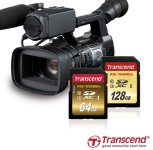
Transcend Information, Inc. (Transcend®), a worldwide leader in storage and multimedia products, is proud to announce its launch of SDXC/SDHC UHS-I cards featuring full support for the Ultra High Speed Class 3 (U3) specification. Capable of reaching incredible read and write speeds of up to 95MB/s and 85MB/s, Transcend’s SDXC/SDHC UHS-I U3 cards provide the performance necessary to harness the full power of UHS U3-compliant digital recording equipment.
Cinema-Quality 4K Video Recording
Recently released by the SD Association, the Ultra High Speed Class 3 specification guarantees a minimum constant write speed of 30MB/s to facilitate cinema-quality video recording. Transcend’s SDXC UHS-I U3 and SDXC/SDHC UHS-I U3X “Extreme” cards, however, can achieve at least double this performance with blazing-fast write speeds of up to 60MB/s and 85MB/s respectively. When used with today’s advanced camcorders, such as the Sony® 4K Handycam® FDR-AX100, Panasonic® Lumix® DMC-GH4, and Canon® EOS® C500 Cinema Camera, these cards ensure smooth 4K video capture in stunning color and clarity.
Quick and Seamless File Transfers
In devices that do not support the UHS-I specification, Transcend’s SDXC/SDHC UHS-I U3 cards offer constant write speeds of at least 10MB/s (SD Speed Class 10 performance), which makes them perfect for Full HD video recording as well as fast-action consecutive shooting. Pairing the new UHS-I U3 cards with Transcend’s RDF8 USB 3.0 multi-card reader or the handy RDF5 USB 3.0 card reader with built-in USB port significantly reduces the time it takes to transfer data from card to computer with read speeds of up to 95MB/s.
Enormous Storage Space Up to 128GB
Featuring capacities ranging from 32GB to an enormous 128GB, Transcend's UHS-I U3 memory cards are fully equipped to handle the increased capacity requirements of professional photography and filmmaking. For instance, the 128GB SDXC UHS-I U3 card can store more than 20,000 high-resolution JPEG images (12 megapixel camera, 6MB file size), over 8,500 RAW images (based on 14MB file size), or a full 8 hours of 4K Ultra High-Definition footage (4096x2160 35Mb/s H.264 AVC compression). Moreover, Transcend’s SDXC UHS-I U3 cards make extended video recording sessions possible thanks to the use of the exFAT file system that allows users to exceed the 4GB size per file limit of FAT32.
http://www.transcend-info.com/Press...570&NewsKeyWd=&Func1No=6&Func2No=219&Func3No=

Transcend_SDU3.jpg
 
Out of 6 transcend cards I had, 4 of them failed. They all failed in cold or hot conditions, but I had never an issue with Sandisk. The main issue I have with Transcend is their customer service, which is none. THE WORST/ NON EXISTENT! They do not return phone calls or email. My experience was quite the opposite with Sandisk, where they contacted me very promptly about an issue with my CF cards. On that principle alone I can't recommend Transcend, as they left me stranded. Pinching pennies on a media is not a wise policy imo.
 
Maybe I don't understand? You state you have never had an issue with a SanDisk card, and then go on to say SanDisk contacted you promptly after you had an issue with their cards.
 
Out of 6 transcend cards I had, 4 of them failed. They all failed in cold or hot conditions, but I had never an issue with Sandisk. The main issue I have with Transcend is their customer service, which is none. THE WORST/ NON EXISTENT! They do not return phone calls or email. My experience was quite the opposite with Sandisk, where they contacted me very promptly about an issue with my CF cards. On that principle alone I can't recommend Transcend, as they left me stranded. Pinching pennies on a media is not a wise policy imo.

Yeah, but it's not established that transcend is any worse than sandisk. So why spend more money?

Look around the internet and you'll have guys that hate sanddisk because they failed.
 
Pinching pennies on a media is not a wise policy imo.
True, but in terms of GH4 4K compatible "128GB" cards, we don't have many choices. As far as SanDisk goes, their new U3 cards only go up to 64GB in capacity, and they are extremely expensive due to the extreme speed offered via the second row of pins on the back of the card -- pins which the GH4 is incompatible with!

Perhaps some of you will be satisfied with 64GB, but when you get into serious 4K shooting, you surely will want a bigger card.
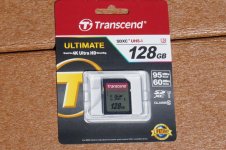
I just ordered the new Transcend 128GB UHS-1 SDXC Memory Card (Speed Class 3) from B&H today for $104.99 with free shipping. That is the only 128GB UHS-1 U3 speed class 3 SDXC card that I know of and is a great price.
http://www.bhphotovideo.com/bnh/controller/home?O=invoice&A=details&Q=&sku=1044487&is=REG
 
My UPS guy just delivered my Transcend 128GB UHS-1 SDXC Memory Card (Speed Class 3) from B&H today so now I wait for my GH4 from them.
13761583664_a89cb2f40b_b.jpg
 
Five years ago I had a problem with a couple Transend cards, but I think card technology has improved quite a bit since then. The past two years I've been shooting with SanDisk and Patriot EP Pro cards, and they've been flawless for me. When I start shooting with the GH4, I will probably buy a few U3 cards from what ever major brand is on sale, though I'm hoping that my SanDisk 95MB/sec SDXC cards will get me started when the camera arrives.
 
Seems Nick Driftwood prefers recording the GH4's internal 4K in inter frame instead of All-I.

He also stated the current Sandisk 95 Mbps cards have been working fine for 4K inter frame.
 
Back
Top