GH2-to-APSC Crop factor

Agreed.

That 10mm APSC lens I am referring to is a Canon EFS 10-22mm zoom lens, designed for 1.6x crop bodies like a 60D or 7D, similar to how your Nikon lenses have been designed for full frame 35mm bodies, like the D800/E etc.

That definitely is 'confused'... there is no 10 mm APSC 'lens'(*)... there is just a 10mm lens... how the 10mm lens affects the Field of View, is related to how large the sensor is. I don't have experience with the APS-C sensor... but I do know it is not the same size as the GH-1 micro-4/3's size.

Hence these sensors will have different Fields of View for the SAME LENS FOCAL LENGTH.

*It may happen that the 10 mm lens is a Canon lens and usually mounted on a Canon APS-C sensored camera... but that does not 'tie' it to the APS-C sensor size.

The Nikon lenses I have were all designed for a full frame 35mm still negative, but when I put the 28mm Nikon lens on the GH-1... it has an Angle of View of about 37 degrees. A 25mm lens has an Angle of View about 40 degrees.

A 50mm lens on a 'full frame still' has an Angle of View about 40 degrees... but on my GH-1... it's about 20 degrees...

A lens is a lens... it is the sensor size that sets these parameters.
 
Agreed.

That 10mm APSC lens I am referring to is a Canon EFS 10-22mm zoom lens, designed for 1.6x crop bodies like a 60D or 7D, similar to how your Nikon lenses have been designed for full frame 35mm bodies, like the D800/E etc.

The only 'wyrdness' that may result from using a lens designed for sensor sized X in a camera that has sensor size Y, is, if the X size is 'smaller' the designers may not have made the lens 'coverage' good to the edges of the larger X sized sensor...

So, for example, taking a 4/3 lens, putting it on a 'full frame' sensor, may result in serious fall off at the edges of the circle of coverage... ok... if you wanted vignetting... not ok if you wanted a flat field...

Some of this can be mitigated by stopping down the lens which tends to cover a number of 'errors'... but only so much...
 
Indeed, good thing I am only interested in putting the larger sensor lens on the smaller sensor camera.

The only 'wyrdness' that may result from using a lens designed for sensor sized X in a camera that has sensor size Y, is, if the X size is 'smaller' the designers may not have made the lens 'coverage' good to the edges of the larger X sized sensor...

So, for example, taking a 4/3 lens, putting it on a 'full frame' sensor, may result in serious fall off at the edges of the circle of coverage... ok... if you wanted vignetting... not ok if you wanted a flat field...

Some of this can be mitigated by stopping down the lens which tends to cover a number of 'errors'... but only so much...
 
LOL- You are making precisely the mistake I thought you were making!!

If I put an APSC 10mm on my GH2 body and a M43 10mm on my GH2 body I would get two images with different FOVs, wouldn't I?

Nope. Go back and ready my post here: http://www.dvxuser.com/V6/showthrea...factor&p=1986188681&viewfull=1#post1986188681
And look at Eric's demonstration here: http://www.dvxuser.com/V6/showthrea...factor&p=1986188599&viewfull=1#post1986188599

Eric put a 28mm made for a full-frame camera on his GH2, and compared it with the kit zoom at approx 28mm. You'll see the FOV is roughly identical (save for him accidentally bumping the camera during lens changes). According to your theory, the difference should be something like 28mm vs 45mm! But no- its all the same because they are both at 28mm.

We've been trying to spell it out to you: A 10mm m43 lens, APS-C lens, full frame lens, etc, will all give the exact same FOV on a given sensor size. The mm rating is independent of the mount type!

The only difference is when you go SMALLER than your sensor, like an m43 on a larger full frame (forgetting about focus problems and flange distance), because the area won't cover the full sensor and end up with black vignette borders.
Because that 10mm APSC lens is directly based on the diagonal dimension of the APSC sensor which of course is a wider FOV than a M43 senor. So in order for my GH2 to see as wide as the 10mm APSC lens on an APSC body, the GH2 needs a M43 lens that is 1.18x wider. 10mm in APSC sees approx. what a 8.47mm sees in M43.

::facepalm::
 
Thanks for your determination to teach me. I will look at the links shortly and then will look at some frames through some of the different lenses I have.
 
I see your point and I'll raise you this... what bloody mistake have I been making then!?

I checked the EFS and the Panny at 14mm and the images are near identical. I am definitely more confused now than ever and I am man enough to admit it!
 
Think about it this way: a 50mm lens is 50mm lens. Whether it's made for full frame, crop, MFT, etc. It's pretty much a universal measurement between the formats. The sensor area for those formats, however, is different. The name crop is pretty literal. Smaller sensors use less area of the lens, so the actual focal length that's captured is technically longer than the lens itself. So 50mm on a full frame is 50mm, on a Nikon APS-C body it's 75mm (1.5x crop), 80mm on a Canon APS-C (1.6x crop) and on a GH2 it's rougly 90mm (about 1.8x crop).
 
I see your point and I'll raise you this... what bloody mistake have I been making then!?

I checked the EFS and the Panny at 14mm and the images are near identical. I am definitely more confused now than ever and I am man enough to admit it!

Haha- your mistake is reading into the whole "equivalent FOV" nonsense. The truth is, you shouldn't really need that information for anything. If you are shooting on two different sized sensors (for example, APS-C and m43) and want your FOV to match, then you need to do some calculating. Or if you come from the world of 35mm photography, and want to know what the equivalent portrait lens length would be (because it used to be 50mm, but not on a modern cropped FOV sensor), you can calculate that. Otherwise, you just need to know what focal lengths will work for you on YOUR sensor!

If you have a 5D, a medium portrait lens would be a 50mm. On an APS-C, you'd want somewhere around 35mm. On a GH2, you want a 25mm. These would all give roughly the same FOV on their respective bodies. On a GH2, 14mm is a standard wide, but throw that on a full frame, and you're in fish-eye ultra-super-wide territory. Make sense?

All you need to know, shooting with a M43 body, is that around 14 is wide, 25 is medium, 50 is already pretty deep, and more than that gets serious telephoto FOV. These numbers are totally different on other cameras.
 
My problem lies somewhere within this: "If you have a 5D, a medium portrait lens would be a 50mm. On an APS-C, you'd want somewhere around 35mm". That makes sense to me so I've carried that idea over to other focal lengths and when comparing FOVs of different sensors.

My Nikon 50mm lens on my Nikon 35mm still photography body sees the world the way my 35mm EF lens on my 60D body does.

So why does my Panny zoom at 50mm see the world the same way the Nikon 50mm does on the same GH2 body?

Haha- your mistake is reading into the whole "equivalent FOV" nonsense. The truth is, you shouldn't really need that information for anything. If you are shooting on two different sized sensors (for example, APS-C and m43) and want your FOV to match, then you need to do some calculating. Or if you come from the world of 35mm photography, and want to know what the equivalent portrait lens length would be (because it used to be 50mm, but not on a modern cropped FOV sensor), you can calculate that. Otherwise, you just need to know what focal lengths will work for you on YOUR sensor!

If you have a 5D, a medium portrait lens would be a 50mm. On an APS-C, you'd want somewhere around 35mm. On a GH2, you want a 25mm. These would all give roughly the same FOV on their respective bodies. On a GH2, 14mm is a standard wide, but throw that on a full frame, and you're in fish-eye ultra-super-wide territory. Make sense?

All you need to know, shooting with a M43 body, is that around 14 is wide, 25 is medium, 50 is already pretty deep, and more than that gets serious telephoto FOV. These numbers are totally different on other cameras.
 
I see your point and I'll raise you this... what bloody mistake have I been making then!?

I checked the EFS and the Panny at 14mm and the images are near identical. I am definitely more confused now than ever and I am man enough to admit it!

The Wife took a 'long time to assimilate' the difference between her full frame still 35mm experience and the digital DSLR's we looked at, and eventually bought... She was totally confused about when, and how to apply the 'magic number' ratio.

Even now she still talks about 1.4x... rather than just simply stating 35mm focal length lens is 'normal'... (for the camera she has... we need to upgrade her to something like the D800 or whatever 'next year's new thing is...'.).

From that 'jumping off point'... one can then estimate... a 70mm lens would be like(sort of...) her 105mm on a full frame... if it was important to get a 'feel' for the telephotoness...

I long ago decided to think in terms of Field of View or Angle of View, then ask 'what is required for my camera to achieve that'.

Calculating these things is tedious, and sometimes errors are due to not really knowing exactly how much of the sensor is being 'used' by the media... The GH-1 has a couple of different aspect ratio options... so how does that affect the Fov/AoV
calculations... I only use the 16:9 aspect ratio ever... so I've not looked at the 4:3 capability at all...
 
See, this here is exactly as I was thinking just before posting this thread. But Gilden has proven me wrong. What am I missing? I am now hearing conflicting remarks.

If "one can then estimate... a 70mm lens would be like(sort of...) her 105mm on a full frame..." then why is that Canon EFS 10mm on a 60D not "be like(sort of...)" a 8.47mm M43 designed lens on a M43 body?

The Wife took a 'long time to assimilate' the difference between her full frame still 35mm experience and the digital DSLR's we looked at, and eventually bought... She was totally confused about when, and how to apply the 'magic number' ratio.

Even now she still talks about 1.4x... rather than just simply stating 35mm focal length lens is 'normal'... (for the camera she has... we need to upgrade her to something like the D800 or whatever 'next year's new thing is...'.).

From that 'jumping off point'... one can then estimate... a 70mm lens would be like(sort of...) her 105mm on a full frame... if it was important to get a 'feel' for the telephotoness...

I long ago decided to think in terms of Field of View or Angle of View, then ask 'what is required for my camera to achieve that'.

Calculating these things is tedious, and sometimes errors are due to not really knowing exactly how much of the sensor is being 'used' by the media... The GH-1 has a couple of different aspect ratio options... so how does that affect the Fov/AoV
calculations... I only use the 16:9 aspect ratio ever... so I've not looked at the 4:3 capability at all...
 
So why does my Panny zoom at 50mm see the world the same way the Nikon 50mm does on the same GH2 body?

Because they are both 50mm lenses... (or zoomed to that same focal length...).

If you want to think about 'comparisons', then 50mm on the GH-2 is the 'same'(almost...) as a 100mm on the full frame 35mm still camera...

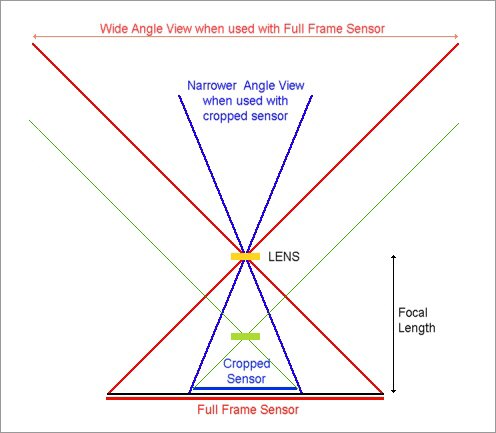
Here's a diagram.... (Note ignore that 'green' rectangle and 'green' lines. I don't know what that is addressing since I'm just getting an arbitrary 'geometrical drawing' for the purpose of illustration...).

cropped_sensor_view.jpg


Ignore that 'cropped sensor' business and replace the phrase with 'smaller sensor relative to larger sensor'. The diagram works in general for any comparison between a larger sensor and a smaller sensor.

In the case of APS-C, that is the 'slightly larger' sensor to the GH-2...

Notice how the lines that extend out to the 'top of the diagram'. call that top horizontal line the 'subject line'. The 'larger sensor' results in lines (red lines) that are wider at the 'subject' line, the smaller sensor results in narrower lines (blue lines).

The focal length is the same for both cases.

I will also note that most 'ordinary' photographers don't usually think in terms of Angle of View or Field of View in terms of 'hard numbers'... they just think in terms of 'wide angle', 'normal', 'telephoto', or 'long telephoto', or perhaps 'portrait'... or the like...

They usually do not calculate like the following...

I'm in the back of the church, at about 75 feet, the groom is approx 6', the Bride, Groom and Minister 'shot' is about 12 fee wide... so I want a Field of View of about 16'x8', what 'lens length' do I need to get a reasonably 'filled frame', that is head and feet not crowded, and enough width (hence the slightly larger numbers for the desired FoV...).

Most wedding photographers will slap on the zooom lens and adjust...
 
Last edited:
So why does my Panny zoom at 50mm see the world the same way the Nikon 50mm does on the same GH2 body?

A lens is a lens is a lens... So it doesn't matter what type of lens you use, a 50mm lens will always have the FOV of a 50mm lens on a camera with the SAME sensor size.

For video purposes... A 50 mm on a Canon 5D MK3 will have the SAME FOV as a 31mm lens on a Canon 7D which has the SAME FOV as a 27mm lens on a GH2. The small differences in FOV can be made up by moving your camera slightly forwards or backwards from your subject. ( assuming your subject is not a 200+ feet away )
 
Because they are both 50mm lenses... (or zoomed to that same focal length...).

If you want to think about 'comparisons', then 50mm on the GH-2 is the 'same'(almost...) as a 100mm on the full frame 35mm still camera...

Here's a diagram.... (Note ignore that 'green' rectangle and 'green' lines. I don't know what that is addressing since I'm just getting an arbitrary 'geometrical drawing' for the purpose of illustration...).

cropped_sensor_view.jpg


Ignore that 'cropped sensor' business and replace the phrase with 'smaller sensor relative to larger sensor'. The diagram works in general for any comparison between a larger sensor and a smaller sensor.

In the case of APS-C, that is the 'slightly larger' sensor to the GH-2...

Notice how the lines that extend out to the 'top of the diagram'. call that top horizontal line the 'subject line'. The 'larger sensor' results in lines (red lines) that are wider at the 'subject' line, the smaller sensor results in narrower lines (blue lines).

The focal length is the same for both cases.
Exactly.

And lenses made specifically for smaller sensors (APS-C, MFT, etc.) still use the same focal length formula, but don't need to make the glass as big, since the sensor sees a smaller section than a FF sensor does. Beyond body contacts and size, that's the only difference between using an MFT lens and a Nikon/Canon/etc. lens of the same focal length. Even smaller 1/2" sensor C-mount lenses do the same, though of course, you need to factor in the additional 2.6x crop of ETC mode (needed to fill the GH2's frame).
 
So are the markings on all photography lenses relative to/marked in full-frame? Meaning, if you were to put a 50mm full-frame lens on my GH2 body, then it would see the world the way the 50mm marking on my M43 zoom does?

But if I wanted to see the world on my GH2 the way a 50mm on full-frame see the world then I would need 25mm/26.8mm M43 designed lens?
 
Yes, focal lengths marked on lenses are all related to full frame field of view. Technically it makes things easier, since you only need to know your camera's crop to determine the actual focal length. If they were camera specific, you'd need to know the crop of the camera the lens came from, the crop of your camera, and figure out what that totals.

If you took a full frame image taken at 50mm and cropped it down by about 50%, you'd have the same image the GH2's sensor would be seeing with the same lens. Put a 50mm lens made specifically for the GH2 on the GH2, and you'd still see the same image. Put a 25mm lens of any variety on the GH2, and you'd see the same image from the full frame camera's 50mm before the crop was applied.

That's why you see most standard GH2 lenses starting at what would be a very wide focal length for full frame, which is actually a standard focal length for the GH2. Standard wide angle for full frame is about 28mm. APS-C is about 18mm. GH2 is 14mm. They'll all have roughly the same field of view when used on their respective cameras. Start putting different lenses on different cameras, and you need to whip out the calculator. ;)

PS: The D4 and I believe the D800 have crop modes. They have the standard full frame, Nikon DX (APS-C 1.5x), and Nikon CX (2.7x). Might want to research into how that affects things, since it alters the field of view when using the same lens.
 
If I put an APSC 10mm on my GH2 body and a M43 10mm on my GH2 body I would get two images with different FOVs, wouldn't I?
No no no no! You'd get exactly the same image.

Because that 10mm APSC lens is directly based on the diagonal dimension of the APSC sensor which of course is a wider FOV than a M43 senor.
No no no. 10mm = 10mm = 10mm, no matter what body it was designed to fit.

The only difference is in how large a circle of illumination the lens will project. But the field of view and DOF will be identical.

10mm in APSC sees approx. what a 8.47mm sees in M43.
That part is correct, yes.
 
So why does my Panny zoom at 50mm see the world the same way the Nikon 50mm does on the same GH2 body?
Because it's on the same body! So 50mm = 50mm = 50mm. Same lens length, same field of view.

If you put the Nikon lens on a Nikon body, now you'd see a difference, because you'd be comparing two different sensor sizes.

Any 50mm lens, when mounted on a GH2, will look the same as any other 50mm lens when mounted on that same GH2. The only differences would be related to coverage (maybe), or to slight differences between lenses where one might actually be maybe 51mm and the other might be 49mm, due to different design or manufacturing questions.
 
So are the markings on all photography lenses relative to/marked in full-frame? Meaning, if you were to put a 50mm full-frame lens on my GH2 body, then it would see the world the way the 50mm marking on my M43 zoom does?

But if I wanted to see the world on my GH2 the way a 50mm on full-frame see the world then I would need 25mm/26.8mm M43 designed lens?

The 'focal length' calculation has nothing to do with the sensor (or in the olden days the negative size...) 'size/ratio'... The focal length is calculated from the 'middle of the lens' to the 'film plane', with the lens at 'infinity focus' on the film plane. It has nothing to do with the 'coverage' of the lens.

A different set of parameters govern coverage, for a given focal length.

For a correctly placed 50mm lens, it will be 50mm from the film plane to the center when focused at 'infinity'... you can have 'cardboard boxes' for a camera body and that calculation would still hold.
 
So are the markings on all photography lenses relative to/marked in full-frame?
No! No no no -- who cares what full frame is? Lenses are marked as to what they ARE, not what they would equate to in some other camera system that you're not even using.

Meaning, if you were to put a 50mm full-frame lens on my GH2 body, then it would see the world the way the 50mm marking on my M43 zoom does?
50mm = 50mm. So if you put a 50mm full-frame lens on the GH2, it will deliver exactly the same image as your M43 zoom when it's zoomed to 50mm.

But if I wanted to see the world on my GH2 the way a 50mm on full-frame see the world then I would need 25mm/26.8mm M43 designed lens?
Yes.
 
Back
Top