We don't know for sure that the bodies use identical power (but I agree it's likely). Have you actually measured the GH1 PSU output? That would be interesting.
The GH1 adapter puts out 9.55V. I have two adapters for the Sony FX820 DVD player (the model number is AC-FX-150) and a generic replacement from a Chinese seller on eBay.
The genuine adapter outputs 9.77V, the other one 9.22V.
I also have a Sony adapter/charger for their TRV series of camcorders. They are rated at 8.4V. The actual output was measured at 8.42V.
This would seem to be the safest one to use. I tried to extend the DC wire by 6 ft, and the voltage dropped below 8.4 resulting in a message that the battery is not recognised.
So I am not using it.

Navigation
Install the app
How to install the app on iOS
Follow along with the video below to see how to install our site as a web app on your home screen.
Note: This feature may not be available in some browsers.
More options
You are using an out of date browser. It may not display this or other websites correctly.
You should upgrade or use an alternative browser.
You should upgrade or use an alternative browser.
GH2 GH2 Power - specs, tests, DIY
- Thread starter keylight
- Start date

keylight
Veteran
We don't know for sure that the bodies use identical power (but I agree it's likely). Have you actually measured the GH1 PSU output? That would be interesting.
The GH1 adapter puts out 9.55V. I have two adapters for the Sony FX820 DVD player (the model number is AC-FX-150) and a generic replacement from a Chinese seller on eBay.
The genuine adapter outputs 9.77V, the other one 9.22V.
I also have a Sony adapter/charger for their TRV series of camcorders. They are rated at 8.4V. The actual output was measured at 8.42V.
This would seem to be the safest one to use. I tried to extend the DC wire by 6 ft, and the voltage dropped below 8.4 resulting in a message that the battery is not recognised.
So I am not using it.
FYI, I measured the GH2 PSU a while ago:
I metered the adapter and it runs at 8.79v. When I connect the Adapter to the camera via my DIY DC adapter, the voltage drops to 8.70. The Amperage is 740mA, even though the adapter says the output is 1.2A. See posts later in this tread for a discussion....
Not to stray to far from the main goal... finding a reliable "long" running power source. However, with very limited resources available where I am.
I am curious how to resolve my power situation without spending a to much monies.
I have several Lithium 2500maH - 3.7 (4.2 when charged, protected so they shut off at 2.75v), I use these for my high end LED bike lights.
I know the camera will shut off once power is under the 7v line.
When configured (4 Cells) should run a solid 8.4v - around 5000maH. I'm pretty sure this setup will work well.
On a side note, has anyone tried several 9v batteries in parallel yet? These are of course easy to get and around the right voltage.
Rechargeable:
Capacity 1200 mAh
Voltage 9 V
And if im in a pinch or remote location, I could buy some disposables.
Any thoughts? I was going to look into using 3 - 9Vs in parellel.
FYI, I measured the GH2 PSU a while ago: I metered the adapter and it runs at 8.79v. When I connect the Adapter to the camera via my DIY DC adapter, the voltage drops to 8.70. The Amperage is 740mA, even though the adapter says the output is 1.2A. See posts later in this tread for a discussion....
The camera will *draw* as much current as it *wants* from an adapter. Current cannot be *forced* into a device. The significance is that the adapter must have more current sourcing ability than the device it powers will demand from it.
Not to stray to far from the main goal... finding a reliable "long" running power source. However, with very limited resources available where I am.
I am curious how to resolve my power situation without spending a to much monies.
I have several Lithium 2500maH - 3.7 (4.2 when charged, protected so they shut off at 2.75v), I use these for my high end LED bike lights.
I know the camera will shut off once power is under the 7v line.
When configured (4 Cells) should run a solid 8.4v - around 5000maH. I'm pretty sure this setup will work well.
On a side note, has anyone tried several 9v batteries in parallel yet? These are of course easy to get and around the right voltage.
Rechargeable:
Capacity 1200 mAh
Voltage 9 V
And if im in a pinch or remote location, I could buy some disposables.
Any thoughts? I was going to look into using 3 - 9Vs in parellel.
9V should work and will be safe to connect.
Good luck.

g.l
Well-known member
9V should work and will be safe to connect.
It depends what the fully-charged voltage actually is, it's usually higher than rated.
I think daihard means the standard non-rechargeable 9v packs.It depends what the fully-charged voltage actually is, it's usually higher than rated.
g.l
Well-known member
I think daihard means the standard non-rechargeable 9v packs.
My bad
 .

The alkaline discharge curve is not like LI-ion as it drops off more quickly during discharge. You'd likely get less time than you think from alkalines that are not regulated. What needs to happen is using a regulator to drop a higher voltage array of alkalines to keep the curve more constant for longer time.
I figured as much with regards to the disposables. The rechargeable lith I'll focus on. But the alks was an after thought if I'm in a pinch for power.
The GH2 stops round 7v, so 3-4 in parallel should give you at least 45m off the disposables. (Fingers crossed)
Reason I'm interested in 9v is because the Cells could fit in a battery grip quite easily.
The GH2 stops round 7v, so 3-4 in parallel should give you at least 45m off the disposables. (Fingers crossed)
Reason I'm interested in 9v is because the Cells could fit in a battery grip quite easily.
Last edited:
I figured as much with regards to the disposables. The rechargeable lith I'll focus on. But the alks was an after thought if I'm in a pinch for power.
The GH2 stops round 7v, so 3-4 in parallel should give you at least 45m off the disposables. (Fingers crossed)
Reason I'm interested in 9v is because the Cells could fit in a battery grip quite easily.
For an external power the GH2 will stop at 8.37v. So with 9v batteries you will not utilize their full potential.

monkeyking
Well-known member
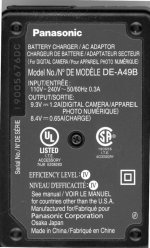 So is it safe to run my GH2 on a GH1 charger/power supply via DCC-8 ?
Last edited:
keylight
Veteran
And here it is...
And here it is...
Got my DMW-DCC8 today. Very cheaply made. No cutting required. It opened using my hands. Just popped apart. Sad that it took so long for Panasonic to mass produce these....
And it is pretty much what we thought. Just two contacts used.
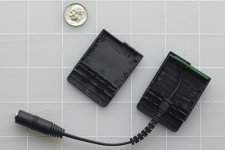
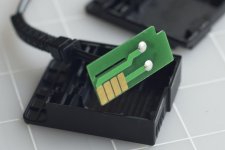
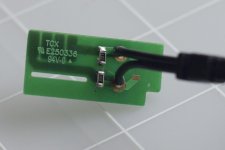
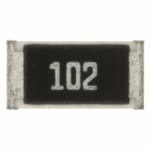
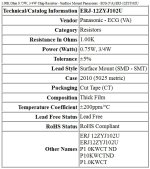
Looks like they are using these resistors:
http://uk.digikey.com/1/1/4481613-res-1-0k-ohm-3-4w-5-2010-smd-erj-12zyj102u.html
And here it is...
Got my DMW-DCC8 today. Very cheaply made. No cutting required. It opened using my hands. Just popped apart. Sad that it took so long for Panasonic to mass produce these....
And it is pretty much what we thought. Just two contacts used.
Looks like they are using these resistors:
http://uk.digikey.com/1/1/4481613-res-1-0k-ohm-3-4w-5-2010-smd-erj-12zyj102u.html
Last edited:
Interesting that they have a 2Kohm load on that board. Must need it for power supply stability or something.
I took the 10$ ebay battery I bought and disassembled and then gutted it. I removed everything off the PCB but a tantalum cap and reverse protection diode and soldered a lead/connector, just like that one in the pic, to the PCB and ran it out the bottom corner of the battery case.
It works great. I just hacked a small 5v switcher into a 8.5v output to use with it too.
g.l
Well-known member
To follow up my last post, I tried my 3m DC extension cable again @ 8.6V, and today it worked. But the 10m extension needed 9.05V (unloaded).
When measured, the extensions droop briefly during the intial power-up, but quickly stabilise (but the camera has already seen the dip and rejects it).
Electronics gurus, what is the cause? Resistance of the cable? (the 10m measures about 1.5ohm) And what's the correct way to address this? More voltage works (and I guess 9.05V is safe), but would (say) a larger output cap after the regulator work instead?
Last edited:
resistance yes, but might also be inductive/reactive. Since your power source is at one end of the cable and the load is at another end, the source sees a resistive and inductive path before having to charge the capacitors on the input of the camera while simultaneously needing to source all of the power the camera demands at once. This can cause a lag in time between where the camera demands a lot of power and where the switcher senses it's outputs drooping and increases output(propagation delay). Thicker wires can mitigate this when using long cables. Be careful though, long cables between the powersupply and unit can cause a condition where you get an inductive kick when making/breaking the circuit when it's under load(not turning off camera first, accidentally kicking out cord, etc). I would use the shorter DC cable and use a longer AC extension to the external supply.
g.l
Well-known member
resistance yes, but might also be inductive/reactive.
How could I measure this? I only have a multimeter, but I really should get a scope.
I see.Since your power source is at one end of the cable and the load is at another end, the source sees a resistive and inductive path before having to charge the capacitors on the input of the camera while simultaneously needing to source all of the power the camera demands at once.
This one worries me. I'm powering both cameras from the same regulator - it's a 3D setup (2 bodies), and both must be turned on at the same time, so that their clocks are reasonably in sync (required for frame sync, which is important in 3D). That only works if the cameras are already switched on before you power them, and they regularly need to be power cycled this way (as the clocks gradually drift).Be careful though, long cables between the powersupply and unit can cause a condition where you get an inductive kick when making/breaking the circuit when it's under load(not turning off camera first, accidentally kicking out cord, etc). I would use the shorter DC cable and use a longer AC extension to the external supply.
Usually both bodies are within 1 meter of each other, but for some very distant shots I need to separate them much more to heighten the depth effect. That's why I will occasionally use a 10m extension cable for one camera, and they have to be on the power line (after my regulator). So I really need to check on any inductive kick, and some way to mitigate if it's a problem. Any ideas? The TI regulator has a 'soft start' (slowly ramping voltage up), will this help mitigate the issue at powerup?
Actually thinking about it, this could presumably also affect the power-up timing of the camera on the extension, that could be bad.
Last edited:
The "softstart" function only works when the switching regulator is powering up, not the cameras. If you plug the cameras in first and then turn on the power to them, you should be OK. If the cameras are off before you unplug them I wouldn't worry.
The inductive kick should only be a major problem with fast plug/unplug situations. Using a snubber circuit, a TVS or simply a reverse biased zener(maybe 10v or so) should clip off the transients enough to not be a problem.
http://www.coilgun.info/theoryinductors/inductivekickback.htm
http://en.wikipedia.org/wiki/Inductive_kick