GH2 GH2 Power - specs, tests, DIY

keylight

Veteran
---------------------------------------------------------------------
UPDATE #2: I now use the incredible Tekkeon MP3450i R2.
Over 10 hours on a charge. More details in Post #201.
---------------------------------------------------------------------
UPDATE: In Post #152 guyburns put together a
GREAT summary of what we know as of 5/25/2011.

---------------------------------------------------------------------


​


There's a lot of information in various places on powering the GH2. I thought it might be useful to put links in one place. Hopefully this will help others in the future.

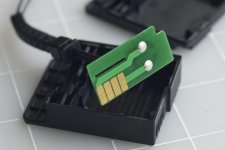
First, there's a DIY DC Adapter (DMW-DCC8). The original idea is from Tyampel. Another nice variation is from g.l., who also had some useful tips.
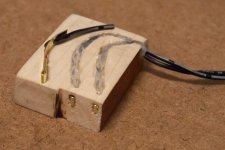
GH2 DIY dc adapter (2 of 5).jpg

UPDATE: And now we know what the inside of a Panasonic DMW-DCC8 looks like. Full post here
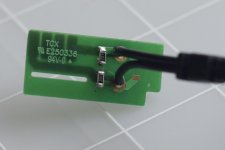
DMW-DCC8-board-back.jpg

DMW-DCC8-board-front.jpg

Then, there is the DIY DC Power Source. I made one of these and then ran it for 8 hours non-stop: Video Here
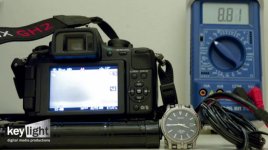
test.jpg

I used an 8.4v 4500mAh 7 cell Ni-MH flat battery for this test.

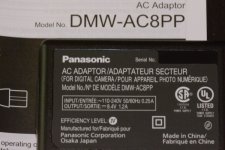
Below is a photo showing the bottom of the Panasonic AC Adapter (DMW-AC8PP). I metered the adapter and it runs at 8.79v. When I connect the Adapter to the camera via my DIY DC adapter, the voltage drops to 8.70. The Amperage is 740mA, even though the adapter says the output is 1.2A. See posts later in this tread for a discussion....

adapter_bottom.jpg

I've scanned the manual, but the site isn't allowing me to upload. Anyone know if there's a pdf file size limit (it's approximately 1.2MB)?


Last Edit changes: Added update to the top. Removed some quotes from later in this thread, as the link in the update summarizes everything best.
 
Last edited:
Thanks for collecting it all.

The one missing piece of the puzzle is what voltage the adapter actually outputs - could you test that?
 
Thanks for collecting it all.

The one missing piece of the puzzle is what voltage the adapter actually outputs - could you test that?

Good idea. The adapter meters 8.79v. When I connect the Adapter to camera via my custom DC adapter, the voltage drops to 8.70.

Edit: The Amperage is 740mA, even though the adapter says the output is 1.2A. This seems strange. And when I try to check the Amps with the Adapter hooked up to the camera, the camera shuts off (camera runs fine otherwise).
 
Last edited:
Great, this is the crucial bit. We now know that anything up to 8.8V at least is safe. Also interesting that it's rated for 1.2A.

I've suggested cheap 9V/1A adapters as suitable replacements. Looking at this all again:

- 9V is probably safe, but there's no way to be 100% sure (I will run my DC converter at around 8.6V).

Has anyone run the GH2 at 9V or higher for a long time?

- 1A is safe, but is it enough? The 1.2A rating may indicate that under exceptional circumstances the body needs a bit more juice (maybe only in tiny bursts). Or it's also possible that Panny is deliberately obfuscating so users don't look for common 9V 1A replacements.
 
Or it's also possible that Panny is deliberately obfuscating so users don't look for common 9V 1A replacements.

Here's an interesting note from Tyampel in another thread, which may help explain the 740mA output I got on the adapter....

Thanks for posting the picture of the adapter. It is interesting to note that it differs from the one for GH1. On the GH1 it says:

INPUT/ENTREE:

110v - 240v ~ 50/60 Hz 0.3A

OUTPUT/SORTIE:

9.3V = 1.2A (DIGITAL CAMERA/APPAREIL PHOTO NUMERIQUE)

8.4V = 0.65A (CHARGE).

Perhaps the ommission is deliberate to confuse the DIY people as I don't think the cameras differ in that regard.
 
We have a standard product called vDoubler which is used to power the HD monitors and other accessories. It outputs 12V up to 2A which is more than enough power to run the GH2; we could set the output voltage to 9.2V instead of 12V and add the right connector, so it will be like the DMW-AC8PP AC adapter from the camera point of view. This adapter plate would power the GH2 camera for many hours using a DV battery (either Pan, Sony, or Canon). The problem is we do not own the camera, so can not test the configuration. If somebody is interested to be a beta tester for us, please IM directly so we can discuss logistics.
 
Looks nice, but the price seems a bit high for a single output. The RC battery goes for about $40 and for another $5 in parts you can make a little adapter cable.

But it's something for people to keep in mind if they have a whole bunch of 7.2v batteries at their disposal. Thanks for posting it.

What would be really nice is if you came up with a solution that would allow you to plug multiple devices (that have different power requirements) into a single power source. Something like your adapter but with multiple switchable outputs (and a variety of adapter cables for different devices.

We have a standard product called vDoubler which is used to power the HD monitors and other accessories. It outputs 12V up to 2A which is more than enough power to run the GH2; we could set the output voltage to 9.2V instead of 12V and add the right connector, so it will be like the DMW-AC8PP AC adapter from the camera point of view. This adapter plate would power the GH2 camera for many hours using a DV battery (either Pan, Sony, or Canon). The problem is we do not own the camera, so can not test the configuration. If somebody is interested to be a beta tester for us, please IM directly so we can discuss logistics.
 
It isn't strange that the voltage changes 90mv. That's just loss through the output filtering of the adapter. It also is NOT strange that the unit only draws 740mA from a 1.2A source. All the specs you read are always spec'd at full load. What you see is what we call "floating voltage/current". Without the load, those numbers can be all over the place.

Generally, designers just overdesign power supplies to meet instantaneous demand, or simply because they can, have certain parts available, just copied a manufacturer's design or they might have even simply reused a design from something else.

It's no attempt to obfuscate anything, I can guarantee that.

I design battery chargers amongst other power devices at my day job and this is just business as usual.

EDIT:

OUTPUT/SORTIE:

9.3V = 1.2A (DIGITAL CAMERA/APPAREIL PHOTO NUMERIQUE)

8.4V = 0.65A (CHARGE).

That difference is due to the loading of the battery vs. the loading of the camera body. The battery, when fully depleted, needs to be charged with a constant current, at a certain rate (hence the different voltage and current), until around 10-25%(depending on the cells) of it's capacity and then constant voltage charged to withing a couple mV of it's full capacity.

Allowing the cells to be charged too quickly or with too much current can alter their chemistry and damage them, aside from making them dangerous.

Anyway, I took a peek inside the GH1 charger and it has a switcher to bring down the 120vac to around 10V and then a separate battery circuit. The camera taps off the ~10v circuit. So that's why you can get different powers for the battery and body.
 
Last edited:
On another note, I've been intrigued with all the fuss over second sourced batteries. I bought two ebay specials, which surprisingly claim to be LI-ion complete with protection circuitry and everything. I plan on taking one apart to see what's actually inside and if it actually is what it says it is. (I'll also use the body of it to make a DC adapter)

The second one I'll use if the first one is actually decent.

Once I get them, I'll post my findings and the link to the batteries if I think they are safe enough for use.
 
Just an FYI...the 9 volt power supply I tried that didn't work was listed at 1200mAh. New one coming in is the one from Amazon listed in one of the threads. I believe it's rated at 2 A. Soon as I get it I'll report back.

Mark

ps Thanks for collecting all this keylight!!
 
You beat me to it, Keylight. I was just about to start a new thread (written offline) when I saw this one. So I hope you don't mind me pasting here.


Voltage characteristics of GH2 when powered externally
I want to find out the voltage characteristics of the GH2 when powered from an external battery. There have been several threads devoted to this topic:

1. http://www.dvxuser.com/V6/showthread.php?243760-GH2-DIY-DMW-DCC8-(DC-adapter)
2. http://www.dvxuser.com/V6/showthread.php?245022-DMW-DCC8-9.3v-or-8.4v
3. http://www.dvxuser.com/V6/showthread.php?245497-8.4v-Battery-test-results-(timelapse)
4. http://www.dvxuser.com/V6/showthrea...one-NP-F975-Lithium-Ion-Battery-(7.2V-7600mAh)
5. http://www.dvxuser.com/V6/showthread.php?236137-Gh2-battery-a-joke&highlight=battery+joke

And one thread about 3rd-party batteries, which I have linked-to here because some people have suggested that 3rd party batteries won't work (and they appear to):

http://www.dvxuser.com/V6/showthread.php?242159-GH2-battery-13.99-on-Ebay

I hope that via this thread, with help from others (as I don't own a GH2 yet), that we can establish how the GH2 operates regarding voltage. This will enable users to purchase external power packs and know for certainty that they will work. Any input will be most appreciated.

Voltage required by internal electronics
The GH2 uses a 7.2 volt lithium-ion battery, consisting of two lithium-ion cells in series. Assuming there is nothing special about this particular lithium-ion battery, it will have a voltage range from 8.4 volts (fully charged) to about 6.6 volts, below which it does not have much capacity left, and below which it should not be discharged anyway.

The upper limit is definite, but I am unsure about the lower limit (some lithium-ion batteries are taken as low as 2.7 volts/cell). The lower limit is probably controlled by the camera. i.e. it will purposely switch off to protect the battery when the voltage is too low, and not because the electronics simply stop working.

It has been clearly shown (see Thread 3) that the voltage must be above 8.4 volts when the GH2 is powered via the DCC8 adaptor, otherwise it turns off. I want to determine why that happens and if it is possible to overcome that limitation, because it would be desirable to operate the GH2 from 6.6 volts to 8.4 volts to optimise the battery efficiency. For example:

• The GH2 could then be powered by an external, large-capacity, 7.2 volt lithium-ion battery. At present, this is not possible because of the 8.4 volt lower-limit constraint. To run the GH2 from an external lithium-ion battery requires at least a 3-cell battery (10.8 volts) and circuitry to convert that voltage to a lower voltage. In doing so, some of the battery power is wasted.

• Or you could use 6 NiMH cells, instead of 7 or 8 as users are doing now. Depending on the exact lower-voltage cutoff point, 6 cells may not discharge their full capacity, but would come close if the cutoff is 6.6 volts (guessed). Seven cells would allow 100% of their capacity to be used.​

As things stand, using 7 NiMH cells wastes a significant amount of the battery's capacity because the GH2 will turn off when the battery pack reaches 8.4 volts (1.2 volts per cell) – and NiMH cells still have a lot of capacity left at 1.2 volts. I have just tested an Eneloop 2000 mAh battery. I fully charged it, then measured its capacity down to 1.0 volts (2020 mAh), then charged it again. When I discharged it to 1.2 volts it provided only 1180 mAh, 53% (1080/2020) of the available capacity of the battery.

If a way can be found to power the GH2 from less than 8.4 volts (as is done by the original battery), users would then have a choice:

1. Use a 7.2 volt Lithium-ion battery at 100% efficiency;

2. Use an 8.4 volt (7-cell) NiMH pack at 100 % efficiency (presently ~50% efficiency);

3. Use a 7.2 volt (6-cell) NiMH pack at an unknown efficiency (it would cut off early).​

To be able to work out what the GH2 is doing to external power, and whether it is possible to bypass its interference with external power supplies, I need answers to the following questions. I'd like actual test results if possible.

Q1: Using the DCC8, will the GH2 turn ON and stay on if the voltage is less than 8.4 volts?

A simple way to perform this test is to use 6 x AAs in good condition that have been fully charged – but measure the voltage first to make sure it is less than 8.4 volts to start with. Using a regulated AC-DC power supply would be better, in which case set it to 7.2 volts.

The obvious answer to this question is "no", because it has already been established that the GH2 turns off below 8.4 volts. But that may not be the correct answer. There is a possibility that if the GH2 sees less than 8.4 volts at turn-on, it assumes a battery is in place and maybe it won't turn off.​


Q2: What is it about the original battery, and 3rd party batteries, that ensures the GH2 sees them as batteries? A thought experiment: buy a 3rd party battery, open the case and remove the chemistry, then run two wires from the terminals to an external battery: would the GH2 then work as if it was running from an internal battery?


Q3. What is the function of those two extra terminals on the original battery? Do they simply transmit capacity data to the GH2, or are they somehow involved in telling the GH2 that "Hey, we've got a battery here".


Q4. Do 3rd-party batteries have those two extra terminals, and are they connected to each other or to the other terminals? If so, I want to work out their "Thevenin equivalent circuit". That way I should be able to mimic their function, so that the "less than 8.4 volts turn-off" is not triggered when running from an external supply.

One way to find out what is connected to the terminals is to pull the battery apart (I've ordered a battery and charger from HK, and that's what I'll be doing when the battery arrives and I have finished testing it). But there is a non-destructive way, if you are keen to help. You'll need a digital voltmeter, a 1 kohm resistor, and a 3rd-party battery. Measure the open-circuit voltage between the 0V terminal and all the others (3 measurements); the same for the +ve terminal (3 measurements); and now repeat by putting the 1 kohm resistor between the same set of terminals (6 measurements) and measuring the voltage again. Then measure the voltage across the two extra terminals, with and without the resistor. Let me know those 14 measurements and I may be able to work out what's inside the battery. For each measurement, I have to know which terminal the meter's "ground" plug was connected to and whether the reading was positive or negative.​


Q5. Other than not providing capacity readout for the GH2, do 3rd-party batteries function identically to the original battery?


Q6: Instead of spending several hours making a fake DCC8, why don't experimenters simply buy an el-cheapo battery from HK for $15 (free postage) and replace the internals?


Q7. Does the DCC8 have the extra two terminals?


Q8. Are the power terminals of the DCC8 connected straight through, or are there components inside? To find out without pulling it apart, power up the DCC8 outside the camera, take the Thevenin measurements as described in Q4, and pass them on to me. I'll see what I can work out.


Looking forward to any replies in the hope of being able to extract maximum energy from external batteries. Feel free to gmail me at gdburns if you have any questions.
 
Last edited:
I have a nice source maybe someone can test out.
You can get very cheap LI-ion cells of different sizes, volts, and amps.
http://www.dealextreme.com/c/batteries-400?page=1&pagesize=52&pagesort=popularity
I awaiting a shipment of a few cells for my high powered LED lights. They come in protected and unprotected configurations so you cant overcharge or discharge.

Can anyone verify if this sounds safe to try with the batteries I do have?
TrustFire TR 18650 2500mAh 3.7V Batteries (2-Pack)
So its about 7.4V LI-ion that would be going into my GH2
The cells are small and slim so I think in the future, someone can make a battery grip with these very easily.

Hope this helps.

Dai-Lon
http://www.dailonweiss.com/
http://www.kristinaweiss.com/Magyar/
 
Just a thought for the "Wood" adaptor, has anyone thought of doing a plaster mold? Then casting the battery outta.... say hot glue gun rubber or something equivalent? I'm just looking round the house to see what I have available...
 
So its about 7.4V LI-ion that would be going into my GH2
The cells are small and slim so I think in the future, someone can make a battery grip with these very easily.

Unfortunately this won't work. Only official Panny batteries will work at 7.2V (2x3.6V) as they communicate with the body to ID themselves.

The only option is using AC adapter voltages of 8.5V-8.8V (known safe), or maybe 9V (probably safe). People have been using up to 10V, but I really would avoid pushing it that far.

Also note that rechargeable batteries usually put out more voltage when they're fully charged than they're rated for. The bundled Panny battery 7.2V battery actually outputs ~8.3V fully charged. So you need to take that into account too.
 
Hey Guy....don't know if this helps.....I have a home made adapter. With a radio shack 9v 1200mAh power supply the cam would not power up.....nothing, not even a warning. Measured 9.3 v at the adapter. If I connect the OEM battery to my home built adapter it flashes on and I get the "This battery can not be used". warning. That same battery will power up the cam if placed in the cam. Waiting on a power supply that others have used with success.

Here are some voltages on a twice charged brand new battery fresh off the charger..... the terminals from the inside to the outside of the battery are labeled +, T, D, and -. Pos lead on +, neg lead on - is 8.26v move neg lead to D it flashes 8.26v but then drops to 7.61v in about 5 seconds. neg lead to T 8.26v Neg lead on - pos lead on T is 0.00v move pos lead to D 0.062v Wish I had a resistor I could do more....

Mark
 
Hey Guy....don't know if this helps.....I have a home made adapter. With a radio shack 9v 1200mAh power supply the cam would not power up.....nothing, not even a warning. Measured 9.3 v at the adapter.

9.3V worked fine for me on two bodies. Are you sure you got the polarity right? And that the contacts were definitely in the right place?
 
Last edited:
Hey Guy....don't know if this helps.....I have a home made adapter. With a radio shack 9v 1200mAh power supply the cam would not power up.....nothing, not even a warning. Measured 9.3 v at the adapter. If I connect the OEM battery to my home built adapter it flashes on and I get the "This battery can not be used". warning. That same battery will power up the cam if placed in the cam. Waiting on a power supply that others have used with success.

Here are some voltages on a twice charged brand new battery fresh off the charger..... the terminals from the inside to the outside of the battery are labeled +, T, D, and -. Pos lead on +, neg lead on - is 8.26v move neg lead to D it flashes 8.26v but then drops to 7.61v in about 5 seconds. neg lead to T 8.26v Neg lead on - pos lead on T is 0.00v move pos lead to D 0.062v Wish I had a resistor I could do more....

Mark

Thanks for the voltages. I'll pull some circuit theory out of my old head and see if I can deduce anything about the internals.

As for the Radio Shack power supply not working: the important thing is not the voltage at no-load, but the voltage when loaded. I'm guessing here, but the GH2 could be doing this:

1. When the on-switch is pressed, the GH2 checks the voltage at its power terminals, before most of the electronics are turned on.

2. If it finds greater than 8.4 volts it thinks to itself: "Power adaptor" and sets a "power-adaptor flag" internally that switches off the camera if the voltage drops below 8.4 volts.

3. If it finds less than 8.4 volts, and the required signals on certain of the pins are present (signals that I'm trying to determine), it thinks to itself: "Battery", sets a "battery flag" internally, and this allows the camera to operate at lower voltages.

4. The GH2 then tries to fire up. If the "power adaptor flag" has been set and the voltage at anytime drops below 8.4 volts, the GH2 presents a message and then shuts off. If the "battery flag" has been set, the GH2 won't turn off till a much lower voltage, the value of which is not yet determined.​

In your case, the only reason I can think of that the camera just died is that when the GH2 tried to give you the message by turning on the screen, the voltage out of your supply dropped below the minimum required for the GH2 to even turn on.

I'll explain this a bit further. If the GH2 has a large inrush current when it is first turned on, you can expect a large voltage drop in the power supply (if it is not well-regulated) and further drops in the connecting leads and contacts. I don't know if the GH2 has a spike in current when turned on, but the two other digital cameras I own certainly do have: a Kodak DX3500 (2001 vintage) and a Nikon Coolpix 7600 (2005 vintage). I have just tested the Coolpix (2 AAs), and these are the current readings at turn on:

0-1 second: ~400 mA

1-4 seconds: 1000-1200 mA

4+ seconds: 750 mA.

That middle section (electronics and monitor turning on, lens being moved out ) is the killer for anything other than good-quality batteries or power supplies. My Eneloops can handle it, even when they are nearly exhausted, but my other rechargeables, well, if newly charged they may work for 10 or 20 turn-ons, but then the camera won't fire up. There's still plenty of life in the batteries, but the voltage drops so low during attempted turn-on, that the camera turns off.

You can test your power supply, but you'll need to attach it to something that draws about 10 Watts (about 1 Amp) and measure the voltage. If there is an electronics shop handy, buy yourself a 10 ohm, 5W resistor (about 50 cents). Just don't leave it on for more than about 10 seconds. Or jump up to a 10W version for about $2 and test all day long.
 
Back
Top