
Navigation
Install the app
How to install the app on iOS
Follow along with the video below to see how to install our site as a web app on your home screen.
Note: This feature may not be available in some browsers.
More options
You are using an out of date browser. It may not display this or other websites correctly.
You should upgrade or use an alternative browser.
You should upgrade or use an alternative browser.
GH1 Stereoscopic Rig Collaboration
- Thread starter David Cole
- Start date
David Cole
Well-known member
I'm seeing correlation with manual lenses - however - I don't need to check because I never get initial offset with manual lenses. I get massive offset approximately 25% of the time with M 4/3 lenses - and - there is no correlation to VSYNC. I'm working on a theory.... ISO gain and available light MIGHT be playing a role in the offset. I usually test in the dark, with only the light from the CRT illuminating the room. I THINK the offset problem is less prevalent when more light is available or the ISO is lower. This is a wild guess theory at the moment - I'll have to test to see if there is a shred of truth to it.
David Cole
Well-known member
Check this out.... I was shooting a stranded pilot whale rescue in the Florid Keys last Thursday with my GH1 rig when I was approached by John Landau (Producer, Avatar & Titanic) !! He asked a lot of great questions about stereo with the GH1. Specifically, he wondered if Panasonic knows what we're up to. He seems like a hell of a good guy and was genuinely interested in a hack camera that could produce quality results. He didn't want to trade me for two of his new Epics, however 


g.l
Well-known member
If it is light-related, then it might be the aperature.I'm working on a theory.... ISO gain and available light MIGHT be playing a role in the offset. I usually test in the dark, with only the light from the CRT illuminating the room. I THINK the offset problem is less prevalent when more light is available or the ISO is lower. This is a wild guess theory at the moment - I'll have to test to see if there is a shred of truth to it.
Check this out.... I was shooting a stranded pilot whale rescue in the Florid Keys last Thursday with my GH1 rig when I was approached by John Landau (Producer, Avatar & Titanic) !!
Nice
.andycorleone
Member
Hi, I'm building a 3d RIG very similar to the one here, but to make it work properly (Fully calibrated), I need a couple of XYZ PLate, I want something simlar to this:
http://www.3dfilmfactory.com/index.php?option=com_content&view=article&id=56&Itemid=79
I really apreciate if someone point me to an Alternative, Thanks
http://www.3dfilmfactory.com/index.php?option=com_content&view=article&id=56&Itemid=79
I really apreciate if someone point me to an Alternative, Thanks
g.l
Well-known member
Hi, I'm building a 3d RIG very similar to the one here, but to make it work properly (Fully calibrated), I need a couple of XYZ PLate, I want something simlar to this:
http://www.3dfilmfactory.com/index.php?option=com_content&view=article&id=56&Itemid=79
Interesting, I'm just finalising my side-by-side mount (pics and footage when I have it), and an adjustable plate like that would definitely be useful - far too expensive for me though.
If my alignments get too rough (and they don't seem that bad so far) I'll look into a DIY solution. But if anybody knows something cheaper, let us know.
g.l
Well-known member
GH2-3DD on the pr3Dator
GH2-3DD on the pr3Dator

The mount is based on a couple of chopped-up shelf runners. The camera platforms are on ball bearings and can smoothly adjust interaxial between ~14cm -> 50cm. The arms that hold the platforms can then slide out to give a maximum 80cm for super-hypers.
The shutter circuit is driven by a modifed generic remote (seen dangling), which feeds N-channel mosfets. 8-pin AVR-based timelapsing is also implemented.
Everything is powered by a single 6800mah 12V Lithium-ion battery (which will also drive my 50%-done stereo monitor, that's what the arm in the middle is for), which also serves as the power-cycler. The circuit regulator drops that down to ~9.1V (any less would fail with a 10m DC power extension, for super-super-hypers).
1st Quick Test Footage - watch in on Youtube in your preferred 3D mode and HD (1080p stutters like crazy here though :/ ).
GH2-3DD on the pr3Dator
Here's my GH2-3DD rig, mounted on my DIY'ed side-by-side mount, the pr3Dator:
The mount is based on a couple of chopped-up shelf runners. The camera platforms are on ball bearings and can smoothly adjust interaxial between ~14cm -> 50cm. The arms that hold the platforms can then slide out to give a maximum 80cm for super-hypers.
The shutter circuit is driven by a modifed generic remote (seen dangling), which feeds N-channel mosfets. 8-pin AVR-based timelapsing is also implemented.
Everything is powered by a single 6800mah 12V Lithium-ion battery (which will also drive my 50%-done stereo monitor, that's what the arm in the middle is for), which also serves as the power-cycler. The circuit regulator drops that down to ~9.1V (any less would fail with a 10m DC power extension, for super-super-hypers
).1st Quick Test Footage - watch in on Youtube in your preferred 3D mode and HD (1080p stutters like crazy here though :/ ).
Last edited:
David Cole
Well-known member
Nice rig! Can't wait to see footage! Think we should create a Stereoscopic GH1/2 Vimeo or YouTube group for footage?
g.l
Well-known member
Nice rig! Can't wait to see footage!
I've updated my last post with it (watch it on Youtube in 3D @ 1080p).
Last edited:
g.l
Well-known member
Think we should create a Stereoscopic GH1/2 Vimeo or YouTube group for footage?
Sure, YouTube is better so people can watch in full colour on a suitable display (it does various analgyph flavours and colours too). But the 1080p stutters and catch-up pauses suck - is it that bad for anyone else? It seems like Youtube can't actually deliver 1080p properly, seems almost pointless.
Is your footage on Youtube David? I can add it to my channel, or we can create a new account for it.
g.l
Well-known member
Keeping the settings on two cameras synchronized is an interesting exercise. I thought I had them all covered, but I just found that my 1st 3D timelapse (shot today) has a much smaller frame sizes on one cam. I use that body for general 2D shots and I'd set the JPG frame size to S for an Ebay pic. Of course it doesn't come up with RAWs (which I normally shoot), but I shot the lapse in JPG and didn't notice. Not a disaster, it's still 2400px wide .
BTW, Auto Whitebalance is working out great so far.
.BTW, Auto Whitebalance is working out great so far.
g.l
Well-known member
(watch out for tumbleweeds ...)
I just stumbled on a problem - variable ND filters may act like polarizers! I know they're made of polarizers, but if designed correctly, they don't have to act like them on the light entering them.
Simple test - hold the fader to an LCD monitor, and rotate it (the whole filter, not just the adjustment ring) - mine gradually blocks out the LCDs light, just like a normal linear polarizer. The problem is that if you mount them on two bodies for stereo, they won't be in exactly the same rotation - so incoming polarized light is filtered different on each body!
It doesn't matter for most scenes, but is a disaster on anything with reflections - water, glass, metal etc. My old Nuview 3D attachment had the same problem (I fixed it with a wave retarder so both views matched).
A fader wouldn't have to do this. The fading is done by 2 linear polarizers doing their thing - but if you make a fader with two circular polarizers (which are made of a linear polarizer layer and a wave retarder layer which effectively unpolarizes light), facing each other so both retarders are on the outside, the problem would be solved - incoming light is unpolarized, then faded, then unpolarized again - ie. the fader does NOT act like a polarizer!
So the commercial ones seem to be circular at the back (for camera metering compatiblity) and linear at the front, that's the problem.
If you have one, check yours against an LCD.
I just stumbled on a problem - variable ND filters may act like polarizers! I know they're made of polarizers, but if designed correctly, they don't have to act like them on the light entering them.
Simple test - hold the fader to an LCD monitor, and rotate it (the whole filter, not just the adjustment ring) - mine gradually blocks out the LCDs light, just like a normal linear polarizer. The problem is that if you mount them on two bodies for stereo, they won't be in exactly the same rotation - so incoming polarized light is filtered different on each body!
It doesn't matter for most scenes, but is a disaster on anything with reflections - water, glass, metal etc. My old Nuview 3D attachment had the same problem (I fixed it with a wave retarder so both views matched).
A fader wouldn't have to do this. The fading is done by 2 linear polarizers doing their thing - but if you make a fader with two circular polarizers (which are made of a linear polarizer layer and a wave retarder layer which effectively unpolarizes light), facing each other so both retarders are on the outside, the problem would be solved - incoming light is unpolarized, then faded, then unpolarized again - ie. the fader does NOT act like a polarizer!
So the commercial ones seem to be circular at the back (for camera metering compatiblity) and linear at the front, that's the problem.
If you have one, check yours against an LCD.
Last edited:
g.l
Well-known member
I just stumbled on a problem - variable ND filters may act like polarizers!
I've create this thread about the issue, check it out.
I just stumbled on a problem - variable ND filters may act like polarizers!
I have another, but related question regarding half-mirror setups. Polarised light (from some objects/surfaces) approaches half-glass angled by 45o. Can it happen that incoming light can change its "split-ratio" (let's say from 50:50 to some other ratio) for polarised part of the light? I noticed that even though surrounding (houses, trees) was approx. of the same brightness, the sky was noticeably brighter on one picture than on the other. Anybody noticed it?
g.l
Well-known member
Can it happen that incoming light can change its "split-ratio" (let's say from 50:50 to some other ratio) for polarised part of the light? I noticed that even though surrounding (houses, trees) was approx. of the same brightness, the sky was noticeably brighter on one picture than on the other. Anybody noticed it?
Well, mirrors rotate polarized light by 90 degrees, and people often say that this a a big problem with beamsplitters... except I can't think why, because the light isn't getting filtered anywhere.
except I can't think why, because the light isn't getting filtered anywhere.
Most of the light coming to the cameras is un-polarised. However, part of the light is polarised, for example scattered light from the sky, reflections from horizontal surfaces, etc. Since half-mirror glass is placed at 45o angle, it might additionally polarise part of the light which is already polarised. Therefore, such light can be attenuated. Since the cameras had different picture of the sky, while other subjects were equally bright, I suppose that this is true. Therefore it might be a problem when using "beam splitters".
g.l
Well-known member
Most of the light coming to the cameras is un-polarised. However, part of the light is polarised, for example scattered light from the sky, reflections from horizontal surfaces, etc.
Sure I know, I've had polarization problems with my old Nuview 3D attachment, which had a design flaw that rotated incoming polarized light 90 degrees in one view only. It was a disaster on shots of the sea I took at the time, one view would have tons of water reflections and the other almost none. One solution (and one I've heard people mention in regard to beamsplitters) is to install a quarter-wave retarder at the front. That will change any linearly polarized light to circular, which may avoid the issue. It did something similar on my Nuview (half-wave retarder to rotate one view to match the other).
Since half-mirror glass is placed at 45o angle, it might additionally polarise part of the light which is already polarised. Therefore, such light can be attenuated.
Interesting, so it is in effect acting like a filter.
David Cole
Well-known member
Darkride - GH1 3D Nightvision Rig
Darkride - GH1 3D Nightvision Rig
Gents... this is my latest rig, a wearable beamsplitter for infrared shooting. Darkride uses 2 modified GH1s with custom beamsplitter glass and IR lighting to shoot in total darkness. It was a LOT of work - but - it really performs. It's jobbed out on a ghost show and a nature show at the moment. As soon as I can clear some footage for rights, I'll post samples.
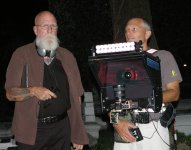
Darkride - GH1 3D Nightvision Rig
Gents... this is my latest rig, a wearable beamsplitter for infrared shooting. Darkride uses 2 modified GH1s with custom beamsplitter glass and IR lighting to shoot in total darkness. It was a LOT of work - but - it really performs. It's jobbed out on a ghost show and a nature show at the moment. As soon as I can clear some footage for rights, I'll post samples.
g.l
Well-known member
Gents... this is my latest rig, a wearable beamsplitter for infrared shooting. Darkride uses 2 modified GH1s with custom beamsplitter glass and IR lighting to shoot in total darkness. It was a LOT of work - but - it really performs. It's jobbed out on a ghost show and a nature show at the moment. As soon as I can clear some footage for rights, I'll post samples.
Looks great, really looking forward to IR 3D samples. So it's attached to some kind of belt? How heavy is it to wear?