External vs. Camera

odonnelly99

Active member
Can anyone explain to me the actual technical reasons why recording to an external recorder is considered better than recording in camera?


Thanks!
 
The two main reasons are: A) most external recorders record at 24 bit while camera audio is 16 , and B) Really good external recorders may have better preamps than a camcorder.

While external recorders are all the rage, fact is, you can record great audio with most XLR in camcorders. It does improve the S/N ratio if you use an external mixer, but the audio circuitry in camcorders designed for broadcast is just fine. If you don't believe it, ask the network news guys. The spec obsessed will disagree, but that's OK.
 
In any camera, the audio section is secondary to the video. Dedicated audio gear obviously doesn't have this problem.

External audio gear lets the sound person / people control the audio recording during a shot. You don't want someone screwing around with buttons on the camera while the camera guy is trying to get the shot.
 
Gotcha. Thanks guys. The reason I ask is that when I was talking with the sound crew for an upcoming film I'm working on, I realized that while its been hammered into me that external is better quality, I didn't really know why.
 
As Jordan and MainStreet mentioned, the odds are that you will get much better quality - provided of course that you use quality external audio gear.

You get higher bit/sample rates (some as high as 24bit/192kHz; I don't know any cameras that can compete with that), you get better monitoring options, better pre-amps, better access to the controls, better limiters, and you are not tethered to the camera. You can also get multiple audio channels (up to 16 with the Zaxcom Deva).

Up until 10 or 15 years ago or so that was the way it was always done - and still is when you work with film.

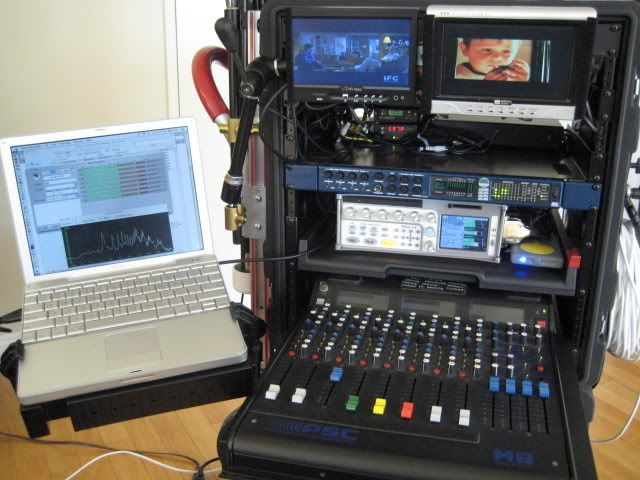
IMG_0818.jpg


IMG_0881.jpg


No, they're not mine...
 
It is true that really good external mixers, recorders, etc. may have better mic preamps than the camcorder, but the average to low-end mixers, recorders, etc. have mic preamps that are no better than the camcorder's mic preamps. External recorders don't necessarily record at 24 bit, and in noisy locations it is dubious whether 24 bit is of significant value.

You DO NOT get "better signal to noise" simply by using an external mixer and feeding the output into the camcorder input. All camcorders in use today simply throw an attenuator pad in front of the mic preamp to accommodate line-level signals (such as out of an external mixer). Because you are still going through the camcorder's mic preamp, you are actually ADDING the noise from the camcorder preamp to the noise from the external mixer.

I know those statements are contrary to "indy lore" around here, but the truth hurts sometimes.

There are no video cameras of ANY price-level that have exemplary audio sections. They are all added on as an after-thought or a marketing gimmic. The higher-end cameras (that could afford to have good audio sections) assume that you are recording double-system if you are using a camera that expensive. And at the other end, many cameras like DSLRs that people are using for shooting video these days have audio sections that are barely adequate for recording a "scratch" or reference audio track.

Of course the original reason for doing "double system" sound was that most film cameras simply did not (and many still do not) record sound at all.
 
Regarding S/N ratio, all I know is with my HVX, when I used an SD Mixpre instead of going straight in, there was a noticeable , though slight, improvement in background hiss level. But to me, not enough difference to justify using it every single time I shot a scene on "Class of 91".
As far as no video cameras having exemplary audio sections, well, all portable broadcast television cameras have similar audio capabilities, and they are used to shoot some pretty important people and programming, and I think the audio sounds great. The notion that sound must be recorded apart from video is simply film tradition, not necessity.
One thing I will agree on is that DSLR video needs the audio recorded separately, if you are serious about what you are doing.
 
You DO NOT get "better signal to noise" simply by using an external mixer and feeding the output into the camcorder input. All camcorders in use today simply throw an attenuator pad in front of the mic preamp to accommodate line-level signals (such as out of an external mixer). Because you are still going through the camcorder's mic preamp, you are actually ADDING the noise from the camcorder preamp to the noise from the external mixer.

If I'm understanding correctly, you're saying that even though I'm feeding external mixer output direct to the camera's line in jack, I'm still going thru the cameras preamps, thus achieving an additive noise level ? Is this true of all digital cameras ?

How about line in to say a H4n or Fostex, Marantz, etc??
 
Gotcha. Thanks guys. The reason I ask is that when I was talking with the sound crew for an upcoming film I'm working on, I realized that while its been hammered into me that external is better quality, I didn't really know why.
I have usually been very satisfied with the audio on my camcorders, provided I bypass the internal camera microphone and use external microphones plugged into the camera (with an XLR adapter). The only time I have used an external recorder was for backup. I am not saying you shouldn’t use an external recorder, but as long as the microphones are properly placed, the camera should capture good audio, IMO.
 
If I'm understanding correctly, you're saying that even though I'm feeding external mixer output direct to the camera's line in jack, I'm still going thru the cameras preamps, thus achieving an additive noise level ? Is this true of all digital cameras ?

How about line in to say a H4n or Fostex, Marantz, etc??

Yes it is true for probably every video camcorder, analog or digital, running today. I cannot think of ANY camcorders that have true line-level inputs. Now some have extra switching to reduce the gain of the mic preamp when used as a line-level input, but you are STILL going through that mic preamp circuit.

Dunno about the little recorders, but the lower price they are, the more likely they simply have pads vs. genuine line inputs.
 
As far as no video cameras having exemplary audio sections, well, all portable broadcast television cameras have similar audio capabilities, and they are used to shoot some pretty important people and programming, and I think the audio sounds great. The notion that sound must be recorded apart from video is simply film tradition, not necessity.
One thing I will agree on is that DSLR video needs the audio recorded separately, if you are serious about what you are doing.

Broadcast camcorders that cost many 10s of thousands of $$$ still have switchable pads to create "line-level" inputs. And the mic preamp circuits themselves are rather ordinary and bear no resemblance to the high-quality mic preamps that audio people crave. Of course that is not to say that they don't perform reasonably well. But "Broadcast Quality" doesn't mean what it used to.
 
...
Dunno about the little recorders, but the lower price they are, the more likely they simply have pads vs. genuine line inputs.

And though the indy and event community is currently enamored with the Zoom H4n and similar recorders, I just can't comprehend how anyone could imagine these $300 or so devices could have anywhere near the same level of quality in their preamps and other circuitry as one finds in a single system rig with decent mics and a proper mixer like an SD 302 or 442/552 upstream from the camera, even when the mixer is mated to a prosumer camera. I'm not denying the consumer compact recorders might not have a place in production but I can't imagine considering using them for even a moment as the primary recorder for serious production sound.
 
They're not suppose to be on the same league as the more expensive professional recorders, but I use it occassionally for the projects and gigs that call for it. Sometimes you just have to bite it and use what you have or can afford at the time. Don't be blinded or persuaded by gear snobberism (opening a can of worms), but make the most out of the tools around you. It gives you new challenges to work with.

Just today, I was on a documentary shoot that involved two Flip cameras side by side for the 3D process. Don't get me wrong, but aren't these like $300 each? Heck, I had the heaviest rig in the entire crew. I was thinking, "Man, 5 years from now, we'll have 8 channels of wireless, mixer, and recorder all in a small hanheld device." My main recorder for the day was the Zoom H4 because the budget calls for a cheapo backup.
 
They're not suppose to be on the same league as the more expensive professional recorders, but I use it occassionally for the projects and gigs that call for it. Sometimes you just have to bite it and use what you have or can afford at the time. Don't be blinded or persuaded by gear snobberism (opening a can of worms), but make the most out of the tools around you. It gives you new challenges to work with.
It's not gear snob'ism - it's a matter of what level of quality - actual tangible differences in performance - is required in order to deliver a fully professional, no visible-or-audible compromise from the audience's perspective, result. If you can't afford adequate tools such as are required to do the job in a fully professional manner, you don't just live with it, you figure out how to gear up properly before undertaking the project. If you can't afford it, sell your car and mortgage your house. It's all about the audience and their perceptions. Remember, they have been steeped for years in the best of the best and your production is inevitably going to be compared to the market that has been established by years of exposure to the studios and broadcast networks offerings. Your dramatic video is going to judged against "CSI," your interviews against "Oprah," your standups against "60 Minutes," and your theatrical story against "Hurtlocker" in their eyes. This is just as true for the corporate market as well as it is for shows hoping for distribution to the public. For your story to be accepted beyond perhaps a fan or cult audience or for your corporate video to have credibility in the eyes of its audience, the audience can't be allowed to perceive any difference from a techncal standpoint between those shows and yours. Amateurish sound (or picture) is never acceptable except as a learning exercise never shown to an audience. You don't have to spend millions but when you go public you're entering a NASCAR race and you don't do that driving a Yugo.
 
Last edited:
Broadcast camcorders that cost many 10s of thousands of $$$ still have switchable pads to create "line-level" inputs. And the mic preamp circuits themselves are rather ordinary and bear no resemblance to the high-quality mic preamps that audio people crave. Of course that is not to say that they don't perform reasonably well. But "Broadcast Quality" doesn't mean what it used to.

Just imagine what a corner on the market a mfr would have if they put a few hundred bucks of real audio capability into a camcorder, making the whole discussion unnecessary. Say an HPX170 with 24 bit audio , first class preamps, and the mixing/monitoring capabilities of a Mixpre built in. One can dream.
 
It's not gear snob'ism - it's a matter of what level of quality - actual tangible differences in performance - is required in order to deliver a fully professional, no visible-or-audible compromise from the audience's perspective, result. If you can't afford adequate tools such as are required to do the job in a fully professional manner, you don't just live with it, you figure out how to gear up properly before undertaking the project. If you can't afford it, sell your car and mortgage your house. It's all about the audience and their perceptions. Remember, they have been steeped for years in the best of the best and your production is inevitably going to be compared to the market that has been established by years of exposure to the studios and broadcast networks offerings. Your dramatic video is going to judged against "CSI," your interviews against "Oprah," your standups against "60 Minutes," and your theatrical story against "Hurtlocker" in their eyes. This is just as true for the corporate market as well as it is for shows hoping for distribution to the public. For your story to be accepted beyond perhaps a fan or cult audience or for your corporate video to have credibility in the eyes of its audience, the audience can't be allowed to perceive any difference from a techncal standpoint between those shows and yours. Amateurish sound (or picture) is never acceptable except as a learning exercise never shown to an audience. You don't have to spend millions but when you go public you're entering a NASCAR race and you don't do that driving a Yugo.

This I get as well. Always to have the most rugged piece of gear to handle the harshest environments being thrown at you.

Thus my example was both equal in performance in terms of visuals and audio. Two Fliips and a H4 for recording. But I had my Schoeps, Sound Devices to drive it through before it gets printed. I can tell just a bit of difference between the H4 and my SD recorders, but it's not a concern in terms of audio for the given circumstances. I wanted to use my Schoeps because it was one of the smallest mics I have and can pick up very adequate dialogue at even a distance of 6-8'. I needed better preamps so I brought out the SoundDevices. we needed a simple backup recorder for the visuals so it was the H4. They could have used an Ipod/Iphone.

Your analogy with NASCAR is spot on, but this wasn't a NASCAR nor a Yugo. More like a tricycle.
 
It would be interesting to hand an H4n to a recording engineer working back in the 60's or 70's and see if they would have the same disdain that so many have for it today.

Back to the original question, regardless of equipment, the main reason I want external audio is so I can have one person, solely focused on capturing the sound. I want this person to understand that their job is as important, if not more so, than the camera op. What they hear is as critical as what the camera sees.

However, for a lot of people, just having the camera op glance periodically at the on-camera meters is good enough. IMHO, they get exactly the sound that they deserve. - Tim
 
It would be interesting to hand an H4n to a recording engineer working back in the 60's or 70's and see if they would have the same disdain that so many have for it today.

...- Tim

It's not a matter of holding it in disdain - it's a great tool for certain purposes. But looking at 2 mini 4-channel recorders that can fit in the talent's pocket, a Sonosax MiniR82 and a Zoom H4n, one can't escape the feeling that there has to be SOMETHING translatable into bottom-line results that accounts for the $5000 price differential beyond just the Sonosax name. Likewise something accounts for the $4000 price difference between the Zoom and an industry standard EFP/ENG recorder such as the Sound Devices SD744t. If that were not the case, the ruthless bean counters at the studios and networks would insist producers not use any of the more expense gear.
 
It's not a matter of holding it in disdain - it's a great tool for certain purposes. ...
Yugos vs Nascar certainly sounds like disdain to me. A more apt analogy would be a V-8 Vega (or something similarly tricked out, amazing in one or two performance metrics, but sereiously lacking in others.

As for the "SOMETHING," there's no doubt in my mind that, under the right circumstances, an audience might notice some of the artifacts that represent the delta between the H4n and serious gear. How many of the things you and I capture sound for regularly are going to fall into that category? If the answer is "all of my suff appears in theatrical release, played on a properly adjusted, top-notch system, and mixed in a manner in which dialog doesn't seem like an afterthought" (that last part disqualifies quite a few theatrical releases I've seen), then you absolutely want to avoid a situation where your gear is the weakest link in the chain.

As for me, the number of times I've captured sound and an H4n was the weak link is... once or twice. The difference is there, and it's definitely measurable. However, I'd love to see the sound guy who could sit in the theater and confidently say, "Did you hear how the voices sound? They must have used a cheap location recorder because the noise floor is much higher than it ought to be. And man, those preamps just suck!" You're more likely to notice that I didn't boom it well, that I didn't shut off the fridge, or a thousand other things that typically stand in my way of getting good location audio.

If the audience can't hear it, then we get down to whether or not a given device has the features necessary for the task. This is where, IMHO, the H4n falls off, because you're limited to two XLR inputs (or an external box), a funky UI, and handful of other features that you'll find on even midrange location gear.

I hear what you're saying, and I'm all for pushing the quality level as high as possible, but I think in many ways we've become spoiled by how good even low-end gear really is, in terms of performance. From a raw performance standpoint, the H4n compares favorably against pro gear of 25 years ago, and how many people would, even today, watch some of those films and complain about the sound quality? - Tim
 
Back
Top