
Lee Wilson
Veteran

This would not work either.
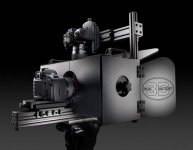
The images from the cameras have a differing point of view. Their overlap areas will not hold the same image as the point of view differs.
ie: the bottom section of camera 2 (the area that overlaps with the other cameras F.O.V) and the top section of camera 4 (the area that overlaps with the other cameras F.O.V) will not contain the same image.
You only need raise or lower your head by a tiny amount (let's say the height of a DSLR) to see that nothing in the scene you are looking at remains stationary in respect to anything else.
Look at it like this . . . . .
If we place two objects in the field of view (object A and object B).
We can see that object B is completely obscured by object A when viewed from camera 4 (the red line-of-sight lines).
While the top third of object B is visible when viewed from camera 2 (the blue line-of-sight lines).
So in this respect camera 2 and camera 4 will render differing images of the scene, even in the 'overlap area'.

Last edited:


 )
 I actually wasn't proposing it for HDR.