DVX Geniuses UNITE! 3K video solution. Less than 3K?

82739913.jpg


This would not work either.

The images from the cameras have a differing point of view. Their overlap areas will not hold the same image as the point of view differs.

ie: the bottom section of camera 2 (the area that overlaps with the other cameras F.O.V) and the top section of camera 4 (the area that overlaps with the other cameras F.O.V) will not contain the same image.

You only need raise or lower your head by a tiny amount (let's say the height of a DSLR) to see that nothing in the scene you are looking at remains stationary in respect to anything else.


Look at it like this . . . . .

If we place two objects in the field of view (object A and object B).

We can see that object B is completely obscured by object A when viewed from camera 4 (the red line-of-sight lines).

While the top third of object B is visible when viewed from camera 2 (the blue line-of-sight lines).

So in this respect camera 2 and camera 4 will render differing images of the scene, even in the 'overlap area'.


beam.jpg
 
Last edited:
Interesting idea. I read the Nikon D7000 has a shutter tested to 150,000 actuations. So if you can shoot 6 fps for 100 frames, you would be able to shoot around 1,500 different shots before you were in the danger zone of having a camera shutter fail. Several years ago when people first started using DSLRs for animation, they considered the bodies to be part of a projects "consumables" because of shutter failure.
 
vimeo video

vimeo video

Hi Grench. Are you saying that you asked HIM (the creator of the HDR video on VIMEO) this question? Cool!

Here is the DVXUser link where I saw the video.

http://www.dvxuser.com/V6/showthread.php?p=2101576#post2101576

I thought the guy who started this thread actually created the HDR video. After checking back I see it was a guy by the name of Soviet Montage. I asked him the same question. But I don't expect a reply due to the fact that over a hundred question on his Vimeo page have gone unanswered including a question from Phillip Bloom. Looks like this will be a project based on trial and error :)

http://vimeo.com/14821961


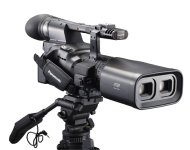
I was thinking that panasonic might have the right idea. It would be very cool if they updated this camera with an additional HDR Mode allowing for a user to shift the mirrors from 3D mode to HDR with optimal HDR settings with at least 1080p resolution and a SDI 10 bit outputs. Heavy order I know. But I would think based on the vimeo footage that at least a stand alone HDR camera could be made.
 

Attachments

  • 00399_panasonic-3d-camcorder.jpg
    00399_panasonic-3d-camcorder.jpg
    50.7 KB · Views: 0
Last edited:
I was thinking that panasonic might have the right idea. It would be very cool if they updated this camera with an additional HDR Mode allowing for a user to shift the mirrors from 3D mode to HDR with optimal HDR settings with at least 1080p resolution and a SDI 10 bit outputs. Heavy order I know. But I would think based on the vimeo footage that at least a stand alone HDR camera could be made.


I know I am starting to sound like a stuck record . . . . :)

. . . but, the requirements for 3D and HDR are different - 3D requires a fixed horizontal translation or offset - HDR requires two images shot from identical view points.

It doesn't really matter how Panasonic shifts the 'mirrors' (assuming a prism is not used) it won't give you the basis for a HDR image as the two lenses are clearly offset.

Buy yourself a cheap plastic EL mount 3D lens and play around with it for yourself to see why it would be little use for HDR, I have a couple that are just gathering dust and might take one apart to show you what I mean.
 
The would not work, you need a horizontal translation, rather than a rotation.

Imagine this:

. . . if your two eyes where in the same spot (impossible - I know but bear with me !) then you would have mono-vision . . . . if you were then to translate one eye horizontally you would get stereo vision . . . but if you were to rotate one eye you would still have mono-vision but with mis-registered images.

I know I am starting to sound like a stuck record . . . . :)

. . . but, the requirements for 3D and HDR are different - 3D requires a fixed horizontal translation or offset - HDR requires two images shot from identical view points.

Hi Lee. Thanks for your comments and for taking time to think about this. Do me a quick favor and watch this. I understand what you are saying. I there are two problems. One: I have explained this *in depth* in other parts of the forum, and have abbreviated the description here...so that's my fault. :) Sorry. Two: You haven't had the opportunity to see that this solution is already proven and already in use all over the world. Here is one example: http://www.youtube.com/watch?v=IX7ybS7fnow

OK. Do you see HOW it is providing THE SAME methodology for creating the TWO PERSPECTIVES? You just slide the camera apart...or together. It is EXACTLY the same as many other 3d approaches. 2 cameras...sliding together or apart...etc. (I know the lens that Panny has doesn't slide together or apart...btw that makes it LESS flexible as this solution. So...YES...it will work. And it DOES work. People are already doing this for 3d. Here is Red Camera using this solution for 3d. (It works for them too.) http://www.reduser.net/forum/showpos...91&postcount=1


For HDR. It has ALSO ALREADY BEEN DONE. These cameras (using a beam splitter) CAN have the EXACT same FOV, focal length, focus point, etc, etc (instead of off setting it)...by aligning the two cameras you can now shoot one +3, one -3, then process in post. Here is an example of that: (this is footy) http://vimeo.com/14821961

I KNOW that you are saying that they have different requirements...one should be aligned...the other SHOULD BE OFFSET. That is true. What you didn't understand is the MECHANISM OF A BEAM SPLITTER INCLUDES A SLIDER TO OFF SET IT.

If you have watched the video with the beam splitter being used for 3D, (on youtube), we are on the same page about this. Right? (ps...mine has the exact same mechanism it's just smaller) If you're still not sure after seeing the video, I'll set mine for 3d, then I'll take pictures so you can see the offset.

THANK YOU FOR YOUR QUESTIONS!! If you have these questions...likely other people do too. The only reason I am SO POSITIVE that a beam splitter can be used for 3d....is because it ALREADY IS BEING USED. :) Good question Lee. Let me know if you have more. I'm going to do another post to discuss 3K/24P with stills. OK? (That one will take a very long explanation.)
 
?

?

I know I am starting to sound like a stuck record . . . . :)

. . . but, the requirements for 3D and HDR are different - 3D requires a fixed horizontal translation or offset - HDR requires two images shot from identical view points.

It doesn't really matter how Panasonic shifts the 'mirrors' (assuming a prism is not used) it won't give you the basis for a HDR image as the two lenses are clearly offset.

Buy yourself a cheap plastic EL mount 3D lens and play around with it for yourself to see why it would be little use for HDR, I have a couple that are just gathering dust and might take one apart to show you what I mean.

That would be awesome. :2vrolijk_08:

But tell me Lee based on the link I provided above from the guy who created that HDR video he clearly made use of 2 Canon 5D Mark II cameras.
The images look to have been matched up perfectly. How would a person achieve that? I can see how it woulds have been possible on the wide city shots, but on the shot of the man on the roof how would a person pull that off? If indead the cameras were placed side by side I would believe that using the technique I posted would yield even better results do to the closeness of the 2 lenses. The center point of the lens on 2 5D Mark II s are spread alot further apart than the optical view on the Panasonic 3d camera I would believe.

But don't get me wrong I'm not married to this idea. I'm just curious to know how he got such a dead on image with 2 5D Mark IIs on that shot.
 
Last edited:
This would not work either.

The images from the cameras have a differing point of view. Their overlap areas will not hold the same image as the point of view differs.

ie: the bottom section of camera 2 (the area that overlaps with the other cameras F.O.V) and the top section of camera 4 (the area that overlaps with the other cameras F.O.V) will not contain the same image.

You only need raise or lower your head by a tiny amount (let's say the height of a DSLR) to see that nothing in the scene you are looking at remains stationary in respect to anything else.


Look at it like this . . . . .

If we place two objects in the field of view (object A and object B).

We can see that object B is completely obscured by object A when viewed from camera 4 (the red line-of-sight lines).

While the top third of object B is visible when viewed from camera 2 (the blue line-of-sight lines).

So in this respect camera 2 and camera 4 will render differing images of the scene, even in the 'overlap area'.

Thank you again Lee. I appreciate you taking the time to think about this and write a response. Before I posted my other stuff, I thought about this aspect of the solution. The easiest way to describe this problem (for me it REALLY stood out when I thought of this): What if we wanted to do a "macro" or "super-close-up" shot? It would NOT work. TRUE. The distinct points of view, as you have described here will make it "unusable". Each frame would "shift" to a different point of view. I noticed this in the Barry Bonds video. There are slight shifts in the perspective in the background. Good point. Then why even post? Here's why.

So...we just described that the shot that shows this solution in its WORST light is a Macro. So...let's go the opposite direction now: What about a distant-wide angle shot? The further away the perspective...the less our off-set matters. The real question is: how much off-set can we get away with? (Until we are able to use just two cameras with a beam-splitter as camera tech improves) I see that, you see, that the two cameras on a beam splitter will work GREAT (cameras 1, 3). (12FPS for certain on the D7000...12 more to go!) :)

OK...so that IS the question. how much off-set (cameras 2 and 4 in the diagram) can we get away with. OR...how wide do we have to shoot before that offset isn't apparent. I KNOW that these are TWO different questions....but the bottom line is that they lead us to the same final outcome: Can you use ANYTHING EXCEPT a beam splitter (with identical perspectives), on ANY shot?

The reason why this is ~particularly~ important in this discussion is that I know of two other approaches that would be better in some respects and not as good in others....but they both REQUIRE slight offsets. One method is basically using 'periscoping'. You'd lose lots of light that way...and there would still be offset....but *MUCH, MUCH* less off set. I wonder how much we can get away with (if any). The other is by using this same method. But we use Red Cameras orientation, along with my orientation. What this does, is it gives you two beam splitters with one on top, and the other on bottom (up-side down). You will STILL have off-set of two cameras. ...so back to the question: how much can we get away with...if any.

Here's what's next: Testing. Time to set up two cameras with wide shots, stacked together...shoot frames (much less than 24)...and see what we can get away with.

Thank you again Lee. I will post pics of the two beam-splitters upside down, just to show visually what I mean.
 
Last edited:
Wow HHL, That looks like a winner!

Have you seen the mini DSLR version of the 3d rig? Really sick! Now getting back to the topic of this thread. I believe this is exactly what the doctor ordered.

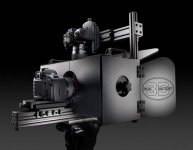
Yes...whoever thought of it is BRILLIANT. I just figured out how to make one for 50 bucks. It will need improvements, but...it works. I already know what to do to make it better and more configurable. I'll need to order some parts, and it will need a little time (for the improved version)...but, it's not a real threat. (I'm certain I can get this to work).

My mind is working with the "3K STILLS 24P" concept. (I just named it...there...it's official.) :)

I'll post another image that brings this EVEN CLOSER TOGETHER.
 
Hi Lee. Thanks for your comments and for taking time to think about this. Do me a quick favor and watch this. I understand what you are saying. I there are two problems. One: I have explained this *in depth* in other parts of the forum, and have abbreviated the description here...so that's my fault. :) Sorry. Two: You haven't had the opportunity to see that this solution is already proven and already in use all over the world. Here is one example: http://www.youtube.com/watch?v=IX7ybS7fnow

That video shows two cameras with an offset (through a beam splitter - although the beam splitter has no effect on the offset).

That is the very point I am making, for 3D the lenses must be offset. For HDR they must record an identical field of view.

For HDR. It has ALSO ALREADY BEEN DONE. These cameras (using a beam splitter) CAN have the EXACT same FOV, focal length, focus point, etc, etc (instead of off setting it)...


My point is that your three cameras stacked above each other (+ a 4th camera) will not work for HDR imaging as the cameras will produce
images with an offset field of view.
 
Wow HHL, That looks like a winner!

Have you seen the mini DSLR version of the 3d rig? Really sick! Now getting back to the topic of this thread. I believe this is exactly what the doctor ordered.

Just to make sure you saw it Grench. Here's the link for my $50 beam splitter. http://www.dvxuser.com/V6/showpost.php?p=2100486&postcount=26

Yes...it can be used for HDR and 3D. No...it hasn't been refined. Yes...I'd love for you to join the party and lead the way. :) "Go Grench! Go Grench! Go Grench! It's your birthday!" :)

Me begging here:
Supposed to be here: (But no one really "bit".)

Looks like I'll be keeping it all in this thread because no one really used the other ones. :) I think the Mods want it all here anyway.
 
Yes...whoever thought of it is BRILLIANT. I just figured out how to make one for 50 bucks. It will need improvements, but...it works. I already know what to do to make it better and more configurable. I'll need to order some parts, and it will need a little time (for the improved version)...but, it's not a real threat. (I'm certain I can get this to work).

My mind is working with the "3K STILLS 24P" concept. (I just named it...there...it's official.) :)

I'll post another image that brings this EVEN CLOSER TOGETHER.

Can't wait. I do know that a 3d rig set up will definitely be great for HDR shots. I am really excited about test 1 out.

But I have to say if you are successful in what your are proposing it will be a complete game changer!
 
But tell me Lee based on the link I provided above from the guy who created that HDR video he clearly made use of 2 Canon 5D Mark II cameras.

Yes, he did.


The images look to have been matched up perfectly. How would a person achieve that?


He obviously used a beam splitter, a prism, a half silvered mirror etc etc . . . that part is no mystery.


I can see how it would have been possible on the wide city shots, but on the shot of the man on the roof how would a person pull that off?


Two cameras recording from a single lens using one of the commonly know methods for splitting the light.


If indead the cameras were placed side by side I would believe that using the technique I posted would yield even better results do to the closeness of the 2 lenses.


Sorry I didn't see the technique you posted (?). But two lenses side by side will result in registration issues, the two images will not be the same.


The center point of the lens on 2 5D Mark II s are spread alot further apart than the optical view on the Panasonic 3d camera I would believe.

Not sure what bearing this has on anything (maybe we are misunderstanding each other here - which is not helped by both 3D and HDR seemingly being conflated in this conversation !! :P)

But don't get me wrong I'm not married to this idea. I'm just curious to know how he got such a dead on image with 2 5D Mark IIs on that shot.

The method for both 3D and HDR is trivial, there is no mystery.

For 3D simply offset the cameras in a liner horizontal translation, place the camera's side by side.

For HDR shoot through a single view point feeding into 2 cameras.
 
That video shows two cameras with an offset (through a beam splitter - although the beam splitter has no effect on the offset).

That is the very point I am making, for 3D the lenses must be offset. For HDR they must record an identical field of view.

Yes Lee. Mine works the same way. Yes...the beam splitter is NOT the key to the 3d...the slider is the key. Please note though, that without the beam splitter (for 3d), the lenses cannot move any closer than the width of the cameras...where as with the beam splitter, very subtle deep field 3d (not very cool) is also a part of what it can do. So we are on the same page. Yes? Cool. Beam splitter WITH THE SLIDER (macro slider in my case) can be used for 3d. It does work.

My point is that your three cameras stacked above each other (+ a 4th camera) will not work for HDR imaging as the cameras will produce
images with an offset field of view.

YES. For HDR. It would NOT work. I'm so sorry Lee. :( I actually wasn't proposing it for HDR. :( (misunderstanding) I'm proposing it for using stills for 3K video. YES....it will have the same problems...so we're good. Your points on that issue are correct...and must be tested and fixed. I have some ideas....and I know and a certain width and distance...it won't matter much....we'll have to test and see where that point is.

FYI...I actually made different threads to address these distinct items: HDR. 3D. 3K. But no one used them, so I'm back to just using this one. :( I think some people might get confused. :( Oh well...when it gets bad enough...we can try using them again.
 
Not sure what bearing this has on anything (maybe we are misunderstanding each other here - which is not helped by both 3D and HDR seemingly being conflated in this conversation !! :P)

Hey Lee. I "forsaw" this problem and proposed this solution already. Please read here:

http://www.dvxuser.com/V6/showthread.php?t=222799

I made threads for discussions about each BECAUSE their needs are distinct. So...I knew what you were saying...before you said it. :) (09-11-2010, 02:04 AM ) Maybe people will use it now?
 
Please note though, that without the beam splitter (for 3d), the lenses cannot move any closer than the width of the cameras...

Ok, I understand, you are using the beam splitter just to allow the cameras to sit closer together.

This might not be the best way as you cut the light in half (that is assuming an optically perfect half silvered mirror surface - in reality you will be losing more than half your available light).

You can bring the lenses closer together in other ways (mirrors, prisms) that does not have the same drastic effect on how much light gets to the camera.


YES. For HDR. It would NOT work. I'm so sorry Lee. :( I actually wasn't proposing it for HDR. :( (misunderstanding) I'm proposing it for using stills for 3K video.

How would this set up produce 3K video ?

By some kind of optical resolution interpolation !!??

Are you hoping to align the three sensors so that they are each recording with an offset of less than 1 quarter of the width of a pixel !!??

:shocked:

And even if this is possible the resulting images will still have differing points of view which would make them ineffective if you were hoping to combine them ?
 
Last edited:
Can't wait. I do know that a 3d rig set up will definitely be great for HDR shots. I am really excited about test 1 out.

But I have to say if you are successful in what your are proposing it will be a complete game changer!

Yes. It would be really cool. I'm not really into seeing it as "fantasy" HDR. I like Red Camera's implementation and purpose. They're just using it to add dynamic range: http://reduser.net/forum/showpost.php?p=650372&postcount=18

This is dynamic range that is so subtle ...you can't TELL it's dynamic range. ME LIKEY! :)
 
How would this set up produce 3K video ?

By some kind of optical resolution interpolation, are you hoping to align the three sensors so that they are each recording with an offset of less than 1 quarter of the width of a pixel !!??

And even if this is possible the resulting images will still have differing points of view which would make render them ineffective if you were hoping to combine them.

OK. Good question. Watch this. http://www.youtube.com/watch?v=_AuyVz89AXg

So. I'm saying to do the same thing with the Nikon D7000. It bursts for 6fps continuous for 100 frames. Using a beam splitter with 2 cameras...we would get 12fps for 16.5 seconds. (AT 16megapixel). Yes...these are STILL RAW IMAGES. Yes...the post/workflow would suck. But HOLY MOTHER OF RAW FOOTAGE!!!

Now...take a second beam splitter. Turn it up-side down. (off set problems withstanding as you have mentioned)....24fps...16.5seconds. WOWSER. I'm sure you get it, but I'll make an image to illustrate.
 
Back
Top